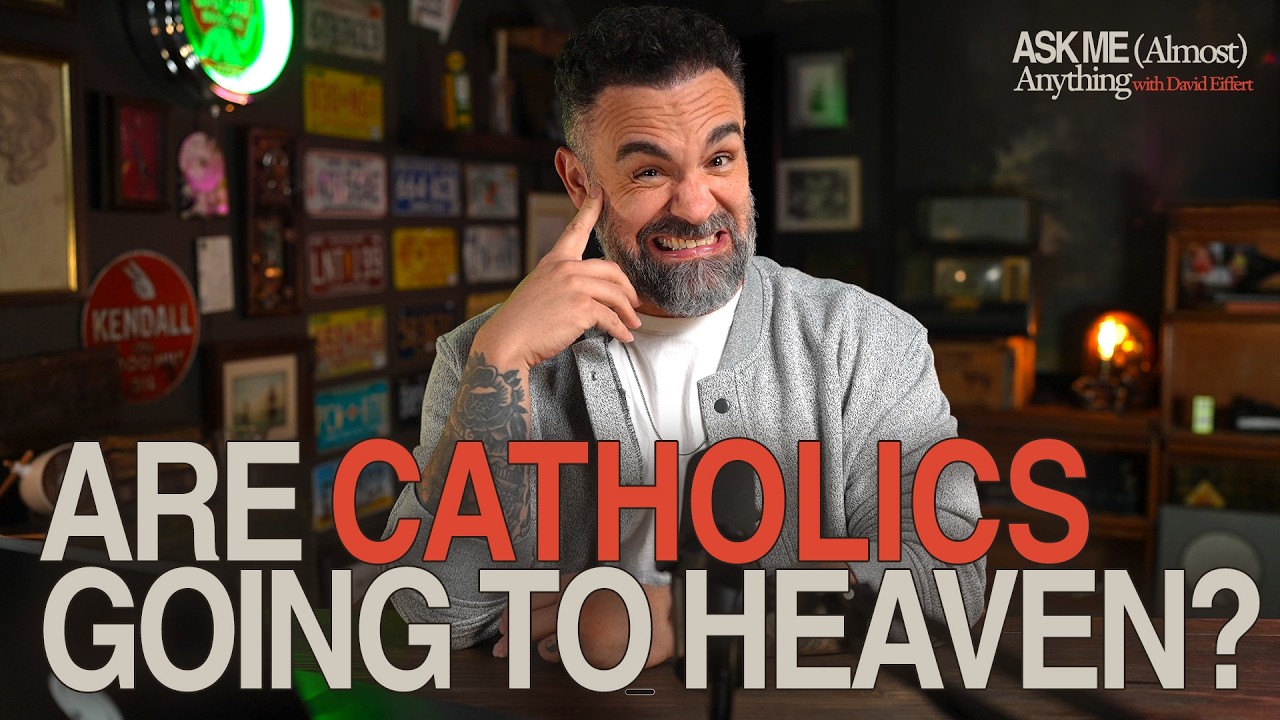
Salvation is not determined by Catholic or Protestant identity but by personally knowing Jesus through grace and faith. It argues that religious systems and sacraments cannot save, while still making room for Catholics and Protestants with genuine faith to disagree on doctrine and remain family in Christ.
Transcript
A few years ago, I made a promo video for a sermon series I was going to do. In the promo video, I used a clip of Brennan Manning. He was talking about the love of God. If you don’t know who Brennan Manning is, he’s this Catholic writer and speaker.
I played the video at church on a Sunday morning, and the next week, this older man who comes to the church came up to me super mad. He said, “My wife and I are very offended at you that you would play that video of a Catholic priest.”
I told him, “Well, first off, that’s Brennan Manning. He’s not a priest. He used to be a priest, but he became an alcoholic and he lost his family. Later on, he discovered the grace of God, and he speaks to both Catholic and Protestant churches.”
Then I realized, “But that’s probably not your point.” So I asked, “Why did it bother you that I played that?”
And this guy told me, “I have family members burning in hell right now because of that cult,” talking about the Catholic Church.
And I said, “Wow, well, that’s horrible. How do you know?”
If it sounds like I was challenging him, it’s because I was, because the truth is he can’t know that. No one can know that. He just looked at me and said, “I’m done with this church,” and he left. I haven’t seen him since. Truth be told, I don’t even know if he’s still alive, because he was very old.
But for a lot of Protestants, and if you don’t know what that is, it just means basically Christians who aren’t Catholic, there is a real theological tension with Catholicism. We’ve got things like purgatory, praying to the saints, the authority of the pope, grace coming through the sacraments, so that’s baptism, confession, the Eucharist. These are not small differences. This is a significant departure from what most Protestants believe about how salvation works.
Some people, when they hear the phrase Catholic, think works-based salvation, tradition over Scripture, layers of religion stacked between the person and God. And so they would often say, “Well, no, Catholics aren’t saved because it’s a totally different gospel.”
Then on the other side of the conversation, you have people who are totally different, and they say, “Of course Catholics go to heaven. They love Jesus. They read the same Bible. They take communion. They’ve been the church for 2,000 years. What’s the problem?”
Here’s what I think both of those answers get wrong: they’re both focused on the institution. One side is condemning the institution, and the other side is defending the institution. But I think the real question is maybe not about the institution at all.
I’ve got three quick thoughts for you about this.
The Real Question Is: Do You Know Jesus?
Number one is this: the question isn’t Catholic or Protestant. It’s do you know Jesus? That’s the question.
Think about it like this. Being a part of the Catholic Church doesn’t get you into heaven. But being a part of any church doesn’t get you into heaven. The question is not, do you belong to the right church? The question is, do you have a relationship with Jesus?
This is exactly what Jesus teaches. John 17:3. Let me read it to you. He’s praying to the Father, and Jesus says this:
“Now this is eternal life: that they know you, the only true God, and Jesus Christ, whom you have sent.”
That’s it. He says eternal life is knowing God and knowing Jesus.
Later, there’s this time where a Philippian jailer comes and grabs Paul and Silas, and he says, “What do I have to do to be saved?” Just notice what they say in that moment. They don’t hand him a membership packet for a church. They say this in Acts chapter 16:
“Believe in the Lord Jesus, and you will be saved.”
So the question, “Are Catholics going to heaven?” Here’s the answer: yes, if they know Jesus. No, if they don’t. But that’s the same answer for Protestants. That’s the same answer for you. That’s the same answer for anybody.
Let me say it like this: I think many Catholics are genuine, Jesus-loving Christians because they have an intimacy with Jesus. They are Christians. But, and I hope I’m not being rude here, I think they’re Christians in spite of, not because of, the official teachings of the Roman Catholic Church.
I think that’s honest. I think that’s fair. And I think it works in both directions, because there’s also plenty of Protestants who are Christians in spite of their church’s bad theology too.
So the question isn’t Catholic or Protestant. The question is, do you know Jesus?
Religion Can’t Save You
Number two is this: religion can’t save you. Only Jesus can.
This is a real difference that’s worth talking about. The Catholic system, and I mean on the official level, teaches that God’s grace is given through the sacraments. So that’s baptism, penance, the Eucharist. What happens, though, is that the church becomes the vehicle through which God’s grace is delivered to you.
And what that does, even if it’s unintentional, is institutionalize salvation. It puts an institution between the person and Jesus, and that’s a mistake.
Paul is actually clear about this. Romans 4:5 says this:
“To the one who does not work but trusts God who justifies the ungodly, their faith is credited as righteousness.”
Look at this, Romans 6:23:
“The wages of sin is death, but the gift of God is eternal life in Christ Jesus our Lord.”
There’s a distinction here. You work at your job, you work for wages, but you just receive a gift. See the difference? Salvation is a gift, not a paycheck.
If I was to be honest, though, I think it’s not really just a Catholic problem. I think there are moments for any of us that we start treating church attendance, rituals, or religious activity as the thing that makes us right with God. When we do that, we’ve drifted into that same territory.
So religion can’t save you. Only Jesus can. And that’s true if you’re Catholic. That’s true if you’re Protestant. That’s true if you’re anything else.
We Can Disagree and Still Be Family
Lastly, number three is this: we can disagree about a lot and still be family.
I have great Catholic friends, and we disagree on a lot, genuinely. We disagree on Mary. We disagree on the Eucharist. We disagree on purgatory. We disagree on the role of tradition. We disagree on the papacy, so the pope.
But I can tell you this: their faith is real, and so is mine. Their faith is real, and so is mine.
I think of it kind of like a Venn diagram, if you know what that is. Catholics are one circle, and Protestants are another circle, and they overlap here. We’re different in some places, but we overlap a lot. If you look at the center of the diagram, that middle piece, that’s the gospel. That’s the cross.
So we can disagree about all kinds of things, but as long as the gospel is at the center, you’re cool with me. I just think the cross is big enough to cover us even when we disagree on other stuff.
So back to the question: are Catholics going to heaven? I’ll say this: I reject the question as the wrong framing. Heaven is not distributed by a denomination. It’s not. It’s received through faith in Jesus.
And that faith can exist genuinely, beautifully, in the middle of an imperfect theological system, just like it does for all of us, because I’ve got things I’m wrong about. You’ve got things you’re wrong about. But the grace of God is big enough to cover us in our imperfection.
So I think a better question to ask yourself, or anyone else, is not, “What church do you belong to?” It’s, “Do you know Jesus?” And if you have a genuine relationship with Jesus, then I just think the grace of God has a way of getting through all the stuff that we pile on top.
You might be asking, though, “Well, if salvation really is by grace through faith, then why do we need to be a part of a church at all?” Well, that’s another question.