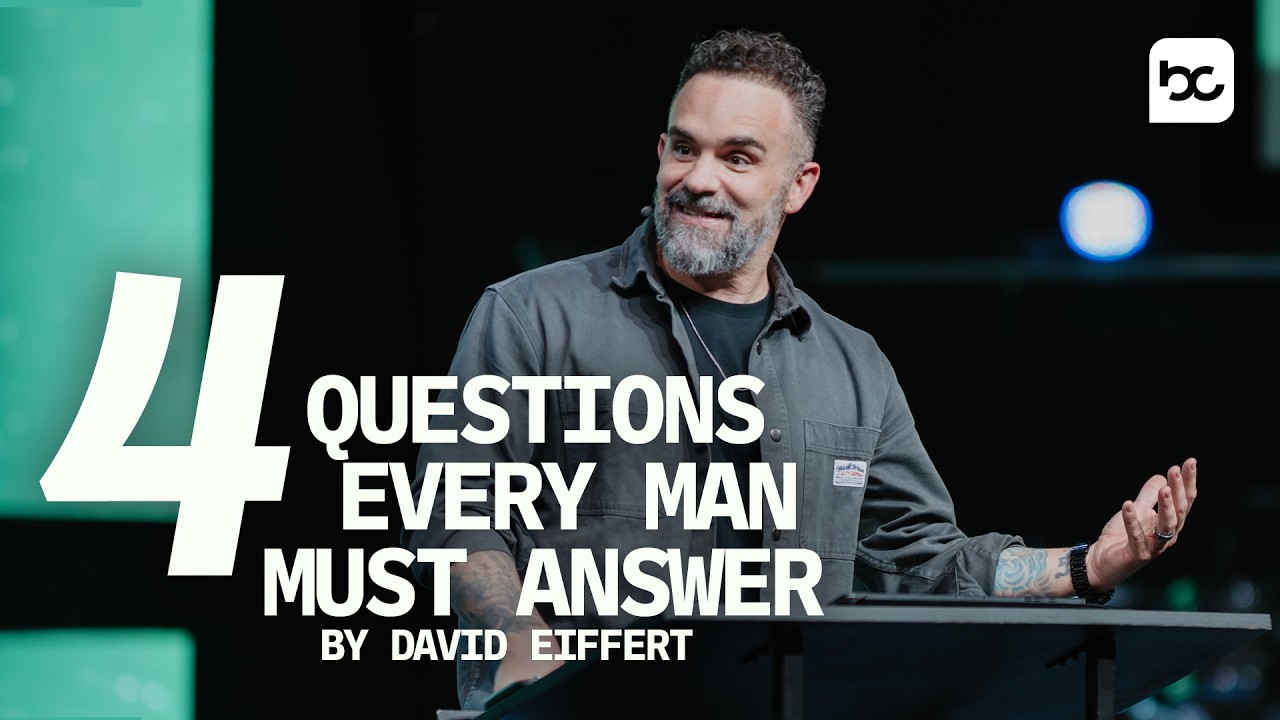
4 Questions Every Man Must Answer
Scripture
Using Jesus's baptism as a model, this Father's Day message challenges men to answer four questions - who am I, where am I, who do I answer to, and what am I passing on - arguing that identity, faithfulness, accountability, and legacy shape the kind of father and man someone becomes.
Transcript
Turn with me to the Gospel of Luke, chapter 3. We are pausing our Hot Potatoes series - we’re two weeks into our Hot Potatoes summer series - because it’s Father’s Day. I’ve got just a one-week message, and the title is this: Four Questions Every Man Must Answer.
Luke chapter 3, beginning in verse 21, says this:
When all the people were being baptized, Jesus was baptized, too.
So this is Jesus’s baptism, right before his ministry. It’s unusual that he gets baptized because he has no new life to be born from, but he’s doing it as an example for all of us and the transformation that we will go through.
Jesus was baptized, too. And as he was praying, heaven was opened, and the Holy Spirit descended on him in bodily form like a dove. And a voice came from heaven saying, “You are my son, whom I love, with whom I am well pleased.”
So I’ve got four questions for you. Every man, whether they’re a father or not, has to answer that, and the answers you provide to these questions shape the kind of man you are and certainly what kind of father you become. So I’m talking to men a little bit today, fathers in particular at some points, but I want you to know that these questions are for everybody. Whether you’re a woman, whether you’re single, whether you’re a teenager, whether you’re 90 years old, you picked a good week to come.
Who Am I?
If you’re taking notes, write this down. One of the fundamental and foundational things that Jesus comes to rewire when we become disciples of him is how we see ourselves - our identity. I’ve told you this a hundred times: you will always live up to the way that you see yourself. If you see yourself as a giant piece of trash who’s incapable of being a good father, a good husband, who can’t hold down a job - if that’s what you think about yourself and that’s what you see when you look in the mirror, you’re always going to live up to that. And it can be a good thing or a bad thing.
If you were to go right now to Coronado Mall and walk around outside, probably what you would find on some of the benches out there is teenage boys - eyeliner on, spiky hair, holding a Hot Topic bag, sucking on their vape, wearing a shirt that says “I don’t like people,” and their face agrees. And you might think, “What is wrong with these men?” And I would say the answer is actually nothing at all. They’re living up to exactly how they see themselves.
You can tell people a million different ways that change all kinds of things about them, but at the end of the day, you are always going to live up to how you see yourself - the kind of father you think you are. So fundamental in what God comes to do is offer you a new way to see yourself and a new identity.
I don’t know if you know this, but years ago I used to play in a band called Old Man Shattered with my buddy Jesse. For a local band, we were really something - we had a tour bus, we played the House of Blues in Downtown Disney World, we opened up for Jessica Simpson. I’m not sure why, but we did it. But boy, we really thought we were something.
After playing in that band for probably twelve years, I felt like God was calling me to enter a new season in my life and leave the band life to pursue ministry. When I left the band, I would see that they still played these cool shows - I’d see it on MySpace at the time - and I remember thinking, “My God, what have I done?”
I remember we were eating at a Mexican restaurant with Marshall and Cindy - I think it was Garduño’s back in the day. I remember we were sitting at the table, and I just cried and cried. I told them, “I just don’t even know who I am.”
It reminds me of what Jesus says about the man who builds his house on the sand versus the house on the rock. The mistake that I made as a young person - that I hopefully don’t make now - is that I built my identity on success rather than on being a son. And every person in here, if you’re not careful, can do the same thing. We answer “who am I” with “what I do.” Who are you? I’m a cop. Who are you? I’m a businessman. It’s not wrong to say that stuff, but there’s a difference between who you are and what you do.
Whatever you build your identity on is the thing you’re going to protect at all costs. If you build your whole identity on career, you will sacrifice your family to protect it, because it’s how you see yourself. But the day it all goes away - you get laid off, you get injured, your kids grow up and leave, or you retire - your sense of self just collapses with it.
So the question is: what does it look like to have an identity that’s not built on the sand, but instead is built on the rock? We see it in the life of Jesus. Luke 3:22 again:
And a voice came from heaven, “You are my son whom I love. With you I am well pleased.”
Did you know this is the first time the Father speaks to Jesus in Scripture? And notice: when the Father talks to Jesus, it’s not about what he wanted him to do, even though he had a calling. It’s not about his purpose, even though he had a great purpose. It was about his identity - who he was. He was about to go into the wilderness and begin his ministry, and the Father knew that for Jesus to succeed in the temptations in the wilderness, he was going to have to know and remember who he is and whose he is.
Some of y’all, like Jordan said, had fathers that said that kind of stuff. I try to be the kind of dad that says that kind of stuff. And some of you have spent your entire life trying to hear a sentence your father never said. Everything you’re doing, whether you realize it or not, is trying to get the approval that was withheld from you and wasn’t withheld from Jesus. Why? Because the words of a father matter.
There will be a time, dads, when you are dead and gone, and your words will still be here at work, still changing hearts, directing lives in ways you don’t realize. It is almost impossible for a small child to separate their view of God the Father and their earthly father. For a lot of young children, you are the first Bible they will ever read. There are people now 50, 60, 70, 80 years old who still struggle to grasp the love of the Father because they don’t know what the love of a father looks like.
I just think it’s such an incredible calling as a father to be someone who, in even a small way, can represent God’s heart to my kid. And if you don’t have kids - you still have power. Your words have power. Sometimes I lose my temper and say things I shouldn’t. Nobody’s perfect. But there is a God-given, spiritual weight to the words of a father, the words of a mother, in ways you don’t realize and don’t intend.
I just want to point out that the Father said this to Jesus before Jesus did anything significant - before his ministry, before his healings, before he preached a single sermon or performed a single miracle. And it’s interesting that in the entire Bible, Jesus hears precisely three things from the Father, and not a single one of them is instruction. The Father didn’t tell Jesus what to do - he told him who he was. That’s the calling for a man - and I understand women are the same way - there’s something spiritual, something significant about a father speaking into a child to communicate who they are. And that has to come from you understanding who you are.
And if you didn’t get those words - “well, my dad never said that to me” - yeah, you’re paying the price for that. Don’t make your kids pay that price. If you want to know how generational curses get broken, it’s by one person saying, “That stops with me.” “I didn’t get that, but my kids will.” “My dad never told me he loved me - cool, break it, stop the cycle.” Because you have godly power, and it comes from you as a man knowing who you are.
Write this down: your worth to God is not based on what you do. Don’t misunderstand me - you might think, “David doesn’t think it matters what I do.” I talk plenty about what you do. But there’s a difference between doing things for God’s approval and from God’s approval. I work really hard to be a good man, a good husband, a good father, a good pastor. But I don’t do any of that to try to get God to love me more or give me approval he hasn’t already given. Before I did anything, before I was a pastor, he said, “You are my son, whom I love, with whom I am well pleased.” Before I can be a good father to my daughter, I need to receive the approval from my heavenly father.
Where Am I?
Number two: Where am I? I’m not talking about “I’m in Albuquerque, I’m in church, I’m on planet Earth.” I’m talking about what season you, as a man or a person, are currently in. Every person here is in a different chapter of their life, and a life is made up of seasons. Seasons stack right next to each other - you’re never not in a season. The moment one season ends, another one starts.
Some of y’all are in the season of married with no kids - that’s a great season. We call them DINKs, dual income no kids. If you’re married but don’t have kids, you’ve just been on a really long date. The season changes with kids, but everybody’s in a season.
I think if you’re careless, you don’t recognize and appreciate the season you’re in until it’s over. But no matter what season you’re in, the question is always the same: what does it look like for me to be faithful in this season? Not the season you wish you were in - the season you’re actually in.
Some people spend their whole life reminiscing about past seasons they liked better. “Man, back in ’82 I could throw a pitch, ski a quarter mile.” Cool, but you’re 60. What is this season? What has God given you to do now?
Other people - young people especially - spend all their time looking to future seasons. “Yeah, I’m just working at Burger King right now, but someday I’ll have a sweet job, and then it’ll really matter what I do.” No - it doesn’t matter what God has for you in the future. The question is: what does it look like for you to be faithful in this season? It’s going to look different at different times, but the question is always the same.
Look at Joshua chapter 1, verse 1:
After the death of Moses, the servant of the Lord, the Lord said to Joshua, son of Nun, Moses’ aide: “Moses my servant is dead. Now then, you and all these people, get ready to cross the Jordan into the land I am about to give them, to the Israelites.”
One man’s season ended and another man’s season began. Some of you are in seasons you didn’t pick - maybe a lot of your season right now is going through chemo. That’s a season you didn’t pick, but you still have the opportunity to be faithful in it. Maybe your husband died - that was a season, but this is a season too. Faithfulness can express itself in any season.
Here’s the devil’s trick: he tells young people “you’re too young” and old people “you’re too old.” It doesn’t matter - the only thing is being faithful in this season. What God is looking for is people to embrace what he wants to do in them right now, not ten years ago and not ten years into the future.
Maybe some of you are retired and think, “I don’t have purpose anymore.” No - you still have a full-time job: to put the love of Christ on display to the world. And when you’re retired, you can do that better, because you don’t have to worry about getting fired for saying “Jesus” at work. You still have the opportunity to make a difference no matter what your assignment is. Whatever your chapter is, be faithful here.
Who Do I Answer To?
Question number three: Who do I answer to? You’re probably thinking, is he talking about God or people? The answer is both. You have vertical accountability to God, but one of the ways that vertical accountability works is horizontally, through people. God doesn’t just talk to you from heaven - I’d say the majority of the time he talks to you through the people he puts into your life.
Look at Proverbs 12:15:
The way of fools seems right to them, but the wise listen to advice.
People will read a verse like this and think, “That’s great for teenagers.” It totally is, but you never graduate from needing good, godly, wise, Christian accountability and care.
My wife and I are the lead pastors of this church. Some of you might think that means we get to do whatever we want - actually the opposite is true. We are still leaders in submission. We have a governing board. We’ve also voluntarily submitted ourselves to mentors and leaders in all sorts of arenas in life. I can be fired. I can’t just decide to take all the church’s money and go buy a boat - I don’t have access to the money. Every godly leader is still a person in submission. That’s just true.
Most of you would say that’s a good thing. Why? Because you know deep down that a man with no accountability, who answers to nobody, is dangerous. That’s true for everybody, but I think especially true for men. Why? Because men and our egos have a hard time admitting when we’re wrong.
Asking for directions - is that a human stereotype or a male stereotype? Male. Why? Because it admits you don’t know something, and men don’t like to do that. It’s crazy how long men will stay wrong rather than ask for directions. That’s true in the car and true in life. How long are you going to be a busted dad because you’re unwilling to ask somebody how you can do it better? Nobody has it all. You have to find a way to humble yourself and graciously receive feedback from godly people.
We live in a society where independence is king, and I love independence - but independence overused can be poison. Independence can turn into isolation, and someone that was safe in the pack becomes lunch in isolation in the wilderness.
Look at Proverbs 18:1:
Whoever isolates himself seeks his own desire; he breaks out against all sound judgment.
It’s amazing how grown men get so defensive when someone suggests they might be wrong. That’s part of why Mother’s Day is packed and Father’s Day is a medium service - men don’t like to be told that something they think or do might be wrong.
If you’re a follower of Christ, you’re accountable - first to God, and you will answer to him. He’s the Mighty Counselor, and the first step in being counseled by the Mighty Counselor is being correctable. And God doesn’t only correct from heaven - most of the time he corrects through the people in your life.
So here’s a question for the men, but really for everybody: Do you have truth tellers in your life? Do you have anybody who will look you in the eyes and say, “No, that’s not right”? Someone who can see your blind spot - because that’s what a blind spot is, you don’t see it, but they can.
Families talk about things. Families have relationships, disagreements, ways of relating to each other. There’s a toxic trait in a man who becomes a non-friendly environment for other people, because they haven’t done the interior work to recognize that maybe they don’t know everything. I don’t want to emotionally punish my wife every time she has something to say to me. I have to learn how to hear other people, even as a man. Doesn’t mean you’re less of a man - it means you’re more of a man, to be able to accept feedback. The enemy wants you isolated.
I think most men don’t have real friends - they have surface friends. I heard a pastor joke once that Jesus’ greatest miracle was that he had twelve close male friends. You need someone who can pull you out when you’re going down a bad path.
I remember years ago I went to Mexico on a mission trip - I think we were in Mexico City. There are dogs everywhere in Mexico, on roofs, roaming the streets. I’m known for being able to make any dog love me - I know how to come slow, do the underhand thing, the whole deal. Well, there was this huge pit bull, and I reached out to do the underhand thing, and the dog lunged at my hand. The instructor with us, named Linus, pulled the back of my shirt and yanked me back. He said, “The dogs in Mexico ain’t like the dogs in the states, little buddy.”
You need someone who can grab the back of your shirt and say, “You’re about to get your hand bit off.” The man who answers to no one is the most dangerous person in the room.
I can’t personally be that for 500 people. I’m learning this as I continue to pastor - there are certain things about this that don’t scale. I can’t be your accountability partner for 800 people. So you have to take the initiative, do the hard work of surrounding yourself with good, godly people worthy of emulation. A good leader is someone you admire and would like to become more like. You’ve got to find people around you who help you become a better person.
The best way to meet people and make friends is to volunteer. Secular organizations admit this too - it’s the best way. If you’re volunteering at a soup kitchen, the people you’re volunteering with are probably good people. Or come to a small group here - that’s the whole point of small groups, to get you connected with people who can push you forward.
What Am I Passing On?
Number four, and I’m done: What am I passing on? I remember when I was in youth ministry, the language was all about “changing your world,” “planet shakers.” We went to a camp called Change Your Planet. “You’re going to be world changers, history makers.” I understand what they’re saying, and it’s super cool. But the reality is, everybody changes the world. Some people change it in big ways, some in small ways, but everybody changes the world - and that can be a good thing or a bad thing.
You might think, “Not that drug addict on Central - he doesn’t change the world.” Sure he does. Go ask his kids. He changed their world. The question is not whether or not you change the world - you certainly do. The question is whether the world will be a better place or a worse place because you’re here.
I understand there’s a spiritual and earthly sense of generational curses passing down generation after generation. But I’m maybe more interested in generational responsibility - a responsibility you have not just over yourself, but over the people who come after you. Scripture says a good man leaves an inheritance for his children’s children.
So the real question is: what are you passing down to the generation after you? Parents get this financially - “I’m trying to set my kids up so they won’t have to hustle the way I did.” You can leave a beautiful inheritance for your kids, or you can leave them nothing, or debt. People understand how that works financially, but it’s also true spiritually - you can lay up a rich spiritual inheritance for your kids, and your kids’ kids. You can set them up to know God.
I have a faith, and I’m determined to pass it on to my daughter. In the same way she gets my bank account, I want her to get my faith - my trust in Jesus. She’ll get my house, but she’ll also get my reliance on Jesus, my devotion to Scripture, my devotion to the house of God.
Here’s some things I wrote down. I want my daughter to know what authentic Christianity looks like because she sees me. I want my daughter to recognize how a real man treats a woman by how she sees me treat her mother. I want my daughter to know what loving parenting looks like because she has two loving parents. I want my daughter to know what a healthy marriage looks like because she sees me and Jordan. And if I fail to set that example, that’s not her fault - it’s mine.
A kid’s first identity isn’t so much formed as it’s inherited. When you’re three, you don’t even know that there’s a “you,” barely - so you’re just whatever your parents tell you that you are. That’s why it’s one of the most tragic and horrific things in the world when I see a parent say, “You’re such a piece of trash.” He’s going to be revisiting that 25 years from now.
I am determined, in everything I can do - doesn’t mean I’m perfect, I lose my temper with my daughter too - but I am determined to instill in her an identity, so that when she grows up, she’ll say, “I understood the love of the Father because I got it from my earthly father.” You have that opportunity too.
A Word to Fathers
I want to talk to the fathers, and then let you know what we’re going to do here at the end - we’re going to have you come up, and Marshall and I are going to pray for you.
As I was working on this sermon, I felt like there was something specific I wanted to communicate: if you want to be a good father, you have got to talk. Being a silent father is not an option. “Well, I told them I loved them when they were 20.” No - they need to hear it again. You cannot be a great dad and a silent dad at the same time.
Notice the example: God the Father at the baptism of Jesus. Jesus didn’t ask, “What do you think about me?” Nobody asked God to say this - he just took the initiative to speak over his son: “This is my son.”
You have the opportunity, father, even if your kids are grown - you’ve got a phone. You still have the opportunity to speak into your kids. Before Jesus did anything noteworthy: “This is my son, I love him, I’m pleased with him.” Every kid is asking their parent, even without words, “Am I worthwhile? Do I have what it takes?” You have the opportunity to speak into that. Maybe your dad never said that, and you paid the price for it - but don’t make your kids pay it. Your children will either be blessed or burdened by who you become. Every decision you make matters, because everything you do and everything you become affects them.
If this feels heavy, I want to remind you it’s never too late to speak into your kids. Maybe you think, “I’ve been telling him he’s a screw-up for 45 years, I can’t just call him and tell him he’s…” Yeah, do it. Change it. Say, “I’m sorry.” “Well, I don’t feel comfortable talking to my kids.” Get over it. Call them. Go through the discomfort to do something that means something to your kids.
Remember, before your kids do anything, before any of that - they’re your son, they’re your daughter. And that’s exactly how God sees you. Before you do good, before you do bad, before any of that - you’re his son, you’re his daughter. And he’s pleased, and he loves you.
Closing
The kind of man and father you become is shaped by how you answer four questions:
- Who am I? You are more than what you do. Your identity is a gift received from the Father.
- Where am I? Be faithful in the season you’re actually in, not the one you wish you were in or the one that hasn’t come yet.
- Who do I answer to? You never graduate from needing wise counsel. Stay correctable before God and the people he uses to speak into your life.
- What am I passing on? Speak identity, confidence, and God’s heart over your children. The words of a father matter.
Prayer for Fathers
We’re going to ask, if you’re a father - and that could be anything, a foster dad, an adoptive dad like me, a stepdad, an uncle who stepped up to raise a kid - these amazing men who have sacrificed to raise children, if you would come down here to the front so we can give you a huge round of applause to celebrate you.
I was thinking this past weekend about you guys, praying for you. I was thinking about Joseph - not Joseph in the Old Testament, Joseph, Jesus’s stepfather. This man is just going along, engaged to a woman, and an angel comes, and the first thing the angel says is, “Don’t be afraid.” I think Joseph is scared of more than just the angel - his life just changed. Now instead of being responsible for just himself, he’s responsible for Mary, for baby Jesus, and it’s an incredibly dangerous time - he couldn’t even call the authorities for help, because the authorities would kill his baby.
I think that’s the fear that comes with leading a family, and that’s something I feel. Women, I want you to know that men are thinking about things they’re not talking to you about. It might just look like a man sitting in a chair doing nothing, but he’s thinking: How am I going to do this? What if I lose my job? How are we going to be okay? And he’s asking himself, and asking God, “How can I not mess everything up?”
Did you know that one of the Hebrew words used to describe men is “weight bearer”? You were designed to carry weight, and God helps you do that. But there’s a difference between carrying the weight you were designed to carry and trying to carry a weight that will crush you. Jesus says:
Take my yoke upon you, for my yoke is easy and my burden is light.
You’re always going to carry weight - I want you to know that. Is there some magical prayer where you don’t feel the weight of caring for your family? No, you’ll always feel that. But God helps us carry that weight, and when we’re tied up with him, it becomes a weight I’m designed to carry, but it never crushes me.
So I want to pray for all of you men with all the different things you carry. I carry something you don’t carry, and you carry something I don’t carry, but we all carry something. There’s something powerful about being next to these men who said, “I don’t want to go fishing on Father’s Day, I’m going to bring my family to church.”
Heavenly Father, today we lift up all these amazing fathers in our life. We’re grateful to be able to live a life where we have a father, where we live in a house with a dad - something a lot of people don’t get. We recognize there is a unique and spiritual weight that comes with providing for a family, protecting a family. For those who feel like they’re encountering a weight too heavy for them, that they’re weighed down, burdened in a way that’s not healthy, we ask that you would come alongside them and help them trust you with the lives of their loved ones, and that as they continue to carry that weight, there would be a lightness to it. For the fathers who feel condemned, who feel like they blew it, who think it’s too late - renew their hearts and help them embrace this season and how they could be a great father in it. We thank you for your supernatural help, for open doors and favor for these men - blessed in their coming, blessed in their going. Breakthrough in their personal lives, their families, their business, all while keeping their eyes on you. Thank you, Lord Jesus.
Just a quick encouraging word for you: because you already have such a unique and powerful place of influence, ask God how you can use that to benefit your children and others. I want to encourage you, as I pray for you, to ask God to help you create a culture where love is easily exchanged between you and your children. Some of you appear estranged right now - you may have little or no contact, or it’s always strained. Ask God to help you be the first to say “I love you” in every situation, including the difficult ones where you’re not feeling it in the moment.
I remember the last week with my father. Mom had called us in - he was close to death. My dad was determined he wasn’t going to burden anyone, so he didn’t even tell my mom he was sick until he collapsed one day in our bathroom. My dad was a big man, 6’4“. He fell, and our mother rushed to his aid. When he came to, she got him to the bedroom. She asked what was going on, and he still wouldn’t tell her - until finally he said he had a visit coming up at the VA hospital. He was a veteran. She said, “I’m going with you.” He said, “No, you’re not.” She said, “I’m going with you” - and that was one argument my mom won.
They examined him, and finally the doctor let her back to see him. She said, “You have to tell me now or I’ll go ask the doctors.” He said, “I have cancer.” He had already made up his mind not to tell her, not to tell the children - just to die, thinking it probably wouldn’t hit us that hard.
The last week of his life, I was beside him on a gurney we’d set up in the den - where his big chair used to be, now he was on a gurney, covered by a sheet, barely conscious, with morphine running through his body to comfort him in his pain. I had the opportunity, and it was a gift, to be with him. Something happened in that moment that had been different throughout our lifetime with Dad - all five of us boys were always the ones who had to initiate love toward him. He didn’t know how. His father didn’t know how. His grandfather didn’t know how. He didn’t know how to look us in the eye and say, “I love you, son.” But in those moments, a week before he passed, he looked at me - barely conscious, barely able to speak - and what he chose to say was, “Son, Marshall, I love you.” He became the initiator in the end.
Why am I telling you that? Because don’t quit, and don’t give up where your own children are concerned. Be the initiator, even if they don’t know how to do it, even if they won’t do it. Make sure you create a culture, because the time will come when they’ll want that meaningful exchange between you.
Father, thank you for grace upon the lives of these men and their situations, whatever they are - whether good or not so good, blessed or not blessed. Help these men - since we can’t control what our children say or do, and we wouldn’t want that anyway, because that wouldn’t be genuine love, it would be something like slavery - help us create a culture where they can willingly and freely approach and say, “Father, I love you,” and be met with “I love you, too.” Whatever it takes, we pray today in these altars for these wonderful fathers, that you would empower them with special grace to build a culture of freedom and liberty where love is easily expressed and exchanged. We thank you for that, as we thank you for all the other things we’ve prayed about. We ask for that and receive it now by faith. You know how to be a father - we don’t always know how to do that, but we know you’re always teaching, and we’re always ready to learn. Thank you, God, for creating the culture where we can come freely and boldly into your presence without hesitation, to receive mercy and grace in our time of need. Help these fathers to do the very same thing in their homes. In the name of Jesus we pray. Amen.