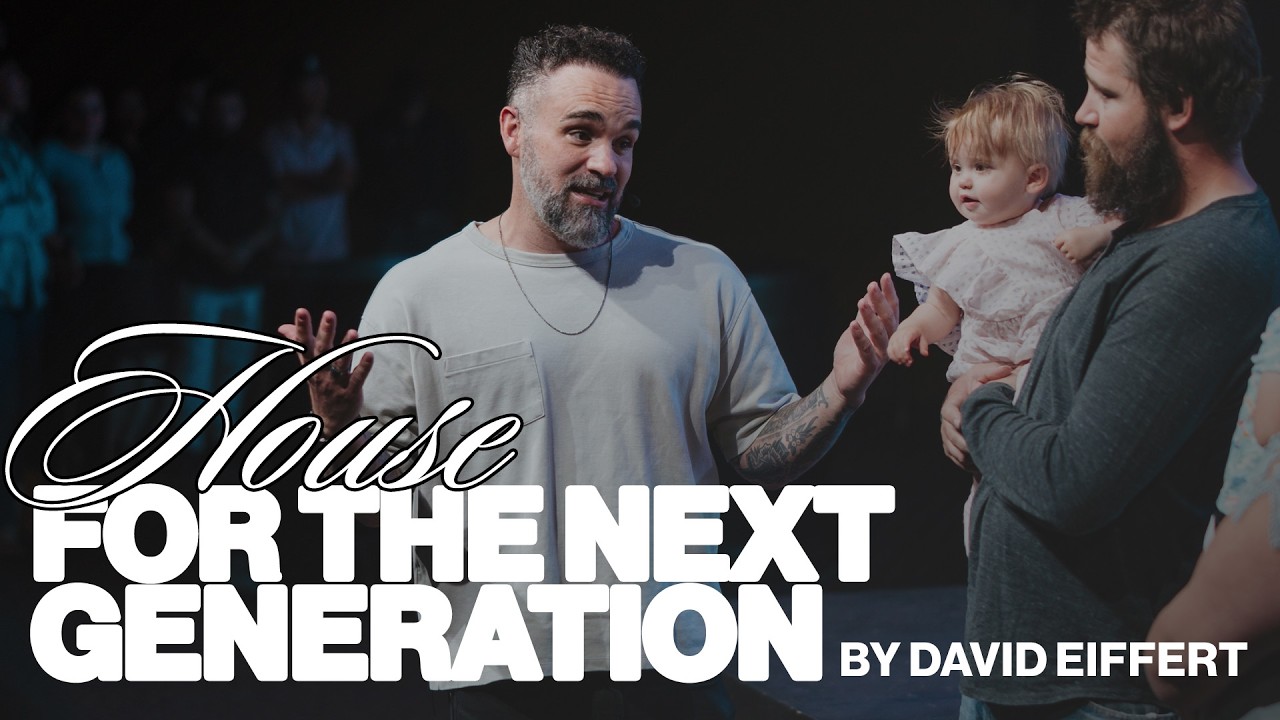
A House For The Next Generation
Scripture
A call to steward the church for the next generation by giving them three things: presence, passion, and sacrifice. Drawing from David's preparations for a temple he would never see built, the message reframes church involvement away from consumer preferences toward generational responsibility - modeling a living faith that transfers to those coming after us.
Transcript
Heart for the House
We are in week three. It’s the final week of a series that I’ve entitled Heart for the House. In fact, why don’t you turn to a neighbor and say that? Heart for the house. And if you’ve been here the last two weeks, we want to say thanks. Thanks for being here. But if this is your first week, we want to say that you came on a great week because today I am landing the plane. In the name of Jesus. And so if you’re taking notes, what I’d like you to write down is this: a house for the next generation. A house for the next generation.
I don’t know if anyone in here is thinking, like, oh, great, you’re gonna be talking about being like some kind of church that’s all about young people. Look, we are not a church that’s all about young people, but we are a church that’s about young people. Young people are 22% of our population and 100% of our future. Right? I’ve gone to so many churches that spend so much effort trying to keep the gray hairs happy. And look, I understand. Right? So, don’t misunderstand me that I am certainly not saying that we in any way are a church that caters only to young people. But I’m really glad that the kids are in there and the midschoolers are in there because I don’t want to talk to them as much this morning. I want to talk to you about what I believe our responsibility is to them. Are you with me? Don’t get quiet on me.
A Generational God
Here we go. Exodus chapter 3 and verse 1.
Now Moses was tending the flock of Jethro, his father-in-law, the priest of Midian, and he led the flock to the far side of the wilderness and came to Herab, the mountain of God. There the angel of the Lord appeared to him in flames of fire from within a bush. Moses saw that though the bush was on fire, it did not burn up. So Moses thought, I will go over there and see this strange sight. Why the bush does not burn up? When the Lord saw that he had gone over to look, God called to him from within the bush. Moses, Moses, and Moses said, Here I am. Do not come any closer. God said, Take off your sandals, for the place you are standing is holy ground. Verse 6. Then he said, I am the God of your father, the God of Abraham, the God of Isaac, and the God of Jacob. At this Moses hid his face because he was afraid to look at God.
So here in the burning bush story, which I’m sure you all probably familiar if you’ve seen the movie, The Prince of Egypt. But the idea is that there’s a bush and it’s on fire, but it’s not burning up. So Moses, he walks over to it and he sees that this is happening. God takes the opportunity to speak to him through the bush, and he identifies himself, which God often does. But I think it’s worth noting how it is that God identifies him. He doesn’t say I’m the God of a person, he says that I’m the God of a family line. Are you with me? He’s he said I’m the God of Abraham, Isaac, and Jacob. What’s God saying? He’s saying, He’s saying, Before you knew me, I was already in relationship with your family. Right? That there’s three generations of your family, and I have been the God through the generations. Do you know this? That we serve a generational God. A generational God.
David’s Legacy
And if you go to First Chronicles, we’ll turn over there in a few minutes. Y’all know David is one of the richest stories in the Old Testament as far as the development of a character. He’s who I was named after, King David, King, and so if you’re wondering, like what David did at the end of his life. So we know that David was a king, we know that he was the warrior, we know that he was the worshiper, we know that he was the poet, right? We know that he was the giant killer. And so if you’re kind of like wondering, like, what did David do at the end of his life? Well, let me tell you that for years, David had in his heart to build a house for God, like a permanent dwelling place for God’s presence.
And so in his later years, he got all the vision, he got all the resources together, he had all the passion to like build this amazing place called the temple for God’s presence to live. He had all the plans in his head, he like planning out. Here’s all the rooms. I know what I’m gonna do. This place is gonna be awesome. And then God comes to David near the end of his life, and he says, Hey, look, David, you know what? I love that you want to do that. But here’s the problem. You’ve got all kinds of blood on your hands from all these wars, and he says, So you’re not gonna build that for me. He says, Your son will, but you won’t.
And I don’t know if you’re like me, like if that was me, you know what I would do at that moment? Tout sulk for six months. Oh, fine, fine. I was trying to do something nice for you, guys. You don’t even want it, you don’t even want a nice gift. Fine, I didn’t really want to do it anyways. It was just an idea. That’s what I would do. If I’m like, God, I’m gonna build you this amazing thing, and God’s like, nah. Fine. Right? But that’s not what David does. You know what David does is he does something amazing, and it’s this. He continues to plan and he continues to build all the way up to the place where he can’t go any further.
The Next Generation Needs Your Presence
And so he gathers, he gathers a hundred and twelve thousand tons. If you can picture that, a hundred and twelve thousand, not pounds, thousand, a hundred and twelve thousand tons of gold and silver. He gets all the plans written, right? He’s he even organizes all the people into shifts, like here’s what the Levites are gonna do, here’s what the priests are gonna do. And he spends the rest of his life planning for a temple that he’ll never see. Are you with me? Right? And I think for a lot of us, this is my thought. This is what I’ve experienced. It’s very hard to get out of the consumer mentality when it comes to church. That’s tough, man.
You know, like because we’ll talk about it, and it’s like, yeah, we’re not consumers, we’re contributors. It’s hard. It’s hard to not come in this room and say, I don’t like these songs. It’s tough. Right? It is like, is, you know, I don’t like, I don’t, I prefer that preacher. I like that preacher. I prefer, I prefer when Pastor Marshall preaches, you know what I mean? I don’t like when it’s so dark. I don’t like blah blah blah. But it’s like there’s all of these preferences, and it’s difficult to exit out of being a consumer. And I want to be careful because it’s not all wrong, because I want you to know this that the church should be a place where you get fed, and you should be expecting and hopeful and believing that you are gonna get fed here.
Side note, that’s not all up to us. It’s also, you know, we cast the seed, it also has to do with the soil, which is the condition of your heart, right? So there’s people in this room that will get nothing, and there’s people in this room that will get everything, and it’s not because the seed is different, not because the word of God is different, it’s about the condition of the heart. But it’s not wrong for you to want to come in here and receive, it’s not wrong for you to want to come in and worship and sing songs, sing words that are meaningful to you. It’s not it’s not wrong, but like what I want to do is this morning is I want to focus not on what the church does for us, but our responsibility for the people who come after us. That’s what I want to do, just for a little bit. Are you okay with that?
Okay, because I need you to know this that somebody’s coming. And it’s just like they’re not in the room yet. There’s people that are coming to this church that haven’t been born yet. Right? And what they walk into has everything to do with how we conduct ourselves right now. Right, that we make a space for them. And so I what I want to do is I’m gonna go briefly three things that I believe the next generation needs from each of us. Are you okay with that? Okay, what do they need? What do they need from me? We love the young people. We love the young people. Okay, cool. Oh, I was I was making fun of that, but it’s great. Oh, we love the young people. It’s so great. Okay. What do they need from me though? What do they actually need me to do here? I’ve got three things. Are you ready?
Number one is this. If you’re taking notes, the next generation needs your presence. That’s what they need. The next generation needs your presence. They need to see you in the church where they experience God. They need you, they need to see you here. Not occasionally, not on special events, right? They need to see you here week after week on purpose. Nobody made you come, right? But you’re just here. They need to see that.
The Next Generation Needs Your Passion
Yesterday my daughter had her first ever gymnastics performance. It was pretty big deal. She’s eight now, and so she’s been practicing, and so it’s been cool. So, like I can’t, you know, me and we were there, and it was really cool, and there’s you know, like I think nine gymnasts, and they were doing a performance. They’ve been spending the last few weeks learning this performance, and so we got to come and we got to go out onto the floor, take our shoes off, and go and see these performance and you know the medal ceremony, they all get the medal and all that, you know.
But it’s it it was really interesting because she had been working on these different so she had like a little floor routine, she had a little bar routine, she had a she had a beam routine, and what was interesting is that when she would do something there at gymnastics, she would do something, and then you know what she would do as soon as she did, she would look to us. Right? She didn’t look to the coach. She didn’t look to her peers. She immediately looked to us. Look to us. I just think she always looks to us. Right. And I was just, I was feeling like in that moment, it’s like I can’t contribute in any way to whether or not she knows her routine. I can’t help if she lands the beam. I can’t control if she hits her head on the bar. I can’t control any of that. All I can control is that when she’s doing what she’s do, what she does, I’m there. That’s what I control. Right?
And so so my contribution in that moment is simply this. When they do what they do, I’m in the room. Right. And you might think, like, okay, yeah, that’s true. No, that’s true in experience experiencing God too. Right? So it’s like, like Seth, phenomenal worship leader growing up. You know what I mean? And as he continues to grow up and grow in his calling and his ability, you know what I think is so beautiful is that he can look up and he can see his dad. He can see his mom. And it’s not like they’re doing anything for him in that moment. It’s just the fact that they’re there when he’s doing what he does. Right?
So young people, they’re out here worshiping and they’re out here praising God, and we have like new speakers, you know, the new, you know, and they’re holding the mic and they’re all nervous and blah, blah, blah. It’s like it’s not about you contributing to what they’re actually doing. It’s about you being in the room when they’re doing what they do. They and they’re learning, by the way. It’s not just that you’re supporting, they’re also learning from you just by where you choose to have your body at any given time. They learn what matters by watching your priorities. You just gotta come. You gotta show up to grow up. You’ve just got to. They just need to see you do it.
And like I’m not just talking about your kids. It’s not just about it’s not just about your kids, and you know, it’s not even only about kids. Right? That your presence in a place can be an encouragement. Look at this. 2 Corinthians chapter 7, verse 6. So this is Paul. He’s currently going through a hard time. And he says this.
But God who comforts the downcast comforted us by the coming of Titus.
Right? I just think that’s the whole verse. That’s like Titus showed up, and Paul felt God’s comfort because one person walked through the door. Like, and so you just you just never know who needs you to be there, Titus on any given Sunday. Right? That it’s like when I when I’m here and I see you, there’s an ability for God to comfort me just with you being here. It just comforts, right? You know what I mean? So, like I look around and I see like every time I see Herb, you know what? It comforts me. He don’t need to do nothing. I just want him here. Right? He encourages me in my faith just by being here. You know what I mean? It’s like every time I see Pastor Shirley, it comforts me. It encourages me in my faith. Every time I see Mitch, my mom sitting in the second row. Is she doing anything to like help me do this in this one? No. But she’s here when I’m doing what I’m doing, and it comforts me. Right? And so you just have to you have to show up consistently. Make this house a non-negotiable. It’s not, you’re not a parent, it’s still for you, right? Like, like you don’t need to be someone’s mom or dad to be their Abraham. You can be their Abraham. You can you can be part of their faith journey, but you can’t be if you don’t show up. So that’s number one. The next generation needs your presence.
The Next Generation Needs Your Sacrifice
Number two, I’ve just got three. It’s quick this morning. Number two is this the next generation needs your passion. The next generation needs your passion. You know, you can be present without being passionate. So you can come and you can sit there and you can slouch in your seat and yawn and not raise your hands, you know what I mean, and like check Facebook. Clearly, I’m talking to older folks here. Facebook. Or Instagram, I don’t know. Fox News, whatever you do when you got 30 seconds. Like you, like you can do that. You can be present without being passionate. And so that so the next generation, I’m just telling you, they need to see you just not in the building. They need to see you alive in the building. Moving your body, moving your face, making your eyebrows go up and down, smile. Like, like they need that. Why? Why? Because faith isn’t just taught, faith is transferred. That faith is some things are taught, some things are caught. It’s a cliche for a reason. Right? That there, that there are things that they’re learning from you, not because you’re teaching them, but because you’re putting it on display. Right?
So, like if you want the next generation to be passionate and on fire for Jesus, you better be modeling that. Right? But don’t just be like, oh, I love these young people, they got so much energy. Right. Look, they’ll have energy in spite of you. But you’re not helping. Right? Like, they need to see you having passion for God. Like one of the that’s one of the greatest things you can give younger people, not just your kids, just all the young people that come to this church now. One of the greatest things you can give them is just them seeing you on fire for God. And you’d be like, they don’t like me. They don’t think I’m cool. It don’t matter. First off, I think they do like you. Um maybe you aren’t cool, but it doesn’t matter. It’s not about that. It’s about it’s about the transmission. Like that the transmission conduit is not you telling them to do it, it’s about you modeling the proximity matters.
And this isn’t just when it comes to faith. Scripture teaches this that this is you just become like the people you’re close to in proximity. It says in scripture that it’s like if you hang around with fools, those who hang around with fools is a fool, right? But a companion to the wise becomes wise. So it’s not even that you’re doing what they’re doing, it’s that you’re around them when they do the thing that they do. Right? And so, like, so like if you want young people to be on fire, well, they need to be sitting next to adults who raise their hands, who sing super loud, you know what I mean? And so it’s like, man, you come and your kids and blah, blah, blah, and it’s like, man, they’re not gonna want to see me do they are. They are, they are. It transfers through proximity.
I was thinking, it was funny that Pastor Cindy said a story about Grace when she was two, not doing anything that we say, and that’s true. But I also noticed I was thinking about maybe around that same time that there was a time when it when it was like Grace started copying the things, not that we told her to do, but just the things that we did, right? So, like if we yawned, she’d yawn. You know what I mean? Like if we stood up, she stood up, you know. Like if we sneezed, she fake sneezed. You know, if I’m there in the kitchen and I’m cooking, like she’s gonna roll up. We bought this whole thing just so that she could stand next to me and like pretend to cook while I’m cooking. And I was just thinking I remember thinking like that is so cute and totally terrifying. You know what I mean? It’s just it’s cute, but it’s heavy. Because nobody nobody’s teaching her how to fake sneeze. She’s just imitating. She’s imitating everywhere she goes. It’s not by instruction, it’s by proximity.
And so, like, if I come into like a I meet a five-year-old and he says naughty words, I know where he got it. You know what I mean? Because you’re always transferring, they’re like little sponges. And so I believe, I’ll tell you, I believe in generational curses. I’m less interested in generational curses, I’m more interested in generational responsibility. Right? Doing the things that we need to do to be responsible for the people who come after us, right? Because a transfer is happening whether you want it to or not.
Exodus chapter 29, which we already discussed, I think, close to. God is instructing Moses. It’s an interesting thing, and it’s around this guy, Aaron. Aaron is the high priest. And he says something really interesting. Look at what he says, a little backstory is that Aaron, as the high priest, he wears these sacred garments. It’s like these sacred special clothes that he wears as a high priest, okay? And then look at this verse 29.
The sacred garments of Aaron shall belong to his descendants after him. They will wear them when they are anointed and ordained.
So it’s interesting that what God’s saying is that the garments that Aaron wore would be handed down. What Aaron wore, his sons wore. Are you with me? What Aaron wore, his son, and in this particular case, is the weight of the priesthood, it was the proximity to God, it was the responsibility. But they would literally wear what their father wore. And that’s a that was a physical reality for Aaron, and it’s a spiritual reality for you.
Let me just talk to parents for a quick second. Your kids will wear what you wear. Right? And that could be something that is it is great. Like your faith and your that your your life of faith gets passed to them. And it might be like, no, they’re not even interested. It’s like there is still a transmission happening. Even if it’s only in seed form, the transmission is happening when you put your faith on display. People are watching you, they might not act interested. They might yawn during the sermon, they might say, like, church ain’t cool, and they’re right, pressure. Like they might they might say that, but there’s still a transfer happening. They will wear what you wear. It’s gonna that’s gonna happen. And so the question is, what are you gonna wear?
And so if you so if you carry, like, you know, God is an obligation, church, I don’t know, man. I got tired, it’s been a long week, blah, blah, blah. If you like, if you wear obligation everywhere you go, they will wear that. Right? But but if you wear passion, it’s like, man, I’m excited about God, it’s a pleasure, you know, and like I now know this. As someone who speaks publicly about God for a living, I know how it feels kind of strange sometimes to talk about those things to your kids. I don’t know why. It just sort of is, you know what I mean? And you just gotta push past that. You know what I mean? Like the men in here is like, blah, blah, blah. Your your kids need to hear you pray, men. I don’t know. It’s it’s awkward. I wouldn’t feel comfortable. Push past it, man. Because if you want them to be people of prayer, you have to put that on because they’re gonna wear what you wear.
Look at what Paul says to Timothy, 2 Timothy chapter 1, verse 5. Timothy is like a young pastor. He says this,
I am reminded of your sincere faith, which first lived in your grandmother, Lois, and in your mother, Eunice, and I am persuaded now lives in you.
I think that’s such a cool verse, right? That he said he says this look, I see your faith. So let’s just go to Seth, because they sit close, right? Like, I see your faith, Seth, and I saw it in your grandma. I see it in your grandpa, and I see it in your mom, and I see it in your dad, and now I see it in you. Right? That’s the way he didn’t say he didn’t say Timothy, boy, you you did it all on your own. And look, if you did it all on your own, praise God for that. But maybe you just decide right now that your kids aren’t gonna have to discover it all on their own. Right? That you’re you’re gonna be the beginning of a lineage of faith. And so it’s all about what you wear. Faith is transferable, faith is generational.
Look at what David says in Psalm chapter 69. He says,
For zeal for your house consumes me.
Zeal, zeal for God, well, yeah, but zeal for your house specifically. Right? That it’s like I would love if each parent in here would have the reputation in their children’s eyes that they’re passionate about church. It’s like my dad, he ain’t perfect, but that guy loves church. Right? That that gets passed down generation after generation, not casual, not lukewarm, not I’ll get there when I get there. Like God’s passion it consumes me. Passion for his house.
And let me just say this like passion for the house isn’t a feeling that you wait for, it’s a decision that you make. Well, I’ll be passionate about it when I feel passionate about it. It’s like, well, keep waiting. Right? Paul says to Timothy, stir up the gift in you. Stir it up. You stir it up. Right? Like, like, don’t wait for it to stir up itself. You stir up yourself. If you’re just like, man, I wish I was passionate about church. Well, decide that you’re passionate about church. Start acting passionate about the church. Like your your emotions follow your your decisions, right? So you can decide that you need to be more passionate about something, and you can talk to yourself and you make decisions about it, you prioritize it, and your emotions will follow. Right? But just decide. I am a person that is passionate about the house of God.
So you worship like it’s real. Because it is. It doesn’t matter. Right? I’ve told you this before. Don’t you dare only raise your hands when you feel it. Don’t you? This isn’t about feeling. It’s not about feeling. It’s about offering something up to God. Right? So just come in here and it’s been like, man, I’m passionate. It’s like, man, I when my son’s here, I raise my hand, that feels awkward as heck. Push past it. He needs to see your faith on display. He needs to see it from you because he’s learning from you. It’s a transfer. Engage with the sermon like it applies to your life. Right? Like, like, like because it does. Serve like it matters because it does. Bring your whole heart when you come to church. Not just for your sake, it is for your sake, but not just for your sake, also for their sake.
So, you know, like how does this play out in a normal Sunday? That you come, you’re excited, you don’t show up late, you’re not dragging. You wake up, you have a coffee, do whatever you gotta do so that you can come up here and you’re awake when service starts. And so and someone says, like, is anyone excited to be in the house of God? You know what you don’t do? Right? Like, it’s it’s because you’re putting something on display that transfers to other people. Right? And so you have to you have to put your faith on display. Like in the car, I say this to parents like if you go in the car with your kids, and even if you hated the sermon, get in the car and say, like, man, don’t you love being at church? I love being a church. Man, it’s such a privilege to be in church. I love church. I wish they had more church. I wish church was longer. Why? Just kidding. Right? But just putting your faith on display because they’re like a sponge. They absorb your passion or your lack of it. The most powerful gift you can give young people is modeling following God with your whole heart.
Number one, the next generation needs your presence. Number two, the next generation needs your passion. Number three, and I’m done, the next generation needs your sacrifice. And you probably think, oh, here’s the money. I’m not just talking about money. Like your sacrifices certainly includes money, but it’s not just money. Every time you put God first, every time that you come and you serve, every time that you take off work so that you can be here at a conference, even every time you raise your hands when you don’t feel like you’re you’re sacrificing for the next generation.
1 Chronicles chapter 29. You can turn there briefly if you want. But this is the time when I told you. So David’s like, I’m gonna build you the sweetest house. It’s gonna be incredible. Everyone’s gonna love it, it’s gonna be awesome. God says, Well, you got blood on your hands, you can’t do it. Too many wars. So your son will do it. And so then he comes and he he gathers all of this money. So he gathers a hundred and twelve, like I told you, tons of gold and silver. What I didn’t tell you is that scholars estimate that in today’s money, that’s right around about probably 200 billion dollars. That’s probably enough to get you a pretty nice place. I don’t know what the ballroom’s gonna cost, but probably not 200 billion. Like that, like wouldn’t you say that like if you’re building a temple, once you have 200 billion dollars, you probably don’t need more money. It’s not it’s not the issue, like they had all the money they needed, all of it. Money, check. We’re totally done.
But look at what David does. 1 Chronicles chapter 29, verse 3. He says,
Besides in my devotion to the temple of my God, I now give my personal treasures of gold and silver for the temple of my God, over and above everything I have provided for this holy temple.
I think that’s amazing. He’s saying, over and above, he said, like we already got 200 billion dollars, right? From like all the wars and stuff. Ironically enough, it’s one of the ways they became very wealthy. It’s the thing that disqualified him, but that was why they got all this money, right? And so there money was not an issue. They had all the money they needed for the project. But David said, you know what? Out of my devotion for God, out of my devotion to this temple, I am giving my own money above and beyond. Right? It’s not the kingdom’s money, nobody asked him to do it. There was no pressure, he just decided. And then what he does is he turns, he’s in a room full of other leaders, and he’s saying this, and then he turns to them and he says, This verse 5. Who then will consecrate himself today to the Lord? He says, and aren’t y’all gonna give too? He says, Who’s with me? We got all the money we need, but I’m gonna give more out of my devotion to God. Who’s with me? And they all do, they give gladly, freely, joyfully, right?
And I just think it’s worth noting and worth paying attention to that they’re giving to a building that most of them won’t live to see finished. Right? So they’re giving, and then they’re gonna die, and then it’s gonna get built. That’s the flow. Isn’t that interesting? So it’s like it’s they’re they’re giving for a generation that hadn’t even been born yet. And I think I just think it’s interesting. So like for me, I I’ve told you this. I have been tithing and giving offerings to this church since I got my first job. I was probably 14 years old, so that’s probably you know, like 30 years. That’s I was trying to I was trying to add up this weekend. I was thinking, I was like, I wonder how much I’ve given to the church total over the last blah blah blah. I stopped doing the math because I didn’t want to even look at it. But it it’s not nothing compared to some of y’all, but it like it’s been significant for me that I’ve I’ve given and I’ve sacrificed for this church decade after decade after decade.
Right that I I have given, I’ve told you I’ve never regretted being a tither, not once. But it but it has been a sacrifice, you know, and I don’t I don’t think I don’t think that’s a wrong thing to say, right? That it sometimes it feels like I’m I’m giving of myself, and one of the reasons that I do that, I do that of course, out of obedience, because God tells you to. But another another reason that I do that, and when we’re doing legacy offering and we’re doing these projects and I’m giving, it’s it’s because I’m giving to a generation that’s after me, that needs the same experiences that I got because of this place. Right that like when I was a kid, before I made a single nickel, I had an incredible children’s pastor who taught me about Jesus, who led me to the Lord in this church. Right? I had I had a youth pastor, I had a youth group that I loved, that I fell in love with worship, I fell in love with Jesus in youth group. I had a youth pastor who who took care of me, mentored me, discipled me. Why? Because other people sacrificed so that he could have a paycheck. So that he could pass through young people.
And so for me, when I’m giving, like I’m I’m like, yeah, I want to give because this ministers to me, but I also understand it’s like, no, this is my time to pass on. That I was the recipient of people’s sacrifices that I I’ll never know. Marshall and Cindy, they’ll know them, but I don’t know, I don’t know them. I don’t know who these people are, but I know that they sacrificed for me. And so that’s kind of like how it is with David. Right? That he’s giving to a temple he’ll never see built. And so for me, when I’m building or like we’re doing something, you know, remember when we did the big old BC kids remodel with all the painting and all that, it was like a really big deal. Really beautiful. It’s not because I was gonna be personally ministered to by having like jungle stuff painted on the walls. No, I was sacrificing for the sake of the people that come after me.
So I’m I hope what the encouragement is is like that this is the posture that we need to have. That I’m coming into this church and I’m being ministered to and it’s great, and I love. But I’m also like, I’m also here, one of the things that I’m doing here is cheering on the next generation. So when they’re singing songs, like me and Jordan laugh that it’s like we’re in our 40s now, and some of these new worship songs, I don’t get them. I’m like, this is cool. I didn’t realize this was cool. We always joke that the people who the people like whenever you were most into music, that’s when you think music was the best. Right? So if you were super into music in the 80s, you’d be like, they don’t do it like the doobie brothers. Just like, yeah you know what I mean like I was into music in the 90s so I’m like they don’t do it how they did it in the 90s but but like I’m here and I’m celebrating God and I’m celebrating what He’s doing and so like I’ll see Maddie I’ll see I’ll see any of these like young people and like and even if their style’s different even if like what they like is different even if that changes how we do a million other things one of the things that I’m here to do is I’m here to cheer them on celebrate them experiencing God you know and that that’s our that’s our kids but it’s all of these young people and so like the the it’s not about the gratification of seeing the fruit it’s it’s the gratification that comes from planting a seed if you have faith that can also feel good right that I’m planting seeds to the future and I want to show you a few pictures of some of these cathedrals in Europe some of y’all have been to some of these but uh this first one I’ve got three pictures of each this is uh Sagrada Familia in Barcelona. So this is um yeah let’s go through them look at these incredible uh they’ve been building uh they’ve been built this one is still under construction they’ve been building this for 140 years and they’re still building it uh this one is the Milan Cathedral in Italy uh if you go through those uh this took 500 years to build. Five hundred years to build. This is the Cologne Cathedral in Germany uh this one took 630 years to build. Six hundred and thirty years to build. I want you to think about this. That wasn’t built by one person. It wasn’t built by one generation. There’s not like one architect’s lifetime. It was generations of builders who spent their lives on something that they would never see finished. But they gave their life to it. Even though they would never see the end result. Sowing seeds came with its own satisfaction.
And what’s amazing is that there’s uh these accounts of some of these builders, the early builders of some of these cathedrals, is that when they were building in the early stages, they were also they were also planting forests around the construction site. These fort because they knew that generations to come were gonna need wood. And some of these trees take like a hundred years to grow before you can even chop them down. But they’re planting seeds now, not for not for their kids, not even for their kids’ kids, but for their kids, kids, kids, kids, kids. That they’re doing things now that will set them up. Planted forests they’d never see for builders they’d never meet, for cathedrals they’d never enter.
And so so what we’re doing now, this is one thing that I think that it’s like I’ve I’ve told you this that this church, you know, has been around for a long time, 47 years, something like that. And and me and Jordan, we have the opportunity to steward this place for a really short little time here, you know, and and everything that’s on the inside of me just wants to be faithful in passing it to the next generation. That’s what I want. That’s what I want for this church, you know? Like, like, I’m so glad that my my generation, I’m so glad that Marshall and say, like, I’m so glad that we all follow God and we can come in here and we can celebrate God’s goodness and faithfulness. And I’m so grateful for that. But like I also want to make this a place that doesn’t die with us. Are you with me? Right? That it’s like, like, I want, I want, um, I want us all to champion the idea of this also being your kids’ church. Right? That like when it comes time for you to move on and go be with him, that it’s like the church is in a good place because we did what we could do to steward these precious young people. And then then one day what they’re gonna do, they’re gonna have to build for the generation after them. That’s the chain. That somebody before you sacrificed for you. You don’t know their name, you’ll never thank them, but you’re the fruit of what they did. And then the next generation gets to be the fruit of what we do.
You know, researchers tell us that listen to this 85% of people that will ever come to Christ come to Christ before the age of 18. 85% come before their 18th birthday. That means that the majority of the people that will find Christ in this church are teenagers. Right? And so I’m not saying, oh, it’s all about teenagers. Here, hear my heart. Like, I’m I’m not I’m not that guy. But I’m just saying we need to do everything that we need to do in here, everything that we need to do out here, so that when they come, we’ll be ready. But they need our presence, they need us to be here, cheering them on. They need our passion and they need our sacrifice.
Last little illustration. If you go to the book of Hebrews, which I’m sure probably most of you are familiar with, the book ends with what’s called the Hall of Fame. It’s like the Hall of Fame, but it’s like for faith. And so it’s all of these people. So they go through Abraham and Moses and Rahab and David and Samuel, like all the heroes of the faith. It lists them all. And then look at what look at what the writer says after talking about all of these people.
These were all commended for their faith. Listen to this, yet none of them received what had been promised, since God had planned something better for us, so that only together with us would they be made perfect.
Leave that up for just a second. There is so much in this verse. The models of faith. But none of them saw what they had been promised. Isn’t that interesting? They did great. We should celebrate them, we should mimic them, we should aspire to be like them, and just know that none of them saw what was promised them. None of them did. And then it’s like, well, it’s why? Why? Listen to this. Because God had planned something better for us, so that only together with us would they be made perfect. Isn’t that a weird verse? Right? So it’s saying this that only through us is Abraham’s promise fulfilled. Only through us is the promises that God made to Moses and Rahab and David and Samuel. Only only through us are their promises. It’s just like it’s interesting to think that it’s like so you’re saying, God, that Abraham is up there right now waiting on us. David is waiting on us. Moses is waiting on us. It’s amazing that we get to partner. And so we get to follow in these great footsteps of we’re sowing seeds, setting things up for the next generation. Not so that we’ll benefit from it, even though we will, but not so that we benefit from it, so that the next generation will be able to receive. Somebody sacrificed for you to be here. Their time, their money, their faithfulness. And that that created this moment. This is what I think. It’s amazing that you’re the fruit of someone else’s sacrifice. You probably won’t know their name. You’ll never talk to them, but you’re sitting in something that they paid for. And so it’s like just part of what we want to do here is to be people that are cheering on the next generation.
I was thinking about like Marshall and Cindy. I’m not saying feel sorry for me. But you can if you want. It was so bad. I look at my notes, I can’t even read them. I just, it’s just so awful. Thank God we all didn’t have iPhones back then, because I would like to make everyone delete the videos. But you know, it’s it’s been amazing how like for them, I’m sure, like if they if they could have along this whole journey, maybe even this morning, they could be like, I could preach that sermon better. And they probably could, and they probably still can. But but you know, when I hop off this stage, you know what Marshall and Cindy are gonna say to me? It’s a great word, Pastor David. Oh my god, what a great revelation you had. Thank you for speaking. And it’s like, why be not because not because I’m the best, but because they’re celebrating what God does generation after generation after generation.
And so we’re gonna get like some younger speakers up here just warning you. There’s gonna be like some more young faces up here sometimes, and like when they do it, like they’re gonna stumble over their words and they’re gonna say weird things, but like we just need to be like, this is amazing. God’s God’s transferring generation after generation after generation. And and don’t mistake your presence for being something that is optional, right? Like, like I still need it. I still need y’all. Like Marshall and Cindy, I wanna I wanna say this honestly, like, this place ain’t the same without you. It’s just not. It’s just it’s just not. And so so generational churches celebrating what God’s doing in the next generation.
And like, again, you might you might think like they don’t even care if I’m here, like this is probably over dramatic. That’s the devil. It’s literally the devil to tell you that your contribution doesn’t matter because you’re old. Right? Like you, you are the backbone of this church. You’re the thing that makes us learning and experiencing God, you’re the thing that makes that safe for us. Right? You’re you’re the you’re you’re the foundation that we build on. Right? You’re you’re the you’re the thing that lets us move farther, move move faster. Generational churches being a house for the next generation. It’s not the only thing we’re committed to. But we’re committed to it. We’re committed to it. We we believe in the name of Jesus we are going to see young people coming and experiencing God in this church. And it’s a privilege. They’re gonna be playing music and you’re gonna be totally confused by it. Why are they hitting the drum so hard? Why it’s like there’s a million things. But it’s just joy it’s just celebration to see God moving in younger people.
Here’s my closing statement what the next generation walks into depends on what we do today. One the next generation needs your presence faith is transferred not just taught they can’t follow a faith they never see lived out two the next generation needs your passion they will not inherit obligation they will inherit a faith that’s alive joyful and worth giving their lives to number three the next generation needs your sacrifice King David gave for a temple he would never enter give for a generation that will be the fruit of what you did. Can I get a good amen there? Amen.