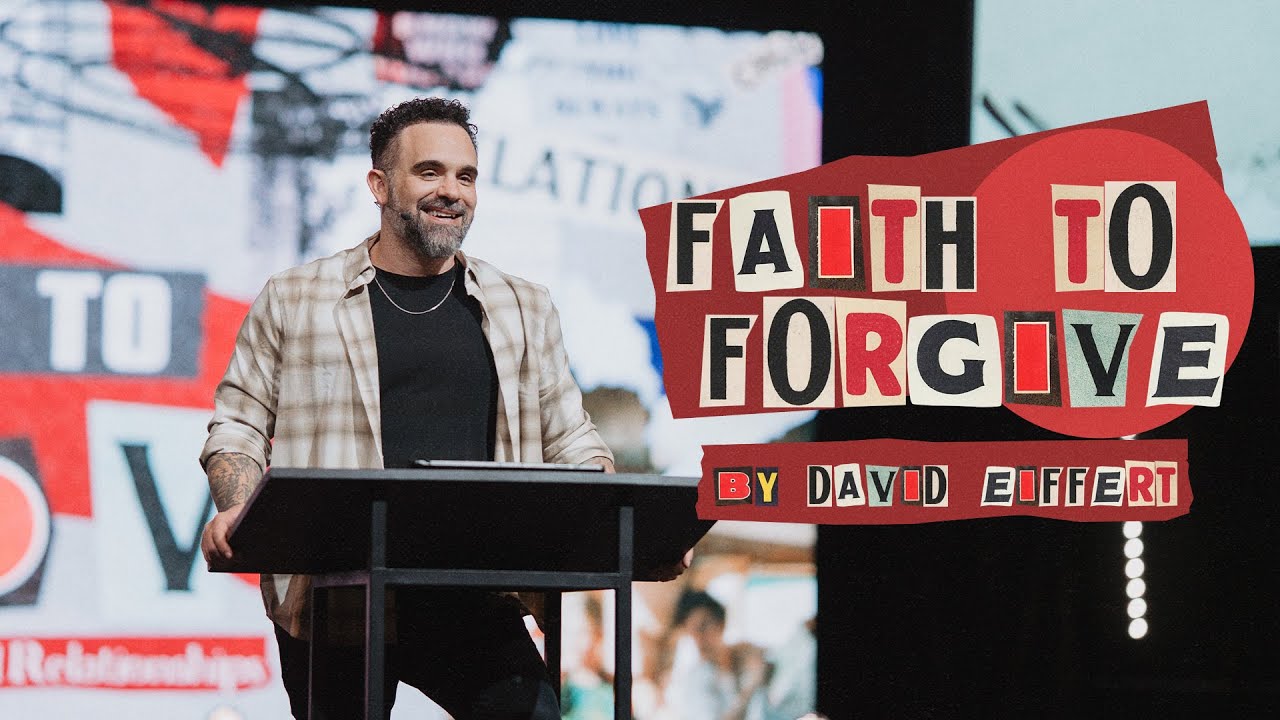
Faith To Forgive
Scripture
The grand finale of the Hard to Love series tackles forgiveness as the hardest part of relationships. Three movements: forgiveness is about your freedom, not the offender's worthiness; it's a choice before it's a feeling, lived out as an ongoing process; and true forgiveness means absorbing the debt yourself, the way Christ did.
Transcript
Celebrating Acts of Service
Hey, if you got your Bibles, invite you to turn with me to Matthew chapter 18. Matthew 18. And I wanted, before we get into it, I wanted to take just a quick minute to celebrate a couple of things that some of our church family did this past week for the city. So this past Sunday, some of the men of the church they took it upon themselves to prepare a big meal for the homeless. And so they prepared it, they bought it, they cooked it, they set up a table, and they went into the international district and fed a little over 100 people. We’ve got some pictures, I think. No? Well. Okay, yeah. Yeah.
Also, we wanted to let you know, you know, this is something that we do every week and every month. But if you don’t know that we’ve partnered with a school through an organization called Feed New Mexico Kids, and so we have a school that has been designated to the Believer Center. And so every month we provide, we pack hundreds of bags, hundreds of bags of food for these kids. There’s, I guess the way that they’ve decided it worked is that throughout the week, you know, of course, childhood hunger is a big issue, and throughout the week, they can mostly get the food that they need from school. And so that they can eat breakfast, they can eat lunch at school, and they’re pretty much okay. But then they found when they learned a little bit more that a lot of these kids would go and they wouldn’t have anything to eat for the weekend. And so they’d be hungry. And so we adopted this school, and so every to next slide, please, we pack hundreds and hundreds of these bags, then we drop them off at the school. And so we just wanted to let you know that that’s something that you do. We know we’re not always the best at reminding you of all the good that we do in the city. But it’s just some amazing things. It’s just a small sampling of what you’re gonna see more of in the coming year, because we believe it’s gonna be a time for us to get back into the city to do more good. So are you grateful to God for opportunities? Amen.
Hard to Love Series
Today we’re wrapping up a series that I have entitled Hard to Love. And for the past few weeks, we’ve been talking, just trying to be really practical about relationships. And in week one, if you were here, we talked about how all relationships produce change. And so if you want to get to the right place in life, it’s important that you surround yourself with the right people. And then week two, we talked about what I called silent killers of relationships. And they were this unmet expectations, negative assumptions, the rumor mill, the resentment cycle, and chronic offense. And then last week, which was week number three, we talked about how our words have the power to heal, and the word our words have the power to kill. And every healthy relationship comes down to one thing, how people talk to each other.
Forgiveness
And so for this morning, this is week four, it’s the grand finale of the series. I decided that we would talk about, thank you. We would talk about what I think is probably the most difficult aspect of any relationship, and that’s forgiveness. Forgiveness. If you’re thinking, how is it that I’m sitting in this seat right now? There’s a lot of ways to answer that. But one of the ways to answer that question correctly would be this. You’re sitting in that seat because of forgiveness, because Christ forgave you. Forgiveness is core, it’s core to who God is and how he expresses himself. And in the same way, forgiveness is core to what we’re called to be as Christians, and core of how we express ourselves to the world.
Matthew chapter 18, verse 21, it says this. Then Peter came to Jesus and asked, Lord, how many times shall I forgive my brother or sister who sins against me? Up to seven times. Jesus answered, I tell you, not seven times, but seventy-seven times. Some of you know probably from the King James, it says this, seventy times seven. And then Jesus tells this parable beginning in verse 23. Therefore, the kingdom of heaven is like a king who wanted to settle accounts with his servants. As he began the settlement, a man who owned him ten thousand bags of gold was brought to him. Since he was not able to pay, the master ordered that he and his wife and his children and all that he had be sold to repay the debt. At this the servant fell on his knees before him. Be patient with me, he begged, and I will pay back everything. The servant’s master took pity on him, cancelled the debt, and let him go. But when the servant went out, he found out that one of his fellow servants who owed him a hundred oh, he found his fellow servant who owed him a hundred silver coins. He grabbed him and began to choke him. Pay back what you owe me, he commanded, demanded. His fellow servant fell on his knees and begged him, Be patient with me, and I will pay it back. But he refused. Instead, he went off and had the man thrown into prison until he could pay the debt. When the other servants saw what had happened, they were outraged and went and told their master everything that had happened. Then the master called the servant in. You wicked servant, he said. I canceled all that debt of yours because you begged me to. Shouldn’t you have had mercy on your fellow servant just as I had on you? In anger, his master handed him over to the jailers to be tortured until he should pay back all that he owed. Verse 35. This is how my heavenly father will treat each of you unless you forgive your brother or sister from your heart.
So if you’re taking notes, I want you to write this down. This is the phrase, faith to forgive. Faith to forgive. So Heavenly Father, today we’re just so grateful. We’re grateful for what you’ve already done, the miracles that have already happened in this service. And in the studying and the reading of your word, we ask that you would speak clearly to us, and that you would help us listen clearly and to receive what you say and to implement what you say. And it’s in your son’s name we pray. Everybody said? Amen.
The Paradox of Forgiveness
Well, this is gonna be one of the longest sermons I’ve ever. I’m just kidding. I know it’s hard. Yeah, right. Here’s what’s interesting about forgiveness. It that forgiveness is simultaneously one of the simplest things, and it’s one of the hardest things that we do as humans. It’s simple because we all get what it is, right? Kids understand forgiveness. My seven-year-old daughter understands forgiveness. I’m sorry, I forgive you. Or if you’re seven, it’s like, I’m sorry, I don’t forgive you. But they understand what forgiveness is it. Toddlers understand what forgiveness is. You think most family movies, what are they about? They’re about ultimately forgiveness. Like, what’s home alone about? It’s about Christmas, but it’s about forgiveness. What’s the grinch about? Forgiveness. What’s Toy Story about? It’s in a lot of things, but ultimately it’s about forgiveness.
So it’s simple. It’s easy to understand what forgiveness is, but it’s also one of the hardest things we ever have to do. Because when somebody really hurts us, when the betrayal is deep and the pain is real, forgiveness can feel like it’s almost unthinkable. And forgiveness can feel, watch this, forgiveness to a lot of us can feel very unjust, especially when we’re the person who’s been wronged. And so that’s the paradox that I want to talk about just for a few minutes this morning is how can something so simple be so difficult.
And here’s what we know is that if you’re alive and breathing, unforgiveness is either something that you’re dealing with right now, or you’re gonna deal with soon. Why? Because it’s like an inevitability in life because people aren’t perfect, and so the way that we figure it is that if you want healthy God-honoring relationships, you are going to have to master the art of forgiveness, master the art of forgiveness. Mark Twain famously said it like this: a good marriage is the union of two good forgivers. A good marriage is the union of two good forgivers. There is no healthy marriage without forgiveness. In the same way, there’s no healthy friendship without forgiveness. There’s no healthy family dynamic without forgiveness. Get this, there’s no healthy pastoral relationship without forgiveness that flows both ways. Every relationship outside of your relationship with God Himself requires that you know how to forgive.
Forgiveness is Not About Their Worthiness
And I think a lot of people, before you’re in a situation where you’re called to forgive, are fine with the idea. The idea of forgiveness is not a big deal. It’s like I don’t know if you’ve ever done this where you’ve ordered something on Amazon, or like for us, we’ve got a kid, and so at Christmas, people buy us things. Pieces of furniture, little things for the kid, and they come in boxes that you have to assemble. So it’s all fun and games when it’s like a cute little vanity. I mean, Pastor Marshall, they and Ciddy, they bought grace a vanity this past Christmas. He was he was so gracious towards me and that he assembled it for me. It was God’s grace to me in that season of life. But man, you know, it’s like you just see the picture and you think, oh, that’s so pretty, that’s so fun. But what you don’t see on the box is the dad who’s like swearing with a hundred and thirty-five pieces all around him, and like the bag when you unroll the bag of hardware, every guy knows how big that bag is determines everything. Right? But you don’t see any of that. You don’t see them up at 3 a.m. trying to figure it out or spending 45 minutes dismantling what they just built because the drawer was on backwards, like calling your friend who knows how to do this stuff. Like you don’t see any of that. They just see the end result. And I think forgiveness for a lot of people is like that. Is because we all know what the finished product is supposed to be. The happy ending, the reconciled marriage, the restored friendship, the healed family. Like we all get that, but what we don’t talk about enough is the stuff that happens between the hurt and the healing. Come on, that’s good. Because the season between the hurt and healing, I say, if you don’t manage correctly, is a season you can live in your entire life.
And so I’ve got three points. If you’re taking notes, I’d like you to write these down when it comes to forgiveness. Number one is this forgiveness is not about their worthiness, it’s about your freedom. Forgiveness is not about their worthiness, it’s about your freedom. Pastor David, they don’t deserve my forgiveness. Well, it’s not about them. It’s about you. It’s not about their past, it’s about your future. And here’s here’s what you’ve got to understand that unforgiveness is like a prison that you build for someone else that you end up living in yourself. Think about it. Like when you have unforgiveness in your heart, think about it. When you have unforgiveness, your chest tightens up when you hear their name. Not theirs, yours. Your mood changes when someone brings them up. Not their mood doesn’t change. Your mood changes. You’re the one that keeps playing conversations over and over in your head, not them, you. So unforgiveness is not something that happens in the offender. Unforgiveness is something that happens in you. And so forgiveness is not something that takes place for them, it’s something that takes place for your freedom.
Look at Hebrews chapter 12, verse 15, it says this. See to it that no one falls short of the grace of God, and that no bitter root grows up to cause trouble and it’s not in them, it’s in you.
And the thing is, the reason it’s important to talk about is you think that you’re doing something by hating them in your heart. You think that you’re doing something that will get back at them. But it’s not hurting them. It’s just it’s hurting you. Most of the time, they’re not affected by it at all. They’re out there living their life. No idea about what’s going on in you while you’re the one sitting in the prison cell. And this is why Jesus, of course, talks about forgiveness so much. Not because the other person deserves it, but because you deserve to be free. And think about it like this. If forgiveness was only about the other person, if the other person died, then forgiveness would be totally irrelevant. But it’s not. There’s still people who are ruining their lives with unforgiveness towards people that are dead. And I can promise you this that like people who are dead don’t care about your forgiveness. On their list of concerns, it’s not there. Because forgiveness is not about them, it’s about you.
Because there are people, what I’m hoping to get here through to you is that there’s people who put their whole life on hold, pull themselves out of their destiny because they think somehow they’re hurting the other person by hating them in their heart. And you’re not. You’re not doing anything, you’re only hurting yourself. You’ve all heard the phrase that unforgiveness is like drinking poison and hoping it’s gonna kill the other person. It’s not about them, it’s about you finding your freedom. But here’s what’s amazing that when you’ve locked yourself in the cage of unforgiveness, you already have the key. The cell’s not locked from the outside, it’s locked from the inside. And you have been, especially us as Christ followers, we have been given the grace and the power to let ourselves free. It’s not about letting them off the hook, it’s about letting yourself out of that cell.
Forgiveness is a Choice Before It’s a Feeling
Okay, number one, forgiveness is not about their worthiness, it’s about your freedom. Number two, if you’re taking notes, forgiveness is a choice before it’s a feeling. Forgiveness is a choice before it’s a feeling. A lot of people never forgive because they’re waiting to feel like forgiving. Right? Like I’ve I’ll forgive them when I’m ready. I’ll forgive them when it doesn’t hurt anymore. But what I’ve learned is this is forgiveness always starts as a choice. Forgiveness never starts as a feeling. It’s like um, it’s like getting in shape. So imagine if you waited to feel in shape before you went to the gym. Right? It’s like, yeah, I’m not feeling in shape right now. You’d be waiting your whole life. Right? Because you don’t feel you don’t feel in shape until you get in shape. Right? Like, like we we talk about unbelievers, in like you don’t have to get in the bath before you get in the bath. Right? That the people are you the point of like getting in shape is going before whether or not you feel like it, because you’re not gonna feel like you’re in good shape. Like the fitness follows the choice. You choose to get fit, and then the fitness falls like the first day, it’s terrible. Everything hurts. You’re gasping for air, you’re like looking around, trying to like learn how to use these machines. You’re like, look at, you know, you’re drinking 47 gallons of water, but like you stick with it, and gradually over time, your body starts to change. And forgiveness works that same way.
You can actually see this. Get this in the life of Jesus. So there’s a time when Jesus in the Garden of Gethsemane, hours before his arrest, the day before days before his execution, he’s there and he’s thinking about what he’s about to have to do. He’s considering the cross, he’s considering the ramifications and the implications of the cross. And he’s thinking and realizing that he’s gonna have to forgive the people that are about to torture and kill him. And look at what he prays.
Luke chapter 22, verse 42. Father, if you’re willing, take this cup from me. Yet not my will, but yours be done.
Not my will, Jesus says this, not my will, but your even Jesus in his humanity wasn’t feeling it. Right? Even his emotions weren’t aligned with what he knew he needed to do. Right? But he made this choice. It’s not my feelings, but your will. Not my feelings, but your will. That’s how forgiveness works. For and the way that I say it is forgiveness comes in two phases. This is my attempt to be as practical as I can when it comes to forgiveness. It comes in two phases. Number one, the choice to forgive. The choice to forgive. I used to say that this was the easy part. Like, I don’t think, I don’t think it’s the easy part, but I do think it’s the simple part. I think it’s simple and not easy. It’s like choosing to lose weight. Right? I’m I’m gonna lose 50 pounds. That’s fantastic. You haven’t lost any weight, and the choice is forget the choice is important, right? Because it without the choice, it’s not gonna probably work. Without the choice, you’re never gonna go. But you haven’t lost, it’s just that it’s just the choice to lose weight. It’s the same way when it comes to forgiveness. It’s that moment where you say, I choose to forgive. I choose to forgive. That your emotions might still be a wreck, you might still feel hurt, you feel like you’re being forced by something on the inside of you to even say that, but you make that decision, I’m gonna forgive. I’m gonna forgive. Not for not for their sake, but for my sake. And without that first step, nothing changes, right? Because if you wait to feel like forgiving, you’re gonna be waiting your whole life. Like if you’re waiting till you don’t feel hurt anymore, you might be waiting your entire life to even choose to forgive. But that’s the first step is choosing to forgive. I’m not talking about your emotions, I’m not talking about you feeling good about the person. It’s just you saying, I’m choosing to forgive. I choose to forgive them.
And then the second phase is this the process of forgiving. The choice and then the process, the process of forgiving. And this is the hard part. This is where you have to wrestle with your anger until it submits to your decision. You have to wrestle with the feelings on the inside of you until those feelings submit to what you’ve decided. Where you’ve decided to forgive. This is how it plays out for me personally. Uh, is that I make the choice to forgive, and then my memories show up and try to make me change my mind. It’s like, oh, I’m gonna forgive. You know, worship music’s playing, it’s beautiful, it’s sweet. It, you know, like I’m I’m here, I’m praying with Pastor Marsh. It’s so incredible. I don’t feel any anger, and then I go in my car and then I remember what they did. Right? And then all of a sudden, my memories try to change my mind. I’m at the grocery store. I see something that reminds them, that’s their favorite cereal. I always hated them. Whatever. Right. That’s not to be much. I’m lying in bed, and that conversation plays in my head over and over and over. Here’s what I want you to know. Your memories aren’t trying to tell you that your choice to forgive was wrong. They’re giving you an opportunity to strengthen that choice. When that feeling starts to come back, that doesn’t mean that you’re doing it wrong. It’s an opportunity for you to get stronger. It’s like building a muscle.
So did you know that this is a lot of gym metaphors this morning? I like this. It’s like, did you know that when you’re working out a muscle, that what’s happening is you’re just you’re damaging the muscles. You’re you’re putting tension on them, and you’re getting like tiny little tears in your muscles. And when the muscles grow back, they grow back stronger. That’s what’s happening when the memories of unforgiveness like come flooding back. The pain you feel when you’re thinking about the person, the tension in your heart, that’s not a sign that forgiveness isn’t working. That’s the forgiveness muscle being strengthened. It doesn’t mean that you’re doing something wrong, that you somehow forgave wrong. Um, it’s not that. It’s an opportunity for you to continue the process of forgiving. I’ve decided to forgive, and now I’m gonna work in the process of forgiving. And each time those memories come back and you choose forgiveness, you’re doing another rep. You’re building that spiritual strength. And I’ve seen this firsthand. People who could like barely lift the weight of forgiveness at first, they practice and they practice and they practice, and now they can carry the weight that would have crushed them before. And that’s why when people come to me and say, like, Pastor David, I thought I forgave them, but I still feel, I still feel angry when I think about them. I say, that’s not a sign that you didn’t forgive. That’s just that’s that’s just a sign that you’re in the process of forgiving. Because it’s something that you have to do over and over and over because forgiveness is not about forgetting, it’s about choosing. It’s about choosing over and over and over to not let that memory control your future. To not let that pain define your relationship. To not let that wound determine your destiny.
True Forgiveness Means Absorbing the Debt
So number one, forgiveness is not about their worthiness, it’s about your freedom. Number two, forgiveness is a choice before it’s a feeling. And number three is this true forgiveness means absorbing the debt. True forgiveness means absorbing the debt. Here’s what I mean by that. When I was in Bible college, I was in Colorado Springs, had a little apartment with my buddy, and one day I had a friend come over, and um, you know, boys. And he thought it was funny for some reason. He had there was this ball, and he thought it would be funny to like try to throw the ball and run to the other side of the room and catch the ball. Boys. Boys are weird. They thought, and I he’s doing it over and over. He thought it was so funny, and I was just like, please just don’t break anything. And he’s like, Oh, it’s fine. Okay. Well, so he’s doing it. So one time he throws the ball, he runs to the other side of the room, and his big butt hits the lamp and knocks the lamp off the table and breaks it. And I’m like, I told you. Uh I t and I don’t know what the lamp costs, let’s say like $30. Let’s imagine. Okay, so here’s the scenario. He broke my lamp. Uh, and here’s what’s interesting about debt. Debt doesn’t just disappear into thin air. Right? It has to go somewhere. Someone has to pay for it. And so if I let him replace the lamp, then I get my lamp back, but he’s out $30. Are you with me? But if I forgive his debt, he’s not out $30. I am. And so when I forgive a debt, what’s happening is this I absorb the cost of that lamp. And this is something I just feel like I need to tell people sometimes when I’m talking to them because they feel like there’s something, there’s something that’s like not making sense in their own heart. But I just need you to know forgiveness always costs. I think I think I think even when the father forgives us, I think it’s a cost to his own heart. And so forgiving is not free. Forgiveness costs.
And it’s the same thing with like relational debt. When you’re in relationship with somebody, when someone wrongs us, they create that debt. Maybe they broke our trust. Maybe they broke our heart, maybe they broke a promise. And that debt is real. And the way that I figure it is you can deal with that debt one of three ways. So one is you can try to collect. You try to make them pay for it. Right? Through your anger, through your words, through making sure they know just how bad you hurt us and how bad you mistreated us. Right. We just keep sending them the bill over and over and over. We keep reminding them the cost and expecting them to pay it. Another way that we deal with a deal with it is that we try to pretend like the debt doesn’t exist. Oh, it’s fine. Oh, it’s totally fine. I thought it was funny, and you didn’t think it was funny. Oh, I I don’t even remember that. It didn’t even bother me. And it did bother you. Right. But you just you pretend like the debt doesn’t exist, but the debt is still there, growing underneath the surface. It’s the second way. Or the third way of dealing with that debt, which is the Jesus way, which is the way of forgiveness, is to absorb the debt ourselves. Instead of making them front the bill, we front the bill. We say, we say, That hurt, that cost me, but I’m paying that debt instead of making you pay.
And some of you might be thinking, that doesn’t sound fair. Like, why should I have to pay when they’re the one who did what they did? And you’re right, it’s not fair. But forgiveness is never about fairness. Never. Right? Like, if it was all about fairness, Jesus would have never gone to the cross. What’s fair about him going to the cross to bear the sin that you committed? Right, to pay the debt to take your punishment. Like there’s nothing fair about that. But he absorbed our debt. He paid what we owed. He took the cost on himself. And so that’s why Jesus called them, by the way, debts, when he taught us how to pray.
Matthew chapter 6, verse 12. And forgive us, look what this, our debts. Forgive us our debts, as we have also forgiven our debtors.
So he didn’t say, hey, forgive us our mistakes. He didn’t say forgive us our accidents. He said our debts. Because he understood that for that sin always creates a debt. And someone has to pay it.
Look at this, Colossians chapter 2, verse 13. When you were dead in your sins and in the uncircumcision of your flesh, God made you alive in Christ. Legal indebtedness, which stood against us and condemned us.
So when we sin against God, what’s happening is that we’re creating an indebtedness. Now we’re indebted. And the same is true with each other is that if I sin against you, I create an indebtedness also. And the thing that makes it hard is this is that when you choose to forgive, right? You’re saying I’m gonna pay the bill, is that you have to pay it in installments. Right? Like you can’t pay it all at once. That’s my opinion. You can’t forgive all at once. And every time that memory comes back and you choose not to seek vengeance, you’re making a payment. Every time you see that person and you choose not to bring up the past, you’re bringing you’re making a payment. Every time we’re tempted to gossip, but we keep quiet, you’re making a payment. And sometimes it takes years to pay off that debt. Sometimes it takes a lifetime. But here’s what we know is that you either pay it off through forgiveness or you carry it forever through bitterness. Those are your only two choices. You either absorb the debt or the debt absorbs you.
And I think this is a uh, I wanted to share as I close, I came across this letter. It was a number of years ago, but a pastor, a lady sent it to a pastor, and a pastor read it. And it there was something about the letter that really struck me, so much so that I clipped it and I saved it in my notes, and I pull it out every couple years, every chance I get. This is what she said. I’ve got it on the screen. Two slides. Once upon a time, I was engaged to a young lady who changed her mind. I forgave her, but it took me a whole year. And I had to forgive her in small sums over that whole twelve months. I paid these sums whenever I spoke to her and kept myself from rehashing the past. I paid them whenever I saw her with another man and refused self-pity and rehearsal inside for what she had done to me. And I paid them whenever I praised her to others while I really wanted to slice away at her reputation. Those were the payments, but she never knew them. However, I never knew her payments, but I know she made them. I could tell. Listen to this. Forgiveness is not only a refusal to hate someone, it’s choosing to love and will the good of the offender. It’s painful. But wood, nails, and pain are the currency of forgiveness. Just as Christ’s wood and nails were, it leads to healing and more to resurrection.
And so at the end of the day, forgiveness is not about pretending that the debt doesn’t exist. It’s about saying, yes, that hurt me. Yes, that cost me, but I’m gonna front the bill because that’s what Jesus did for me. Here’s my closing statement. If you want to succeed in relationships, you’ve got to learn how to forgive. Forgiveness is not about their worthiness, it’s about your freedom. It’s not about letting them off the hook, it’s about letting yourself out of that cell. Two, forgiveness is a choice before it’s a feeling. Forgiveness comes in two phases the choice to forgive and the process of forgiving. Three, true forgiveness means absorbing the debt. Yes, this cost me, but I’m gonna front the bill because that’s what Jesus did for me.