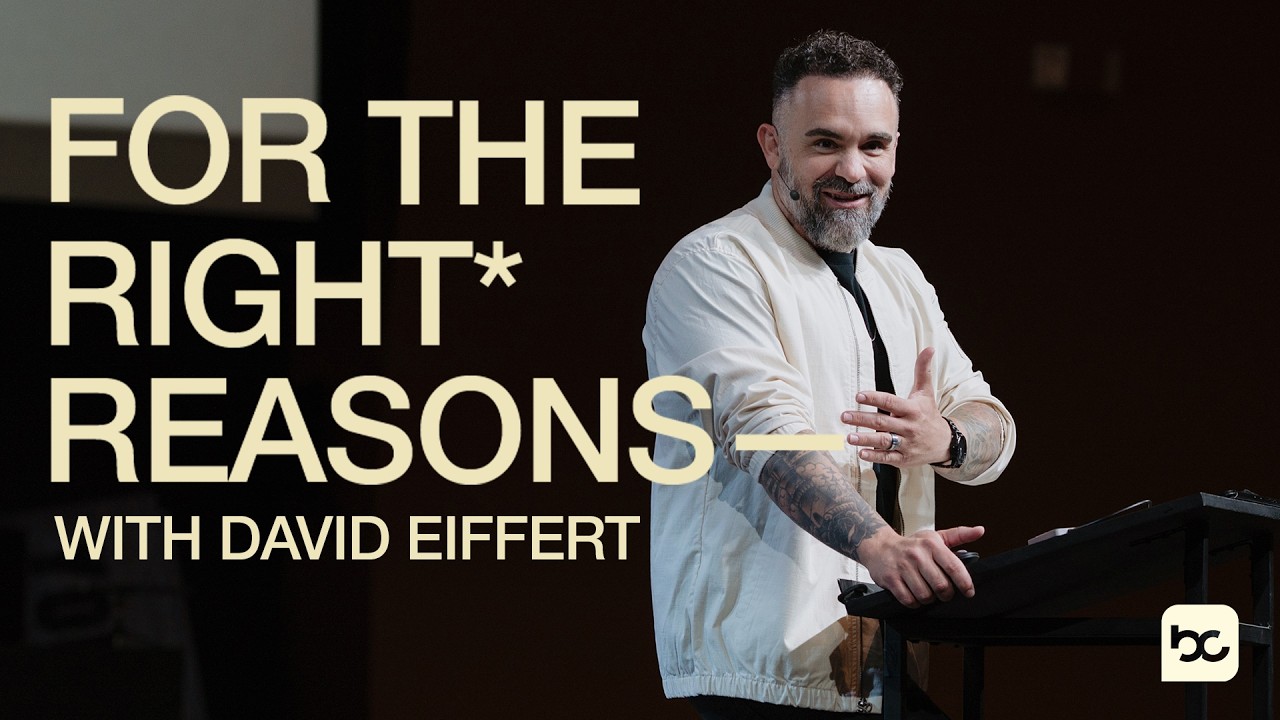
For The Right Reasons
Scripture
An examination of why we do what we do as Christians, using Isaiah 58's rebuke of hollow religious performance and 1 Corinthians 13's love chapter to show that God cares as much about the heart behind our actions as the actions themselves.
Transcript
For the Right Reasons
If you have your Bibles, I’d like to invite you to turn with me to Isaiah chapter 58.
I’m doing a one-week message today called For the Right Reasons. If you’re taking notes, you can write that down.
Let’s pray.
Heavenly Father, we’re so grateful for you. We’re grateful for your word. We’re grateful for your church. We ask that you would help us and be involved in these next 30 minutes, that it wouldn’t just be talking, but it would be you communicating to us and leading us in how we’re supposed to live our lives, how we’re supposed to conduct ourselves, and also the condition of our hearts. We’re so grateful for you. Thank you for being here with us. In Jesus’ name, amen.
How I Decide What to Preach
I want to tell you just real briefly what my process is. Something that people ask me pretty often is how do I decide what I’m going to talk about. People ask me that at the gym - don’t you run out of stuff to say? Here’s my process.
I would say that sermons and sermon series come from basically three different places.
The first one is just God telling me. I just feel like God has told me to preach on something. Some pastors, it’s only this one - they just come down from the mountain, they’ve heard from the Lord, and this is what they’re talking about. And that’s certainly a part of it for me. And all of these points, of course, are all bathed in prayer. But for me, that’s one of the ways that I decide what to talk about - if I just maybe have like a feeling, an unction, Christians would say. An unction - I don’t even know what that means. It’s like an unction on the inside of you where He tells you what to talk about. And so that certainly happens.
The second place I will decide what to talk about is what I’m calling maybe like a felt need. So what that might be is, with my time with us as the people - as Eugene Peterson in his book The Pastor famously says, it’s a pastor’s job to notice what’s happening between God and man. So as I’m spending time with you, as I’m going to people, observing what’s happening in culture, sometimes I’ll just feel like something needs to be said. Something needs to be talked about for your sake and for our sake as we conduct ourselves as Christians.
The third place, and this is the last one, is that I will sometimes preach just from what God is doing on the inside of me. And then what I’m doing is God is doing something on the inside of me, and I’m just inviting you into my heart, into my story, and I’m just believing that God’s going to do the transition work to translate it into your context and in your particular life.
And oftentimes - I bet most pastors would say this - it can be a combination of those three things. And so the reason I’m telling you that is that this message in particular has really come out of God’s work in me as a pastor.
The Weight of Being a Pastor
Let me say this - I wonder if you would agree. I think pastors ought to be very humble people. Not that they are always, but that they should be. And I think the reason, if you would track with me here, should be pretty apparent to you.
A pastor is a person who has been set apart by God to shepherd people and to lead people that he’s been assigned to lead in the ways of God. And so God’s work in me doesn’t just affect me. They talk about the weight of the pastor, and there’s weight in all kinds of different ways. One of the weights of being a pastor is understanding that my relationship with God doesn’t just affect me. My ability to hear from God, and my ability to rightly understand Scripture, and to be led by God and to discern what He’s doing - that doesn’t affect just me, it affects you.
And when you submit to pastors, you’re giving us a certain amount of trust - not that we’re in charge of your relationship with God, we’re not - but that there’s a certain responsibility that we have to stay tender to the Holy Spirit, not just for our sakes, but also for your sakes.
Scripture says:
When you strike the shepherd, the sheep scatter.
And so you see it all the time - when a pastor loses his ability, loses his qualifications, he does things that are unfitting of being a pastor, and he’s removed, rightly so. But you can see one of the things that happens, unfortunately, when the shepherd is struck: the sheep scatter.
And so as a pastor, I just know this - that my life, Jordan’s life, Pastor Marshall’s life, Pastor Cindy’s life, Pastor Shirley’s life - our relationship with God affects more than just us. And so we have to work really hard to stay receptive to God.
And so one thing that God has been working on in me - and I think this is profoundly important to pastors, but I think it’s important for all of us - is He’s been dealing with me not just on what I do, but why I do the things that I do.
The What and the Why
You track with me? You have outward actions, but you also have inward motivations. So like I look at myself as a pastor - here I am, wearing these white shoes, trying to look cool, preaching this sermon at this church - and the question is why. It’s a question I ask myself. Why am I up here? Is it to serve God? Is it to obey God? Maybe is it to help you? Or am I up here because I’m trying to build my ministry, or trying to look successful, or trying to make lots of money?
I don’t know if you know this, but young people do see ministry as a viable path to become famous and rich. I’m neither. But it’s worth examining for a pastor, because we live in an image-driven society. And you would think that church of all places would be a place where that’s not the case - where it’s not all about looking a certain way, where it’s not about Instagram followers and how popular you are and how many people come to your church. But it’s hard, because online has given us this scoreboard. No matter what you do as a pastor, no matter what you do as a church, you can always look online and see someone who’s doing ten times what you’re doing, twenty times what you’re doing. And it bleeds into ministry.
I wonder if you see it in your own life - that there are so many people who are driven by looking a certain way, being perceived a certain way. And even noble-looking actions, underneath, if you examine them, can oftentimes be driven by impure motives. Lots of people care way more about their image than they do their character. You see what I’m saying? I want to look a certain way, and so I’m going to do noble things - not because it’s the right thing to do, not because I’m serving God, not because I’m trying to serve other people, but because I want to be perceived as someone who does that kind of stuff.
You could write this down: God is concerned with the what, but He’s just as concerned with the why.
God cares about what you do with your life. Did you know that? He wants you to do good things and not evil things. You will give a report; you’re going to give an account for all the things that you do and all the things that you say. God cares about the what, but He also cares about the why.
For me, I’ve really learned this in the context of parenting. I’ve become aware of this - having a misbehaving child is really embarrassing. It’s like if you’re at Target and you have a misbehaving child, you can’t win. If you’re all strict and you say, “Get up!” people think, “Oh, nice parenting.” Or if you’re like, “Don’t worry about it,” everyone thinks, “Oh, nice parenting.” There’s no winning. And so parents oftentimes want their kids to behave for the wrong reason - not because they’re that concerned about the kid in that moment, but because they’re concerned about looking like a bad parent.
I remember years ago when Grace was a toddler, we were at Target - I think it was just me and her. I put her in the little seat in the basket, and as we were driving by, we passed a mom who had a kid in her little area, and Grace said, “She’s ugly.” What I wanted to say was, “Now, Grace, those are things we’re supposed to think but not say.” But I just said, “Sorry.”
It’s so hard to not just worry about your kids’ manners, but instead care about your kids’ motivations. But that’s how it is with God - He wants more than our manners, He also wants our motivations. What we try to do imperfectly with someone like Grace is not just, “Don’t say when people are ugly” - yeah, please don’t say that - but also, that she would just be someone who has love in her heart. And if she had love in her heart, maybe she’d be less inclined to say that kind of stuff.
I can come up here and teach you how to treat homeless people - we’ve got a lot of homeless people in the city, you might have noticed - and that’s a good thing. But I think an even more important thing is to check your heart. Because if your heart’s in the right place, maybe your mouth will follow.
It’s easy to just worry about manners. It’s easy to say, “Come to church, pray, read your Bible, give, serve.” But it’s more work to slow down enough - and I’m hoping you’ll be willing to do this briefly - to look at your own heart, and to look not just at what you do, but why you do the things you do.
Why did I say that? Why did I say yes to that party even though I don’t even like those people? What is it on the inside of me that causes me to - and even good things. You raise your hands in praise and worship. I do. Here’s my question: are you ready? Is that why? Or is it, “No, that’s just what cool people do at church”? Maybe you don’t raise your hands in worship. Okay - why? Maybe you come but you don’t give. Why?
It’s more work for a pastor to try to get you to evaluate your own heart than to just convince you to raise your hands in worship. But I want to be one unit - where there’s not an outward me and an inward me, a pastor me and a softball me and a volleyball me. I want to be one person where my actions are not coming out of just manners that I’ve learned, but out of the reality and the truth of who I am.
I’ve been surprised, even in my own life, when I back up and ask, “Why am I doing that?” - how even a good thing can oftentimes be fueled by the wrong motivation. Let’s say you’ve got a cool business. “Man, I’m just so obsessed with building my business.” Great - why? “Well, it’s because I want to look super successful on Instagram.” Okay. At least know that about yourself. “I’ve just been hustling, hustling, hustling, grinding, grinding, grinding.” Cool - why? Maybe it’s because you want the ability someday to really contribute and make the world a better place. “I want to have kids.” Why? “I don’t know, I just feel like they might fill a hole in my empty heart.” That doesn’t happen. Spoiler.
But everything you do - am I making sense? Just thinking about not what you do, but why you do what you do.
Isaiah 58: Fasting for the Right Reasons
We’re beginning in verse one. This is God, and He’s instructing His prophet Isaiah on how to talk to His people. He says:
Shout it aloud, do not hold back. Raise your voice like a trumpet. Declare to my people their rebellion and to the descendants of Jacob their sins.
I think it’s interesting that God is saying this - declare to the people their rebellion and sin. Well, we don’t like that much these days. But did you know that God doesn’t want to just affirm you? He does want to affirm you, for sure. But He also wants to instruct you. He also wants to correct you. Sometimes God will even rebuke you - not because He’s mean, not because He’s angry, not because you personally bother Him as a person. It’s because He loves you and He wants the best for you. And part of that is God telling you when you’re doing something wrong because He wants to help.
It’s important for you to want to get better, right? Highlighting something in your Bible is not the same as doing it. One’s easy - it just requires a highlighter. One’s hard. I’ve turned some of my Bibles into a coloring book. That doesn’t mean I actually do any of it. And so, wanting to get better - look at verse two.
A few words I want to highlight in verse two might seem unimportant, but they’re super important.
For day after day they seek me out; they seem eager to know my ways, as if they were a nation that does what is right and has not forsaken the commands of its God. They ask me for just decisions and seem eager for God to come near them.
It’s interesting that these people - God is saying here you’ve got this group of people doing lots of religious stuff. They’re praying, they’re fasting, which we’ll see in a minute. And from the outside, God is saying they seem hungry for God. Isn’t that interesting? You’re doing all this religious stuff, and God would say you seem to really love God. It seems as if you’re acting as if you really love God.
Why have we fasted, they say, and you have not seen it? Why have we humbled ourselves, and you have not noticed?
People are saying, “God, are you seeing this? Are you seeing how religious I am? Are you seeing how impressive I am, how religiously, piously I’ve served?” They’re thinking, “God, are you even noticing? I’m doing all of these outward things.”
Yet on the day of your fasting, you do as you please and exploit all your workers. Your fasting ends in quarreling and strife and in striking each other with wicked fists. You cannot fast as you do today and expect your voice to be heard on high.
Isn’t that interesting? He’s saying, “Eh, you skipped some meals.” He’s saying you seem to be spiritual, but you’re still fighting, you’re still arguing. And He says, “And you expect me to hear you?”
Is this the kind of fast I have chosen - only a day for people to humble themselves? Is it only for bowing one’s head like a reed and for lying in sackcloth and ashes? Is that what you call a fast, a day acceptable to the Lord?
He’s saying, “You’re fasting just for all this outward appearance stuff? Is that what you call a fast?” God is saying you’re doing the right thing, but with the wrong heart, because you’ve made this day all about you. You’re acting holy, but you’re actually just being selfish.
Is not this the kind of fasting I have chosen: to loose the chains of injustice and untie the cords of the yoke, to set the oppressed free and break every yoke?
God is saying, for such spiritual people, “I sure was expecting you to treat poor people better.” That’s what He’s saying. I’m not even sure you’re treating the poor right, He’s saying - because boy, you can fast, you can wear sackcloth and ashes, you can do the whole thing.
Is it not to share your food with the hungry and to provide the poor wanderer with shelter - when you see the naked, to clothe them, and not to turn away from your own flesh and blood?
Just a quick aside here - I love that God, when He talks about caring for the poor and the sick and the hurting, says, “And don’t forget your own family.” I love that. Because it’s so sad - even in ministry, I see people who are super successful. They get on Instagram - “I’ve got a church of 27,000 people, baptized 4,800 people” - and they’re doing all these great things, but they’re so consumed by the ministry that they lose their own family. And what they don’t realize is that usually if you lose your family, you lose your ministry too.
But what they don’t consider is that it’s not just about looking the part. It’s also about being the person who can carry that responsibility. So the way we talk to our staff, the way we talk to our volunteers, is this: your first ministry is your own family.
I remember my mom years ago - I’m sure many of you remember my granny, who went to be with the Lord a few years back. In the few years leading up to that, my mom was taking care of her; she was in her 90s. And I remember one time my mom asked me, “Is it okay that I’m missing so much church to take care of granny?” And I said, “Mom, it wouldn’t be okay if you didn’t. Because that’s your first ministry.”
Understand - I love that God says, “You’ve got to care for the poor, you’ve got to care for the needy, you’ve got to care for the people who need your help,” but don’t neglect your own family. Someone might need to hear that, because there are people who find themselves in different seasons of life where maybe you’re having to pull away from something so that you can take care of someone who needs your help right now. And I want to say, as one of your pastors, we support you in that. We celebrate you in doing that. Because your first ministry is to your family.
Then your light will break forth like the dawn, and your healing will quickly appear; then your righteousness will go before you, and the glory of the Lord will be your rear guard. Then you will call, and the Lord will answer; you will cry for help, and he will say: Here am I.
It’s a beautiful promise. God wants you to do the right things, but He wants you to do the right things for the right reason.
Four Marks of Right Motivation
So you might be thinking, okay, so what is a right motivation for a Christ follower? You can write this down: our motivation as Christians is to love God, to obey God, and to serve others. That’s the motivation.
And you might be thinking, so what are wrong motivations? I was thinking about this past week, and I found my way to an unusual area - the Seven Deadly Sins. Y’all know those? Some of you are like, “Yeah, I saw the movie with Brad Pitt.” Well, if you’re not familiar, it’s not a Bible list - they come from the Desert Fathers, Christian monks in the third century. Here they are: pride, greed, wrath, envy, lust, gluttony, and sloth.
One thing that’s really interesting about those is that they’re all motivations, not actions. It’s pride, not backstabbing - it’s the inward motivation that results in the wrong action. Greed - more, more, more, more. Wrath - it’s not the violence itself, it’s the deadly sin, the inner motivation that causes the wrong behavior. Envy - wanting what other people have. Lust - I don’t know if you know this, but lust isn’t just about sexual stuff; it’s just an intense desire that’s out of control. You can have lust for sex, lust for money, lust for power. Gluttony - almost every action in here would otherwise be fine; it’s not a sin to eat cake, but it’s talking about the motivation, why you do the things you do. Sloth - not to be confused with the sloth, which is my wife’s spirit animal, we love the sloth - but in old-timey language they were talking about just wanting everything to be easy.
I’ve got four things, super fast, that I’ve learned that I’d love for you to write down.
1. Pure actions will inevitably follow a pure heart
If you let God give you the right heart, then you’ll automatically do the right thing. St. Augustine, who I love, famously said:
Love and do what you will.
What does that mean? He’s saying love, and then do whatever you want. You might think, how could he possibly say that? Well, St. Augustine knows that if you have love in your heart, you’ll want to do the right thing. It doesn’t mean it’s always easy - sometimes it is a struggle - but when you have the right heart, pure action flows out of it.
I’ve never had a particularly good poker face. The idea in poker is you have to act disappointed even when you got something good, and act excited when you have something bad - that’s why the guys wear the mask and goggles and hat, because they don’t want to give anything away on their face. I’ve never been good at that. If I’m happy, I show it. If I’m mad, I have a hard time hiding it.
A poker face might work for you in poker, but I don’t think in life that works for very long. It’s really hard for you to keep what’s on the inside of you from coming out for very long. You might be able to do it for a time, but if you’re bitter on the inside, it leaks out. If you’re angry on the inside, it leaks out. If you’re proud on the inside trying to act humble, we can all see through it. It just has a way of leaking out. And that’s why, for me, I focus not just on what I do, but why I do what I do. Pure actions will inevitably follow a pure heart.
2. Watch out for a shifting heart when success comes
Something we all see happen is that someone starts out with pure motives. They’ve got this God-given ability, so they go build a business, or join a company, or go into ministry. And then success comes, and it goes into their head and changes their heart. At first it was, “I just love this, I do it because I love this, this is my passion.” But then success comes, and another level, a new standard of living comes, and the joy is gone, the humility is gone, the inclination to serve people is gone. Now it’s all just about the bottom line for that person. Everyone sees that when people get super successful, oftentimes the heart of a servant is the first thing to go.
There’s an interesting example - years ago in The Atlantic there was an article called “Seeing Around Corners.” The idea was they did a big study on how violent mobs start. In the last 50 years, they examined how these violent groups of a hundred or a thousand people tend to be comprised of mostly normal, mentally stable, law-abiding people. But then when they’re in the group - y’all know the phrase - mob mentality comes over them. All of a sudden they’re looting, destroying property, assaulting, sometimes even killing. The question is, how do normal, mentally healthy, stable people turn into a violent mob? They don’t just all lose their minds at once.
Here’s an excerpt from the research: when you’ve grown up your whole life thinking that certain things weren’t allowed - robbing, violence, killing - when people suddenly find themselves surrounded by hundreds or thousands of people who are doing the thing you’ve never been able to do, many people find themselves wanting to do it. That’s the idea of mob mentality.
In any mob, there’s about 10% of people who are the “bad eggs” - they’re there to cause trouble. And about 10% on the other side, the “good eggs,” who will not involve themselves in anything illegal or disrespectful, no matter what. But then you’ve got about 80% in the middle who are just regular, normal people. The whole idea behind a mob mentality is that when everyone around you is doing something you’d normally never do on your own, you find yourself wanting to do it too. Everyone’s breaking windows, and all of a sudden people think, “Maybe I could break a window. Might be fun.” And before you know it, they’re breaking a window. It’s a phenomenon that people are smart, but groups are dumb. You’re more liable to do unintelligent things because the consequence feels gone in that moment.
That’s also what the movie The Purge is about - once a year there’s no laws and you can do whatever you want, and people who are law-abiding citizens for 364 days a year suddenly find themselves wanting to do terrible things because there’s no consequence.
That’s also what success can do. Let’s say you invent some brilliant new product and everybody loves it, and now you’re a billionaire because of it. If you’re like most billionaires, the first thing to go is any semblance of humility. At first someone says, “Man, you’re so brilliant,” and you say, “No, no, no” - but really you’re thinking, “Yeah.” And then you hear it enough times, and before you know it, it’s, “Darn right, I’m a genius, I’m brilliant.” And now all of a sudden you know more about therapy than your therapist, more about theology than your pastor - you don’t need help from anybody because you’re so brilliant. And in being so smart in your own eyes, you become dumb. That’s not mean - that’s Scripture.
Do you see a person wise in their own eyes? There is more hope for a fool than for them. (Proverbs 26:12)
So being wise in your own eyes makes you dumb. It’s this gradual descent - you see it with rich people all the time, that they become mean to the waitress, mean to the tech support guy, arrogant, cruel - and it started out with pure motives. Now they’re a poster child for the seven deadly sins: proud, arrogant, envious, angry.
So when success comes, watch yourself. Success is good - I talk about favor all the time, God’s preferential treatment. I believe in favor, I believe in success. But when success comes, you’ve got to watch your own heart, because now you’re allowed to do things you weren’t allowed to do before, and you’re roaming into territory that corrupts a lot of people’s hearts.
3. Impure desires often disguise themselves as excessive self-care
This is when I lose all my millennial friends. There’s a balance, and I hope to strike it, because you need to take care of yourself. Some of y’all need to start taking better care of yourself. You need to love yourself. I did a whole class called Emotionally Healthy Spirituality - I’m not opposed to taking care of yourself.
But did you know Scripture also talks about dying to yourself, denying yourself? So I’m not saying don’t care for yourself, but if self-care takes you out of helping and serving other people, you’ve crossed the line. Jesus says in Matthew chapter 6, if you seek first the kingdom, then what you need will be taken care of as well. That’s not the same as, “I just have to take care of myself for this season.”
If I hear one more person say, “I’m just caring for myself in this season” - people come up and say, “Hey, how’s it going in kids’ church?” “Well, I stepped down. I’m just really caring for myself in this season.” And I think, “Okay, good luck to you” - but really I’m thinking, what kind of half-baked Christianity did you become a part of? Because don’t forget that the invitation from Jesus is come and die.
So you have to care for yourself, but not in exclusion to caring for other people. The biblical way is you find yourself cared for as you care for other people. So if you need to take care of yourself, go do it, but come back happy, healthy, ready to die for yourself some more, because we’re here to serve other people. And the beautiful promise of Jesus is that as we serve, as we love, that’s not something that drains us in a spiritual sense - it’s something that fills us up. The spiritual principle is: as I care for you, God cares for me. As you care for others, God cares for you.
No one on their deathbed says, “I’m just glad I focused on myself.” It’s not admirable. Maybe it’s something you need to do for a season, but you do it so that you can do something with that great and healthy you.
I remember years ago I had a Nissan Pathfinder - my favorite first cool car. I wanted to soup it up so it could be really good at off-roading, got big mud terrain tires, replaced the shocks, got new floodlights so it would light the trail better, got all this different stuff on there. And once I finished, it was so nice that I didn’t want to take it out because I didn’t want to mess it up. I just drove it around town like that.
I think that’s kind of what happens with excessive self-care - you go to therapy and journal and work on your trauma and meditate and on and on and on, and for what - just to sit at home? You never do anything with the new and improved you. So get healthy, be healthy, go to recovery, go to therapy, go to your counselor, do all of that stuff - but do it so that God can use you to pour yourself out into other people.
I just want to warn you, as one of your pastors, that the self-help section in the bookstore is great - I love it, I buy self-help books - but it can be a trap. You can live there your entire life, always going into every room thinking, “Oh, maybe this is triggering something.” And you just become more fragile the more you work on yourself. It shouldn’t be like that. Get healthy so you can soup yourself up - get super healthy, then get out there and do something with it.
4. Without love, even great actions become meaningless
First Corinthians chapter 13 - y’all probably know this Scripture as the love chapter. And it is. But if you read it in the right way, I think it’s also the motivation chapter, because it shows that it’s not just about what you do, it’s the heart behind what you do.
If I speak in the tongues of men and of angels, but do not have love, I am only a resounding gong or a clanging cymbal.
You’re just making a racket.
If I have the gift of prophecy and can fathom all mysteries and all knowledge, and if I have a faith that can move mountains, but do not have love, I am nothing.
Paul is saying: look at all your spiritual gifts, they’re so great, so incredible, so beautiful - you’re the world’s greatest preacher, congratulations, you’re the best worship leader on the planet - but without love, your gift is meaningless. It doesn’t matter. And it’s not always something you can see. You’ve got someone up here playing keys - is she doing that with love or without love? You can’t always tell. Only she can tell. Part of it is inviting God into those sacred spaces to say, “God, am I doing this out of love?”
It’s worth the work to say, am I doing this for the right heart, or have I bought into the lie that bigger and more successful means I get to look a certain way? Because that’s not where real satisfaction comes from. Real satisfaction comes from doing the right things with the right heart.
If I give all I possess to the poor and give over my body to hardship that I may boast, but do not have love, I gain nothing.
You can do incredible acts of benevolence - give away everything to the poor - but if you didn’t do it out of love, it doesn’t matter. Are you doing it so people will clap for you, so people will be like, “Wow, what a guy”? Do the right thing, but do it for the right reasons.
Here’s an honest question I have for you, and I’m done: have you carved out any time in your week to unselfishly serve other people? Not theoretically - literally you. Not to get paid, not to get noticed, but just because you have a thankful heart. If you can’t carve out even a little time to do something unselfish and loving for other people, you have a problem - and your problem is almost certainly ingratitude. It’s a failure of being thankful for what God did for you, and a desire to give that to other people.
So get plugged in. Give a couple hours a week. Doesn’t have to be here, but we’d love to have you - next week, Start Here class, love to have you.
It’s a heart adjuster to have something in your week whose sole motivation is just to unselfishly love other people - going downtown, going to the rescue mission, talking with homeless people, helping a mom, visiting people in the hospital. You don’t get clap offerings or likes on Instagram for that. But there are certain things you can do in the way you organize your week that just keeps your heart calibrated - that everything I do is not about me, I’m also trying to give back to other people.
Closing
God is concerned with the what, but He’s just as concerned with the why.
One: pure actions will inevitably follow a pure heart. When God gives you the right heart, you’ll want to do the right thing.
Two: watch out for a shifting heart when success comes. Praise God, thank God, and stay aware - success is a territory that contaminates lots of hearts.
Three: impure desires often disguise themselves as excessive self-care. Soup yourself up, get healthy, then go out and do something with it.
Four: without love, even great actions become meaningless. Without love behind them, even your greatest gifts and sacrifices come to nothing.