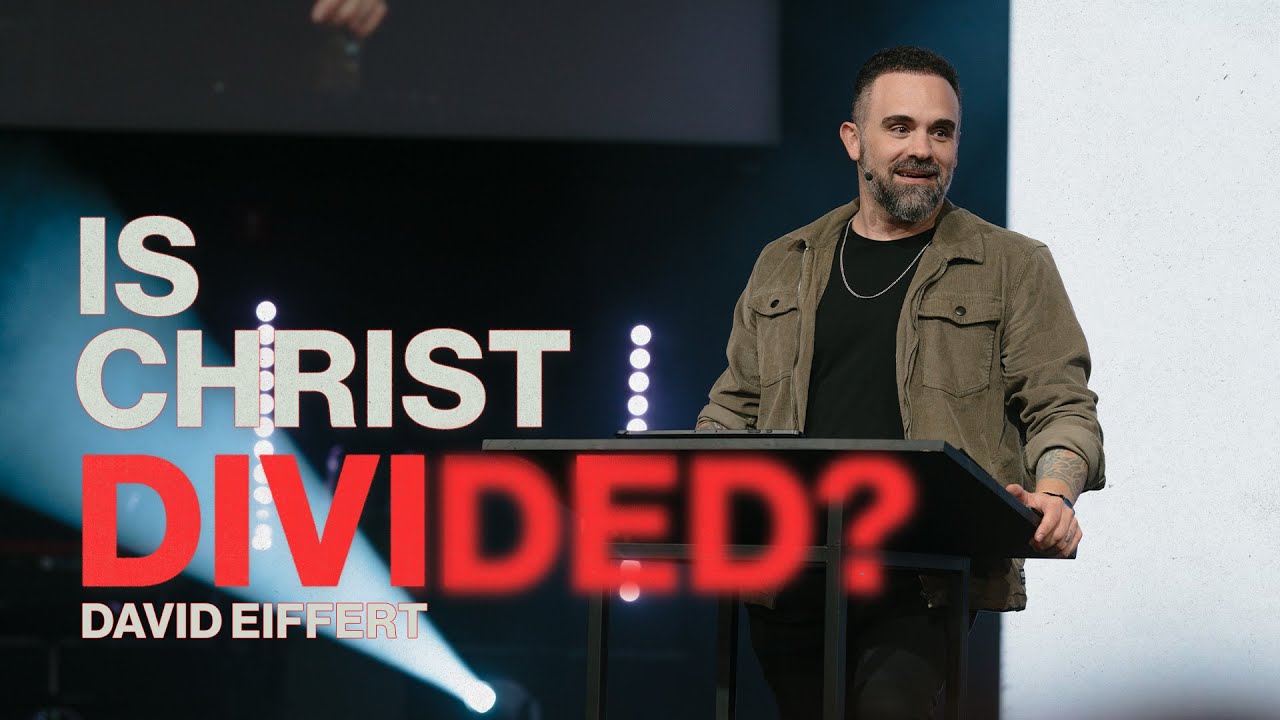
Is Christ Divided?
Watch on YouTube →We would love for you to join us at one of our live in-person services Sundays at 10am and Tuesdays at 7pm for more information visit us at believerscenter.com!
Transcript
This sermon comes from something that God I believe has been doing on the inside of me. You know, I don’t know if you know this, but part of being a pastor is not just seeking God for me, but seeking God for us collectively. And so I spend time thinking about my own personal discipleship to Jesus, but also I spend time seeking God and seeking what he would have to say to us. Eugene Peterson, he’s a pastor that I love, went to be with the Lord years ago, wrote the message Bible paraphrase, which you probably hear familiar with. Amazing pastor, but he wrote a book called The Pastor, and his point was trying to answer the question, what is a pastor? And my paraphrase of what he says is he says that a pastor is someone who lives their life slow enough to see what’s happening between God and man. Someone who lives their life slow enough, hear me, young people, to see what’s happening between God and man. And so I think that this is a timely word. I hope it’s not too much of a tender word, but I think it’s timely, beginning in verse 1 Corinthians chapter 1, verse 10. I’m gonna read again quite a bit of scripture this morning.
Paul would say this:
I appeal to you, brothers and sisters, in the name of our Lord Jesus Christ, that all of you agree with one another in what you say, and that there be no divisions among you, but that you be perfectly united in mind and thought. My brothers and sisters, some from Chloe’s household, he’s talking about a specific household, have informed me that there are quarrels among you. What I mean is this one of you say, I follow Paul. Another say, I follow Apollos, another, I follow Cephas, still another, I follow Christ.
Verse 13. Is Christ divided? And that’s my title for the morning. It’s that Is Christ divided.
So, Heavenly Father, today we as a people turn our hearts and open our hearts to you. And maybe even the parts of our heart that aren’t open to you, we give you permission to bust them open. Because there’s nothing that we are that we don’t want to offer to you and to have you speak into. So we ask that you speak, and we ask that you help us to listen. And it’s in your sons, let me pray. And everybody said Amen. Amen. Love you, Pastor Javi. Thank you so much.
Is Christ divided?
So is Christ divided? Is Christ divided? It’s a question that Paul asks an early church in Corinth. Corinth was a major city in ancient Greece. And it’s a strange question. When you think, is Christ divided? It’s an interesting question because how can Christ be divided? Right? Like Christ is not a concept, Christ isn’t an idea. Christ, they’re specifically talking about Jesus Christ, is a person. So how can Christ be divided?
Well, the question becomes a little bit clearer when we remember that Paul is the one who describes the Christian community, so the collective body of Christ as the body of Christ. That’s what he called. That’s his terminology, that he calls us not just the Christian community or a church or a group of Christians, he would call us the body of Christ. And he goes on, he says that some of us are hands, some of us are feet, some of us are eyes, but collectively, we all come together to form the body of Christ. And when we all take our part as the body of Christ, then the world sees a picture, a complete picture of Christ, not through any one of us alone, but collectively through all of us together. And so Paul is coming and he makes the point that if we’re the hands and feet and eyes and ears of Jesus, how, if we like if we collectively present Christ to the world, how then is it possible that there’s division in within us?
And this is a theme that’s like repeated in Paul’s writings over and over and over and over. In fact, let me give you a few examples. Again, I’ve got quite a bit of scripture.
To the church in Rome, Paul would say this for there is no difference between Jew and Gentile. For everyone who calls on the name of the Lord will be saved.
To the church in Corinth, Paul says this just as a body, though one has many parts, but all its many parts form one body, so it is with Christ.
To the church in Galatia, there is neither Jew nor Gentile, neither slave nor free, nor is there male or female, for you are all one in Christ Jesus.
To the church in Ephesus, make every effort to keep the unity of the Spirit through the bond of peace.
To the Church of Philippi, then make my joy complete by being like minded, having the same love, being one in spirit and of one mind.
To the church in Colossae. Therefore, as God’s chosen people, holy and dearly loved, clothe yourself with compassion, kindness, humility, gentleness, and patience to the church in Thessalonica. Therefore, encourage one another and build each other up, just as in fact you’re doing.
And then to his protege, the young Timothy, he says, This don’t have anything to do with foolish and stupid arguments on the internet. Oh, sorry. Don’t have anything to do with foolish and stupid arguments over text. Why? Because you know they produce quarrels. And then listen to this. And the Lord’s servant must not be quarrelsome, but must be kind to everyone.
So there’s positively no question that one of the primary distinctions of the body of Christ versus the world is that we’re united. And that’s not just an idea that Paul has. Look at the words of Jesus in John chapter 13, verse 34.
A new command I give you. Love one another. As I have loved you, so you must.
Will you say that word with me? Must, so you must love one another. By this, everyone will know that you are my disciples if you love one another. The Apostle John, first John chapter 3, verse 10.
This is how we know who the children of God are and the children of the devil are.
Okay. How do we know who the children of the devil are versus the children of God? He gives two criteria. Anyone who does not do what is right is not God’s child. Nor is anyone who does not love their brother or sister.
Division is one of Satan’s key strategies
And so the question is why do the New Testament writers make such a big deal about being united as opposed to being divided? Well, here’s the reason. You can write it down. I’ve got it on the screen, and it’s this. Division is one of Satan’s key strategies to weaken the church. He knows that a fractured church is never going to effectively represent Christ to the world.
I’ve been in ministry for a long time. I’ve got my friend over there, Pastor Jesse, pastors of great church here. Now, if you were to ask any pastor, hey, what wounds the church? What destroys the church? We all know the answer. It’s division. That’s the thing. What destroys churches? What takes down churches? It’s division. And so the enemy is exceptionally interested in producing division in the church because he knows that when we’re divided, we’re not effective.
So when Paul asks, is Christ divided? What he’s really asking is this is the body of Christ divided? And while Paul is saying we ought not to be, the honest answer, I think a lot of us, if we’re being honest, we would say, yes, in many different ways. And like national politics, man, that’s one way. But that is not the only way. And because it’s being so forced on us right now, the difference is I’m gonna avoid it completely. Y’all know what I think, okay? So we’re not gonna talk about politics at all. We’ve got, and you because you already know it, but I’ve got a few examples for you on things that divide churches, people inside churches and churches between each other.
So here we go. Let’s talk about for a minute about Christian denominations. So, Christian denominations, if you don’t know a denomination, is basically it’s a it’s a governing body that oversees churches. We’re not a part of one. We’re what’s known as a non-denominational church. That’s not like some superiority statement. We’re just like two rock and roll. We’ll do what we want, I guess. We don’t have a denomination, right? There’s good and bad. The good is we do what we want. The bad is nobody saves us. Like there’s no, there’s no there’s no bishop to come and save us because we’re a non-denominational church. But about 88% of churches in America are part of a denomination. 88%. So most. The vast majority of churches, Christian churches in America, are part of a denomination.
And so let’s take one denomination. It’s the church of God. I’ve got a picture. This is the church of God. No, they’re not a cult. You know what that looks like. Does that tell me that does not look like a cult? This is a very poorly done picture at a denominational conference. But the church of God was started in August 1886 in Cleveland, Tennessee. That denomination has over 8.6 million members across 180 countries with over 36,000 churches. It’s huge, huge, huge. So it’s one of the largest Pentecostal denominations worldwide.
But to discuss the church of God, we must acknowledge that there are many churches of God. Right, in fact, I’ve got I’ve got just a few that there’s a denomination, but under the denomination, there’s multi sub denominations. I’ve got a few that I want to list. They’ve got the church of God in Christ. That’s a denomination. The church of God of prophecy, the church of God’s seventh day. These are people who their church day is Saturday, and they feel very strongly about that. The Church of God of the Union Assembly. This is a congregation-led church, so y’all could fire me at any any given day. The Church of God Mountain Assembly. The Church of God of the original Mountain Assembly. The Church of God holiness. So these are folks that teach that they teach entire sanctification, which means that living completely sinless is possible. You wouldn’t be invited. I wouldn’t even matter. It’s a holiness church. They think it’s an additional work of the Spirit to make you perfect. Christian Baptist Church of God. These are snake handlers, y’all. Serious. Fire baptized holiness church of God. Pentecostal Church of God. Church of God all nations. Church of God in divine order. Lastly, the Apostolic Overcoming Holy Church of God, or the A-O-H-C-O-G.
So it’s 16 different denominations. And they all have their own churches. Okay, so that’s 16. How many Christian denominations are there total? Just over 47,000. All have their own churches. To give you context, there’s 41, 41,000 McDonald’s worldwide. So there’s more Christian denominations than there are McDonald’s. And each denomination has its own churches, its own ways of interpreting scripture, its own ways of assembling together to worship.
I wrote a few examples. Some denominations believe that, for example, that the bread and the wine of communion become a transform into Christ’s physical body and physical blood. It’s known as transubstantiation. We do not believe that here. We think the bread stays bread, and I’m fine with that. I don’t need to eat 2,000 year old Jesus skin. I’m fine with bread. Some believe that, some don’t. Some allow instruments in worship, some don’t. Some submit to centralized leadership, so that would be a Pope, a bishop, others don’t. Some would take the entire Bible literally. Some take parts of the Bible artistically. Some churches permit women pastors, others don’t. Some emphasize spiritual gifts, speaking in tongues, healing, prophecy, others don’t. Some believe in the rapture, some don’t. Some celebrate Christmas. Other churches teach you that if you celebrate Christmas, like you go straight to hell. But all kinds of different beliefs and belief structures.
And so the question is like, how do you get to 47,000 governing bodies? How does that happen? Right? The church, there’s there’s one church. Fast forward 2,000 years, there’s 47,000, not churches, governing organization over churches. 47,000. How do you get there? The way that you get there is deciding that it’s easier to split than figuring out how to get along. That choosing that over this issue, it’s easier to split part company than figure out how to be united in spite of our differences.
And so denominations is an example. It’s not the only example, right? There’s also like theological tribes, that’s what I’ll call it. It’s not just denominations, it’s also tribes. So, for example, there is currently a large tribal divide. All the theologians in the room will know this over what’s called Calvinism. Calvinism, it originates around these two Johns. First, the first John is this, John Calvin. John Calvin, he has a tribe. And then there’s also John Wesley, he has a tribe. And people in John Calvin’s tribe, they’re called Calvinists. John Calvin, Calvinists, and there’s this whole resurgence of young people who are becoming Calvinists. We would call them neo-Calvinists. And on the other side, you’ve got John Wesley, and the people who are in John Wesley’s camp are just people who are not Calvinists. That’s the whole idea. Like you could broadly say if you wanted to, you could say Armenians, but that encompasses all kinds of different faith structures Methodists, Wesleyan’s, Pentecostals, charismatics, holiness churches, Anabaptists, right?
And there’s a number of things that these two theological camps divide over, but the most obvious and significant is the interplay between free will and predestination. Is this boring? It’s not just my job to motivate you, you know. I also have to teach you. Okay. So so they fight over the interplay between free will and predestination. So the Calvinist view is this that the only way that a person comes to faith is because God has already chosen them to do so. Okay. So they have a term for this, it’s called the elect. Right? This is the elect. These are the people that God has elected, and the people who are the elect will without fail come to him. Irresistible grace. When God has chosen you to be one of his, and he gives you that grace and he shows himself to you, there’s no way that you, as an imperfect person, could ever come to him. That’s what a Calvinist would believe. And then they also believe this that a non-elect person will never come to him. And so at the end of time, the people that are living eternally with God are the people who have been pre-chosen, pre-selected by God to do so. That’s what Calvinists believe.
Then there’s the other side, and the other side is where we land, even though I know we have both types of people in the room. The other side, which is where officially is the church we are, which is we believe that God wants everyone to come to him, not just the elect. We think he wants everyone to come. Everyone to come. And we all have, right, and listen, and so we all have the free will to do so. We have the free will to choose him. But God takes this great risk. And the risk is this is that he makes creatures with the ability to say no to him. Even though he doesn’t want that. Like that’s the risk that he takes because love requires choice. Right? Can a robot love? I don’t think so. Right? In order for love to be real love, there has to be a possibility that you’ll choose otherwise. That’s what we believe.
Right? And so, and so there’s these two sides, and you might not realize this. If you’ve never even heard that, you might not realize there are churches all throughout the city on both sides of this argument. Huge, massive churches. The biggest churches in town are not in agreement on this issue. It seems like pretty fundamental, right? Lots of churches in town, both sides of this. And they might be friendly at the grocery store, but I’ll tell you, these two camps, they don’t associate with each other in any way. They don’t speak at each other’s conferences. Because for most of most of the Christians, they think that this theological divide in particular is just too great.
And there’s like it’s like a million things to be divided over. Coke versus Pepsi. In fact, why don’t we let’s do this? Why don’t we see see how divided we really are? I want you on the count of three to say either Coke or Pepsi, okay? Are you ready? Whichever one you prefer. One, two, three. Coke. See how see how are we ever gonna get along, y’all? Like, how is this possible? Just might as well split. This is split, it’s just so much easier. Country music versus anything else. On the count of three. One, two, three. Anything else? Anything else? Split again, right? Because we already got four, we already got four denominations. It’s incredible. People who talk in movies versus normal people. People who like pineapple on their pizza versus normal people. It’s good. It’s good. It’s good. Toilet paper, over versus under. You under people need Jesus. Under. It’s all touching on the wall. How big is your role? Big.
Right. And I wonder if you would agree with this. It’s important that we get church right. Like of all the things that we want to mess up, like that would be pretty low. Like I think we’d want to get that one right because the church, because there’s so much hanging on the church. Marshall has said this for 45 years that God that the church is God’s plan A and there is no plan B. God put all of his eggs in the church basket. Right? Conventional wisdom says, don’t put all your eggs in one basket. God says, whoops, too late. You have all my eggs. The church has all my eggs. My mission will be accomplished through you. Not ought to be, not I sure golly goose hope it will, it will be accomplished through the church. But in order to do that, God says we must be united with each other.
And so there’s lots of things to be divided over. Crunchy versus smooth peanut butter. Like it’s a big deal. I get it. Like there’s lots of things, but but I think it’s important for us to never lose the thing that’s most important. Right, which is accomplishing our mission. Because we got to remember that like we’re not about our business. We’re about the father’s business. Right? So it doesn’t matter if you feel super duper doubly dog strong about it, like if it’s he sets his business. Right? And so your priorities reflect his priorities. You care about what he cares about. That’s what you signed up for. I know you might not have realized that’s what you signed up for, but what you signed up for was letting his business be your biggest business.
Right? And so and so, like, and so where does the vision come from? Let’s just move on. Paul tells us this 1 Corinthians chapter 3, verse 3.
You are still worldly. For since there is jealousy and quarreling among you, are you not worldly? Are you not acting like mere humans?
Right. So Paul says the reason that we’re divided and that we fight is that we’re still worldly. There’s still too much world on the inside of us. We’re still living from the unregenerated part in us. And because of that, you gotta understand this that we’ll never get it perfectly right because putting our flesh to death is a lifelong process. Right? Andrew Womak, you always used to say, the problem with a living sacrifice is it’s always crawling off the altar. Like that’s always gonna happen. You’re putting yourself, you’ve got to die daily, right? Die daily. It’s not like woof, put the flesh to death, like you will always be there, and so it’s always a fight.
And so it’s something that we always have to realign ourselves with is to like realize like, I care about this, I care about this, I care about this, but you know what? Unity is important too. Doesn’t mean that what you don’t care about isn’t important, or what you care about is not important. It just means there’s something else important, and that’s unity. Right? Truth is not the only thing that matters. Does it matter? You bet. But unity matters too. Right? And so there’s this tension. So we’re not unified at the cost of truth, but we’re also not truthful at the cost of unity. We prioritize both. Both are important. Because again, it’s not about what you think is important or what you think ought to be important. It’s about what he tells us is important. And he’s clear that the two things are important, both truth and unity.
So I’ve got four fast points this morning that I hope are reminders and encouragements for how to present to present a unified Christ to the world.
Different, not divided
Number one, if you’re taking notes, you can write this down. Different, not divided. Different, not divided. First Corinthians chapter 12, verse 12 says this.
Just as a body, though one has many parts, but all its many parts form one body, so it is with Christ. Now, if the foot should say, because I’m not a hand, I do not belong to the body, it would not for that reason stop being a part of the body. And if the ear should say, because I’m not an eye, I do not belong to the body, I should start my own denomination. I do not belong to the body, it would not for that reason stop being a part of the body. If the whole body were an eye, where would the sense of hearing be? If the whole body were an ear, where would the sense of smell be? But in fact, God has placed the parts in the body, every one of them, just as He wanted them to be. If they were all one part, where would the body be? As it is, there are many parts, but one body.
So one of the reasons that we’re different is because God made us different. Did you know that? Does you know that? Like you, you and me are gonna be similar in a lot of ways, and we’re also gonna be different in a lot of ways. One of the reasons that we might be different is because God has made us different. It’s not the only reason, but it’s certainly one. Right? And that’s something that we don’t just tolerate with each other, it’s something that we appreciate. If you’re a mature Christian, you have the ability and the capability to appreciate Christians who are different than you. It makes the body of Christ stronger, not weaker.
You know, Albuquerque is an incredibly diverse city. We’re diverse racially, socioeconomically, culturally, generationally, linguistically, educationally. So we’ve got like 560,000 people here that look different and dress different and act different and think different. That’s just okay. And so if we’re gonna be people who reach the city, well then we’re gonna have to be comfortable with people who look different, dress different, act different, smell different, talk different. Right? And I’m not talking about sin. I’m not talking about sin, right? Like we do not have a problem calling sin. I’m not talking about that. I’m not talking about calling wrong right.
But I am saying this that a bag full of eyeballs is not a body. You know what I’m saying? Like if we were all eyeballs, where’s the body? Right? Like if if it’s just a bag full of eyeballs, it’s like that’s that’s a horror movie. Like if you if you come across a shoebox of thumbs, right? What you got is a crime scene. That’s not a body. Like a church full of Davids is a nightmare. Church full of ewes, even worse. Right. Our differences don’t make us worse, our differences make us better.
All right. Years ago, me and Jordan and the family, we went to El Paso to celebrate Charles Neiman’s birthday. I don’t remember which one it was. Pastor Charles, he pastors this huge church, he’s Pastor Marshall and Pastor Cindy’s pastor. And so we were there and we were celebrating, and they did an interview with Charles and they were talking with him about church. And the interviewer asked Pastor Charles this question Well, what’s one thing over 45 years of ministry, whatever it was, what’s one thing you wish you would have done differently? And Charles thought about it, and he said, I wish I would have drawn less lines of division and drawn more circles of love. And he’s not a divisive person. Like he’s a great unifier, but I just think after 40 plus years of ministry, looking back and saying, I wish I had done less division and more unity, it’s powerful. Because it’s a powerful asset to the church. It’s not something that doesn’t matter that just feels nice when it works out. It’s something that the church, if we’re to obey Christ, is to be a priority.
Humble, not harsh
Number one, different, not divided. Number two, humble, not harsh. Humble, not harsh. Look at what Solomon says, Proverbs chapter 13, verse 10.
Where there is strife, there is pride.
Oh. Did you catch that? Where there is strife, there is pride. Strife is a Bible word that means conflict. Where there is strife, there is pride. Our culture, by the way, let me just say this, does not believe this. Our culture believes that division is a virtue. Right? That the ability to divide people is something to be celebrated. Like the world does not appreciate humility. Turn on the TV and like, show me the humble people. Dare you? It’s not even the language they speak. Show me the humble people in Hollywood. I’ll wait. Show me the humble people in Washington, DC. It’s like I don’t need a watch. I need a calendar. Show me the humble people in the music industry. You haven’t heard of them. Because according to the world, like if you want to succeed, you have to be constantly promoting your own accomplishments. That’s the world.
Listen to what Solomon says, Proverbs chapter 16 and verse 5.
Everyone who is arrogant in heart is an abomination to the Lord.
Y’all want to sit in that one? I spent the last four weeks just being nothing but nice. It’s time to take some medicine. I’ll read it again. Everyone who is arrogant in heart is an abomination to the Lord. The word abomination is a Hebrew word, toiba, it means repulsive, detestable. The picture is it makes God’s gag reflex go. When people, when people are arrogant in heart, if they’re arrogant in heart, they are an abomination to the Lord. Oh, and it continues. Be assured he will not go unpunished. Everyone who is arrogant in heart is an abomination to the Lord. Be assured he will not go unpunished.
Peter, 1 Peter chapter 5 and verse 5.
Clothe yourselves, all of you, with humility towards one another. For God opposes the proud, but gives grace to the humble.
And so why is it that God hates arrogance and pride so much? Well, for one reason, it’s because it’s idolatry. But also, and you can write this down, I’ve got it on the slide. Pride is the ultimate unity killer. Pride is the ultimate unity killer. This is true in friendships. This is true in marriages. Pastor Shirley could tell you. This is true in marriages. Counsel. This is true in business, and it’s certainly true in church. That pride is the thing that comes and kills unity. You being so convinced that your way of understanding this book is so airtight, that there’s no possible way you might be wrong. Right? It destroys churches. Right? That you become so sharp in the way that you see other people and you see the world that there’s no possible chance that maybe God has something to show me.
I always say, because the gospel comes and says, like, I don’t have, I don’t care how much the world sucks up to you. I don’t care how like all your accomplishments, I don’t care how rich you are, you don’t deserve to be here. That’s the gospel. The world thinks like, you know, Instagram followers, flashing lights, like you, sir, you ma’am, don’t deserve to be here. If you’re sitting here participating in God’s body, his expression, the reason that you can do that is because he’s given you a free gift. Right? And when it comes to you receiving from God, that makes you no different than the homeless man on Central. Because it’s all a gift. Everything that you have received from Him is not because you’re so great and you’re so you’re so full of faith and you’re so holy. It’s just a gift. And so you gotta keep that, you gotta keep that somewhere in there. You know, you got all kinds of different beliefs, that’s cool. Just make sure that’s in there too. The fact that you don’t deserve it. Right? And so it’s humility instead of pride.
You know, in the old days, before there was antibiotics, if you would cut, let’s say you’d cut your hand, and what you would do is they would come and they would put salt in the wound, which sounds not pleasant to me. The reason they would do that is because they would stop it, stop it from getting infected. Salt in the wound. And so, in the same way that like you have this whole stew of beliefs. You do, that’s that’s rolling around on the inside of you, and all of those different beliefs come from a thousand different places. I hope you know this about yourself. Not me, I oh, it’s only scripture from me. No, it’s not, dude. You got stuff that you believe that you learn from your parents. You do. You got stuff that you believe that you learn from television. You do. You got stuff that you believe as true that you learn from your spouse, that you learn from your kids, that you learn from your friends, that you learn from the voices that you listen to, right? And and you’ve got all of these different voices that have formed all these different opinions, which forms what your is your belief system, and that’s great. But but what you have to do, and and scripture, the gospel helps us do, is we rub humility into our beliefs to stop them from getting infected. Right? So it’s like you’ve got this thing, you’ve got to rub salt on it so that it doesn’t get infected.
Because you will encounter people that you think are foolish. That’s true? Right? Like, like you’re gonna, you’re gonna you’re gonna see people and you’re gonna think, like, man, I can’t believe they think that. There’s a lot of reasons for that, right? Why you might think that. One of the reasons might be this, they’re wrong. Here’s another one, are you ready? You’re wrong. That might be another reason you think they’re foolish, because you’re wrong. Here’s another one, you ready? You’re both wrong. And I’m wrong. How about this? You think they’re foolish because you just have different personal taste. How about this one? You might think they’re foolish because you’re wrong, and the reason is just God made you different.
Like my lifelong bestie over here, Jesse McDermott. He is an APD officer, and I’m a pastor, of course. And so he and I, we both encounter the people of Albuquerque, you know what I mean, as part of our job. Albuquerque’s got a lot of interesting people, and so we have we’re like-minded in a million different ways, but we have different callings. Jesse is a carrier of the sword, to quote the book of Romans, right? He’s an he’s a he’s a servant of God that carries the sword. And so that’s his calling, and so he has a calling that requires that he conduct himself in a certain way. And I have a calling that requires that I conduct myself in a certain way too. Right? And so let’s do a scenario. Let’s say we’re both on duty, right? We’re both working, and we come up upon separately, like different days, but we come, we both come upon separately, a man on central shooting up. Not a school, not a school, drugs, right? Shooting up. Well, look, Jesse might act differently than I do in that situation. Do you understand that? And it’s not because he’s right and I’m wrong, and it’s not because I’m right and he’s wrong, it’s because God has called us to different things. See, how insane would it be for us to fight over that? Because God made us different on purpose. And so, in order to do our job, we both develop these belief systems, belief structures that we base our life. And so it’s like he and I are gonna think differently about certain things because we’re called to different things. How crazy, how foolish would it be for me to say I’m right, and you’re like that, that’d be so dumb. In the same way it would be dumb for him to say, now look, if I believe he’s unloving as a police officer, that’s one thing. If he thinks I’m unwise as a pastor, well, that’s one thing. That’s a different thing. But sometimes we see situations differently because we’re called to different things. And that’s not a bad thing, that’s like a good thing.
And so I’m I’m humble enough in my discipleship to say, here’s where I’m at. Here’s the issue. Well, you turn on the news. Oh, I’m not talking about politics. Here, you an issue of the day, right? You turn, and it’s like, okay, this is where I’m at, this is where I, this is how I see the situation, and I’m doing the best I can, but there’s gonna become times when other God fearing, God following people see things differently than me. Right? And it’s not because they don’t take this book seriously. My Bible says, like, don’t ever say my Bible. Like, like my yeah, all of our Bibles say the same thing. But people are coming up with drastically different conclusions on how to follow the Jesus revealed in this. And it’s not because you take it more seriously than A do. Like God has made us different. And you know what? We all see in part. And so you’re gonna interpret this thing differently than me. Right. As your pastor, I’m gonna tell you, you you have the right to read this thing yourself. And you don’t have to agree with everything I say. I would love for you to go home and read and check yourself and say, like, man, that’s what my pastor thinks, but but I think different. That’s fantastic. Because I’m not so arrogant to say that I see things perfectly. And so if we want to be united, we have to have the humility to know that we have blind spots just like they do. You have blind spots. Okay, I’ll break my rule for five seconds. Your political opinion has blind spots. It does. No. I watch Fox seven hours a day. Still does. Right? And so so we come up with our beliefs, but we also put in our beliefs humility that I’m still growing, I’m still learning. And you know what? Maybe God has put something on the inside of you that I can learn from. Right? Like you’re not gonna change me, I’m not gonna change you, but maybe you can help me be a better me by learning to listen to you.
Missional, not tribal
Number one, different, not divided, two, humble, not harsh. Three, missional, not tribal. Missional, not tribal. John chapter 17. Jesus is in his five final hours with his disciples before he’s arrested and killed. And so he prays like some of these really critical prayers because they’re like his closing remarks before his crucifixion. And he prays for his disciples. And then what he does is he opens up the prayer to include all Christ’s followers. Verse 20. So now Jesus is praying for all Christians through all generations. There’s times when we can see that Jesus is praying for other people and we kind of like put that on ourselves, and that’s a fine thing to do. Well, this is an instance where he’s literally praying for you. Because this is for all Christians through all generations. And what’s his prayer? I bet you can guess.
That all of them may be one, Father, just as you are in me and I am in you.
So this is a prayer for unity. That the Christ followers would be one just as Jesus and the Father are one. And you say, why would why would he pray that? Well it’s just so that we can like feel really good about getting along. No, he actually explains it. Verse 21, so that, okay, oh, this is the reason. So that the world may believe that you have sent me. Did you hear that? So Jesus prays for his default for his followers to be united like Jesus and the Father are united, but not so that they can just feel good, not so that they can just avoid stress, but so that people would believe that Jesus was sent by the Father. That there is something about you and I loving each other that makes belief in Jesus possible. How is that I I think people people need to hear logically they need to hear too yeah yeah, they do. But there’s also something about me and you loving each other that makes faith in Jesus possible. Some of the truth, you know, like you need to hear that. Just understand this. That we speak the truth, but there’s also another part that we play behind the scenes, which makes our message credible, which is our love for each other.
Unity is not just about feeling good, it’s about mission. So let’s imagine you’re like on a on a beach, and someone starts drowning, and there’s two lifeguards, let’s say, and the two lifeguards they hop up and they notice that the man’s drowning, and then they start arguing about like the right way to swim. We ought to swim to get him this way. No, we ought to swim to get him this way. And in that moment, of course, like it didn’t matter which of them is right. What they needed to be unified on is the mission of saving the drowning person.
And if you’re thinking, we’ll be ready whenever that, like when do you think that comes? That’s right now. That’s what you’re living in right now, right? The people of the church, people in this church, people across churches, are gonna have a different opinion on a million different things. But we can’t let that distract us from the reality that the world is hurt. The world is dying, like the world is in desperate need of God’s help. And so our mission isn’t about fighting over our differences. Our mission is about coming together to reach the people that God loves.
Romans chapter 15, verse 5.
May the God who gives endurance and encouragement give you the same attitude of mind towards each other that Christ Jesus had.
So that, he’s again, he’s telling us why, with one mind and one voice, you may glorify the God and Father of our Lord Jesus Christ. So unity doesn’t just help us reach the lost, our unity glorifies God as well. And that’s part of our mission, also.
Cross, not culture
Number one, different, not divided. Number two, humble, not harsh. Three, missional, not tribal. Number four, and I’m done. Cross, not culture. Cross, not culture.
And so, as I’ve said, everyone in here has a worldview. And you have external forces that have and continue to shape that. So let’s say, for example, you are born in the West, like me. Well, then you probably have some Western ways of seeing the world that you might not even know about. Like you just do. For example, if you’re if you live in the West and grew up in the West, you probably have a strong concept of what I’m gonna call sacred personal space. Right? Like, like the rest of the world doesn’t see doesn’t see that. Like, stay out of my space. Like I remember I was on a Russian subway one time. If you’ve ever been on a Russia Russian subway, I hopped on there. And then like they’ll just pack that subway with like a thousand people. It’s like bodies are all pushed together, like there’s someone pushed against my butt, there’s someone pushed against my crotch. There’s like, it’s just packed. You’re just like choking on somebody’s hair. It’s like what that’s just like their culture. Versus here is like, I need you to stay out of my protective bubble. Six feet. You pull out the tape measure. That’s just something we’ve adopted, but we’ve adopted a million things, right? And you’ve got a million different ways of seeing the world, seeing yourself, seeing others, seeing issues. And you’ve taken bits of everywhere you’ve gone throughout your life, and that’s created you into who you are. And that’s that’s like a beautiful thing. There’s nothing wrong with that. That it’s great. You’re unique, you’re different because your experience has been different.
But as I’ve grown and advanced in my discipleship, like one thing that I’m endeavoring to do, however imperfectly, is having a cross-shaped worldview instead of a culture-shaped worldview. And I use cross and not Bible on purpose here, right? Because people talk about like, oh, we need to have a biblical worldview, a biblical worldview, and I agree, we do, but it just my thought is like rightly interpreting scripture requires a certain amount of maturity, right? If all you need to do is have like a basic understanding of some of these verses in there that confirm what you already think, and you can call that a biblical worldview, it’s like, well, you can do that for pretty much anything. The climax of scripture is the cross. The ultimate revelation of who God is not scripture, it is script, but specifically it’s the cross. What’s God like? Well, you look at the cross and you say like that. And then if you say, like, what am I supposed to be? Well, what’s my life supposed to look like? Well, then you point to the cross and you say it’s supposed to look like that. And so I don’t I don’t want just a biblical worldview, even though I do want that. I want specifically a cross-shaped worldview.
Right? And so when I see somebody, I’m not asking, like, what does culture say about this person? You know what I’m saying? I’m saying, what does the cross say about this person? What does the cross say about them? And so when I’m faced with an issue, I don’t say, what does Anderson say? What does Tucker say? You know, I say, like, what does the cross say? What does the cross say here? Like, what does the cross reveal about God and humanity that informs what I’m seeing? And if we all do that, like we’ll still have different perspectives, right? But but when we’re focused on the cross and not culture, well, then unity becomes possible. Right? Because culture says I’m supposed to think you’re an idiot. Culture says I’m supposed to hate you. Culture says I’m supposed to roll my eyes at you. I’m supposed to, I’m supposed to argue with you, but the cross says I’m supposed to lay down my life for you. And you’re gonna have to pick, man. Because there’s gonna be people that are gonna be frustrating for you. The question is, do you roll your eyes, make sarcastic comments, or do you endeavor to lay down your life for them? What does the cross say about this person? The world says I’m supposed to hate you, the cross says I’m supposed to serve you. I’m supposed to forgive you. I’m supposed to have self-sacrificial love for you, even if you don’t deserve it. Because newsflash, none of us deserve it, right? Newsflash, you don’t deserve it either. Right? And that’s why the cross is like such a great equalizer. It brings the high down and it brings the low up, and it makes us all the same.
Brendan Manning, one of my favorite Catholics, says it like this, and I’m done. The good news of the gospel of grace cries out we are all equally privileged but unentitled beggars at the door of God’s mercy. And so the truth is, it’s like I don’t deserve God’s mercy any more than you do. And you don’t deserve God’s mercy any more than I do. And so I’m gonna see things differently than you. I’m gonna be frustrated by you, I’m gonna be bugged by you, I’m gonna feel like my life’s easier without you. But then the cross comes and reminds me that the same could be said about me. And so I’m gonna spend my entire life trying to love you with the love that I’ve been shown. I’m gonna spend my entire life trying to show you the grace that I’ve been shown. Spend my entire life trying to show you the forgiveness that I’ve been shown, trying to give you the second, third, fourth, fifth, sixth, seventh chance that I got. Cross-focused, not just culture focused.
And it’s not just about the big things, it’s about the little things. Letting the cross shape how we wait in line. Letting the cross shape how we order coffee. Letting the cross shape how we treat our coworkers. Letting the cross shape how we introduce ourselves to people we don’t know. Letting the cross shape how we treat people we disagree with, how we talk about people we disagree with. Letting the cross shape how we treat people we feel have wronged us. Cross, not culture.
Imagine what we could do
Number one, different, not divided. Two, humble, not harsh. Three, missional, not tribal. Four, cross, not culture. I want you to imagine a world with me. A world of Christians who let the cross shape everything that they think and everything that they do. I remember a friend texted me after a sermon I preached a number of years ago, and she said, please tell me this does not mean I have to love the people from Comcast. So funny. It was so true.
Imagine a world where Christians are so united under the cross that we don’t let our differences define us and divide us and pull us off mission. Imagine what we could do. Imagine what we could do in this city if we stopped wasting time focusing on stuff that won’t matter in five years, let alone 5,000. Imagine a city where Christian churches stop treating each other like competition and start treating each other like teammates, celebrating each other’s victories, working together to reach our city. Like imagine that. I don’t want that to disappoint any of you, but that’s not me. I’m not gonna be up here calling out other churches. I’d much rather be united.
And so I can say, Calvary Church, we bless you. Legacy Church, we bless you. Sagebrush Church, we bless you. Citizen Church, we bless you. Hope E V free church, we bless you. Desert Springs Church, we bless you. New life City Church, we bless every Jesus following church in this city, we bless you. We pray for growth for you. We pray for blessing for you. We pray for open doors. Because look, when you win, we win. That’s right. We can do it. It’s not that bad. They can think differently about it than us about a budget. Like, Pessive, what if they think differently than us? So what? Get over it. It’s gonna happen. It’s not because you take scripture seriously and they don’t. Stop that. Right? People are gonna think differently than you. But our unity matters. Because a united church is the only church that can change the world.
Here’s my closing statement. The cross of Christ calls us to a unity that transcends our human divisions and empowers our collective witness to the world. One, different, not divided. God intentionally created diversity within the body of Christ. Two, humble, not harsh. Pride destroys unity while humility makes it possible. Three, missional, not tribal. Our unity exists to help others come to faith in Jesus. And four, cross, not culture. We must learn to view others through the lens of the cross rather than the lens of culture.
As a Father today, we say that we need your help in doing this. Like there’s nowhere that we’re gonna learn this except from you. This isn’t even the language that we speak, but this is a foolishness to the world. So, Father, we we can see, and we now see that us being united together is part of what makes our faith effective and part of what makes our faith contagious. And so we ask that you help us in a world that’s trying so hard to pull us apart. We ask that you would give us the grace to come together, to unite under the cross, to believe that the cross is just that big. And Father, we say thank you for that. Thank you for the opportunity to represent you as the body of Christ, to be the to be the eyes of Christ. Wow, my God, what a what a privilege. The mouth of Christ, the neck, the elbow, whatever it is, Father, we say that it’s a privilege to be here. It’s a privilege to take a part in what you’re doing in this city and in this world. Help us to do that with pure hearts, unified hearts with each other. And we say thank you for that, and we love you. It’s in your sunset, we pray. Everybody say. Amen.
Will you stand with you on your feet? Well, it’s gonna be a wild week. No matter what happens, we’re part of the kingdom that will not be shaken. Do I got a thing that I want to happen? Yeah. And if it don’t, I’m alright. Because the light is still winning. The light will win.