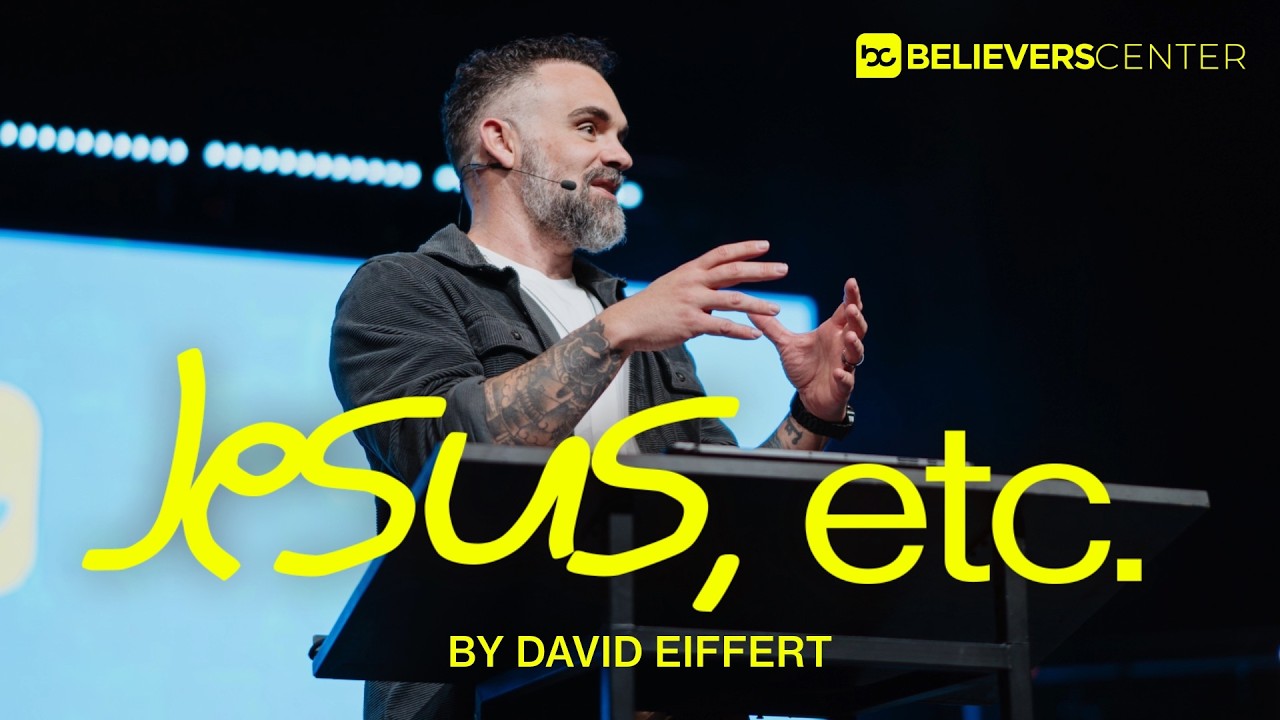
Jesus, Etc.
Scripture
Jesus is presented as the full and final revelation of God, showing that the whole Bible points to him and that the Christian life must begin with him at the center. From that center, every part of life, belief, and practice is meant to be shaped by his character and teaching.
Transcript
Well, hey, good morning, everybody. Well, it’s great to see y’all. Thanks for being here.
Love seeing all the graduates. We wanted to point out one thing, and that’s that Noah, who was up here praying, he’s our youth coordinator. He also graduated from college, so he’s not here, so we can still clap for him. So congratulate Noah too when you see him.
I am excited for the morning. Did you guys appreciate my wife speaking last week on Mother’s Day? Absolutely phenomenal. Proud of you.
I’m excited to do a week here. I’m grateful to be with you, and we’re going to recite our Believer Center Creed before I get into it. If you don’t know what that is, it’s our confession of faith, and we recite it often. If you don’t know the words, they’re on the screen. I invite you to read along with us.
I am deeply loved and graced by God. His life is a gift to me. My life well-lived is my gift to him. I am determined to live the life I could never deserve from the place of his grace. My faith is audacious, my spirit relentless. I will not be deterred. I will not quit until Jesus is fully honored and a hurting world has heard the good news. If not me, then who? If not here, then where? If not now, then when? I am deeply loved and graced by God.
Come on. Can you give God some praise for his grace? Amen.
Well, you guys can turn to a couple neighbors, welcome them to church, and you can take your seat.
If you have your Bibles, I’d like to invite you to turn with me to John chapter 1. John chapter 1.
While you’re turning there, I just want to remind you that we have been in a campaign right now, kind of a fundraising building campaign that we talked about on Vision Sunday. I guess that was about a month ago. Jordan, is that right? About one month ago, Vision Sunday? Yeah, it’s been about a month.
We’ve been raising money for this project. It’s $250,000. We’re doing a number of different things around the facility, and I just wanted to update you guys on where we’re at. As I told you when we first met, we were able to secure dollar-for-dollar matching for the entire project, which is absolutely a blessing. Where we’re at financially so far, just to let you know, with the $125,000 on top of that, you guys have given $68,155, or a total of $193,155 so far. So, that is so awesome. We’re way ahead of where we were expecting. We still have $56,845 to raise, but we’re so grateful for your generosity, and I’ll keep you posted as the project continues. Love you so much.
We are a church that teaches primarily, not exclusively, but primarily around series. What is a series? It’s a group of talks that are around a topic or around a scripture passage. That’s what we do most of the time. The way that that happens is that when the beginning of the year starts coming around, and periodically throughout the year, me and Jordan and Pastor Marshall, Pastor Cindy, and some of the other pastors, we get around and we look at a calendar, and then we kind of work to discern what we believe God’s doing in us and in the church.
Eugene Peterson, if you don’t know him, a great pastor that went to be with the Lord, says that a pastor is someone who lives their life slow enough to notice what’s happening between God and man. That’s what a pastor is. So that’s part of what our calling is, to understand not just what God is telling us, but what we believe God is leading us to communicate to the church as a whole.
So we do that, and we kind of brainstorm. Here’s some of the things that we’re thinking. Then we look at the calendar and try to make the different dates fit, and we all do a little bit of traveling, so there’s a little bit of moving around, and that usually works out pretty good. But sometimes there’s weeks that are just kind of flapping in the breeze, and sometimes that happens because of holidays. So you think about Mother’s Day, something like that, and there ends up being these single kind of weeks where there’s not anything specific. We just call it an open week. It’s just an open week. Don’t start some big old thought that’s going to take you 12 weeks to develop. You got one week, so make it good.
This morning is one of those weeks. What I wanted to do this morning is just have a little fun, and I wanted to communicate with you something that’s so foundational to me and something that’s so fundamental to how I understand Christianity and certainly how I live out Christianity. I want you to kind of peek behind the curtain of what that is.
I’m just going to warn you that I am a bit of a wannabe theologian. I did get a theology degree, but outside of that, I am a wannabe theologian. I love theology. I study theology, and I work hard as a pastor to make stuff really approachable, really applicable to your life. But you got to understand that there’s also a side of me that really thinks there’s a lot of benefit in you understanding this book and understanding who this book points us to.
I think there are a lot of things that are kind of like paradigms that, when you come to scripture and you read scripture, and when you come to church and when you relate to God, they’re either going to help you in your relationship with God or they’re going to hurt your relationship with God. So, I’m hoping that you guys will be willing to lock in for like 28 minutes as we talk about something that’s theological, but I think it has everything to do, not just in little ways in your life, but with how you understand God and how you relate to God.
If you’re taking notes this morning, what I want you to write down, this is the title: Jesus, etc.
Grace and Truth Came Through Jesus
Here we go. John 1:14:
“The Word became flesh”
Talking about Jesus, right?
“and made his dwelling among us. We have seen his glory, the glory of the one and only Son, who came from the Father, full of grace and truth.”
So Jesus came to bring us a number of things, but two of them that he came to bring are grace and truth. There’s a truth that became available to us because Jesus came.
Verse 15:
“John testified concerning him. He cried out, saying, ‘This is the one I spoke about when I said, “He who comes after me has surpassed me because he was before me.”’”
So he’s saying John the Baptist was talking about Jesus.
Verse 16:
“Out of his fullness we have all received grace in place of grace already given.”
For the law was given through Moses; grace and truth came through Jesus Christ. So again, there’s a truth that became available to us that wasn’t previously available to us because of Jesus.
Then listen to this, verse 18:
“No one has ever seen God.”
Pause. Isn’t that interesting? No one has ever seen God. I wonder if someone were to tell you that on the street, if you’d agree with that. No one has ever seen God.
Listen to this:
“But the one and only Son, who is himself God and is in closest relationship with the Father, has made him known.”
Did you know that? One thing that Jesus does is he makes God known. Because of Jesus, we now have the ability to know and understand God in a way that we didn’t know and understand God before.
Paul says it like this in Colossians chapter 2, that the knowledge of God’s mystery is Christ. Ain’t that interesting? The knowledge of God’s mystery is Christ.
I don’t know if you think about it like this, but God is the ultimate mystery. He’s the infinite mystery. God is the one object that you’ll never find in the universe. Are you with me? You can search the whole universe, and the one thing you won’t find is God.
So when I talk to atheists, and I’m grateful to be able to do that sometimes, I will almost always find my way to a question that’s something like this: What do you mean by atheism? What do you mean by that? And they will eventually find their way to a belief, and it is a belief, by the way, that there is no God.
That’s interesting, because when people say that, you know what I say? I say, “Well, I half agree with you.” And they’re like, “What? What do you mean?” I agree on the word there, right? Because the word there is an adverb. It denotes a place and a location, and God doesn’t really work like that. You know what I mean? It’s not like you can scan the universe and say, “There he is. There’s God.” So I agree that you can’t just point and locate God. That’s not how it works.
You can point to Neptune, the planet. I think you can see it in a telescope. Is that true? Okay. You can find Neptune and say, “There it is. It’s right there.” You can get a map and point to Arizona and say it’s right there. This towel, this is a towel I have up here in case I get sweaty, which I do sometimes. I can point to this towel and say, “Here’s this towel, and it’s right here.” But God’s not like that. He’s not an object in a place like a planet or a restaurant.
God is the creator of the universe, and he creates the universe from outside of the universe. So God is not an object inside the creation. He is the creator that creates outside of himself. Y’all with me?
I told you you’re going to have to be thinking with me this morning.
The Author Writes Himself into the Story
Here’s what I’m getting at. On our own, we can no more find God than Bilbo Baggins could find J.R.R. Tolkien.
Anyone in here read The Lord of the Rings? It’s a book. It’s actually a collection of books. They’re quite large. But I think you could say that the main character of the books is this guy by the name of Bilbo Baggins. Bilbo Baggins is a hobbit. He’s a character type that I identify with as a flat-footed, large, hairy…
But Bilbo could search all of Middle-earth, and the one thing that he’ll never find is J.R.R. Tolkien, the writer of the book. So he wrote the book, and in the book the characters can search everywhere in the story. They will never find the author because Tolkien created them, and Tolkien exists in a realm that Bilbo can’t access. You understand what I’m saying?
Bilbo in the story may never suspect that there’s a creator that created him outside of Middle-earth. He may have never wondered that. But I can say that we as mankind, we do. We wonder that. Humanity has always had a universal sense that there’s a great mystery out there somewhere. All throughout history, we’ve come up with all kinds of different theories to try to understand the great divine that we all just have a sense is out there somewhere.
What’s interesting is that mankind, when we try to describe this god, we usually end up making kind of a super version of us. You know what I’m saying?
Let me hit you with some examples. The Greeks had theos, and theos was very Greek. He acted very Greek because he was described by the Greeks. The Romans had Dios, and Dios looked very Roman-like. He was different. The Arabs in the Arab world, they have Allah, and Allah looks very Arab-like.
By the way, let me just say that’s not just for Muslims. That’s also true for Christians. Did you know that Arabic Christians call God Allah? In fact, in the Arabic Bible, where it says God in our Bible, it says Allah. That’s what it means.
But the point is that when people describe God, he ends up looking like them. Americans, for us, I think when we try to describe God, what we end up doing is making a more intense version of us, like a super us. The things that you really stand for and believe in. It’s just really easy to make a God that cares about the same things that you care about, that hates all the same people that you hate, that stands for all the things that you stand for. It’s really easy to make a super you in the form of God.
Unless, let’s say, J.R.R. Tolkien were to write himself into the story. If he did that, then they could meet their creator, right? If he did that, they wouldn’t have to guess what he’s like. Then he would be the Word-made-character.
He could say things like, “I’m from my Father.” He could say things like, “I’m here to do my Father’s will.” He could say things like, “I and the Father are one.” “If you’ve seen me, you’ve seen Tolkien.” Do you know what I mean? If he were to write himself into the story.
Kurt Vonnegut is an interesting author. He did this in one of his books. He’s got a book called Slaughterhouse-Five. Some of y’all probably read it, maybe even read it in high school. He did this where the main character is in a bar, and he gets these chills and notices that something else is going on, and then right in the middle of the story, Kurt Vonnegut shows up, the author of the book, and he says, “Hi, I’m Kurt Vonnegut. I created you,” and has a conversation with his own character.
That’s really one of the ways that we understand the incarnation of Christ. God lives in a world that’s inaccessible to us, but so that he could come and redeem this story, he writes himself into his own story. He brings light and understanding and salvation into human history. So God through Christ has written himself into the story. Are you with me?
We Start with Jesus
That’s why, when we understand God and seek to understand God, we don’t just go to this generalized God like everyone else in the world does. We start with Jesus. That’s not inappropriate for us to do, because that is God choosing to reveal himself to us in a certain way. He brings us truth that before Jesus came, we didn’t have.
What kind of truth? Well, there’s a lot of truth, but one of the truths is this: what God is like. We had ideas. We had some good ideas. We had some bad ideas. God certainly revealed himself to us in certain ways. But when Jesus comes, we finally have the perfect and ultimate revelation of what God is like. Through him, we begin to understand God.
A few years ago, I was talking to a guy, and it’s always funny because when people see me, they don’t assume I’m a pastor, for obvious reasons. So they’re hanging out and they’re like, “So what do you do?” And this is what I say all the time: “I’ll tell you if you promise not to get weird.” They’re like, “Okay.” And I’m like, “I’m a pastor.” Then they try to peel back. “Well, I was just saying…”
One time I was talking to a guy, and he said, “What do you do?” I said, “I’m a pastor at a church.” He said, “Oh, is that right?” I said, “Yeah.” He said, “What do y’all believe at that church?” I paused and said, “Well, you know, Jesus, etc.” That’s what I said. I was just trying to be funny, but I thought about it, and I thought, you know what? That’s pretty good.
What do we teach at that church? Jesus, etc. What do you believe? Jesus, etc. How do you live out your Christian life? Jesus, etc.
The etc. is quite vast. The etc. includes a lot of stuff. It includes your family. It includes your vocation. It includes your worldview. It includes your money. It includes your politics. It includes your relationships, your friendships, your calling, your purpose, why you get up. The etc. is big, but Jesus is the center, and everything else radiates from that. Your life is Jesus, and then everything else. Jesus informs everything.
Jesus informs your priorities, your politics, your education, your philosophy, your music, your art, your ethics, your sexuality, your economics, etc. Jesus is the central character and the central defining anchor of everything else in your life. It’s like the spokes on a wheel. You’ve got all these different spokes, and then there’s a hub in the middle. So here’s your political worldview. Cool. Here’s your money and how you spend your money. Here’s your relationships. Here’s how you treat people. Here’s how you handle homeless people. Here’s how you treat your friends. All of these different spokes comprise who you are, how you behave, and how you think. But the centering principle always has to be Jesus.
You might be thinking, why? Because Jesus is God. But Jesus is also the lens through which we correctly understand the Father and through which we correctly understand the Holy Spirit.
If you’re thinking, “I’m going to need some chapters and verses for this centrality-of-Jesus business,” you got it. I had to cut a bunch. The Bible’s clear on it.
The Greater Light
I’m going to take you up a mountain. There’s a mountain called Mount Tabor. Some of y’all are familiar with it. It’s this green mountain in Galilee. Galilee is a place in northern Israel. It’s forested, and it’s got this real gentle slope. It’s not like the Sandias. It’s just this gentle slope, and there’s villages tucked into the side of the mountain, and you can just walk right up the Mount of Tabor.
One day 2,000 years ago, Jesus decides to take a walk, and he goes up to the top of Mount Tabor. He brings with him what we call the inner circle, Peter, James, and John. While they’re up there on the top of the mountain, Jesus begins to pray. When Jesus starts to pray, some weird things start to happen on this mountain.
Scripture says that Jesus’s face starts shining like the sun. I need you to lock that in. Jesus’s face starts to shine like the sun. His clothes turn bright white. It’s like his divinity is seeping out of his pores, where people are able to see. The three are just looking at this, not super sure what’s happening, and they look up and see that there’s two men standing beside Jesus: Moses and Elijah.
Who’s that? Old Testament characters. These were huge. You might be thinking, why those two? Well, they’re the two giants, you could say, of the Old Testament. Moses, of course, represents and wrote the law. Elijah was probably the greatest prophet. In fact, when we talk about the Old Testament, certainly when they talk about it in the New Testament, they refer to it as what? The law and the prophets. The law and the prophets.
So here you have standing next to Jesus one character that represents the law and another character that represents the prophets. It wasn’t random. It’s basically like the Old Testament itself standing there next to Jesus. That’s what’s happening.
I want to tell you just a tiny bit of backstory when it comes to Moses that maybe only the biblical nerds in here would know. Fifteen hundred years before this, Moses is standing on another mountain, and he tells God, “Hey God, show me your face. Let me see your glory.” God says, “I would, but it would kill you, so I can’t. But I’ll make you a deal. I’ll put you on this little cliff on the mountain so you’ll be hidden as I pass by, and I’ll let you get a quick glimpse of my back.”
That was the deal. So Moses goes his entire life having only seen God’s back. But now he’s on a new mountain, and it’s not God’s back that’s revealed, it’s his face. So before, Moses was able to see God’s back, but now, because Jesus’s face is shining like the sun, Moses from 1,500 years ago is finally able to see his face. What was once forbidden is now permitted.
Peter, one of the three, he’s the first to open his mouth. That’s what we love about him. He’s like, “Lord, this is so amazing. I’ve got an idea.” He’s trying to solve the problem. Who starts speaking up with a plan in this moment?
He says, “Here’s what we’re going to do. We’re going to build three shelters. One for you, one for Moses, and one for Elijah.” He’s still talking, talking, and while he’s talking, basically the translation is this: we’re going to put all three of you on an elevated platform, but you’re all going to be equal. That’s the idea.
As he’s suggesting this, there’s this bright cloud. It rolls in, and there’s this voice from the cloud, and it’s God the Father. He says this in Matthew 17:5:
“This is my Son, whom I love; with him I am well pleased. Listen to him.”
That’s what the Father says. Peter says, “Let’s put them all on the same level,” and God the Father comes in and says, “Actually, this is my Son. Listen to him.”
I want you to know this. You may not know this, but in the entire New Testament God the Father speaks exactly three times audibly. That’s it. Isn’t that weird? At Jesus’s baptism, at Jesus’s transfiguration, and at the end of Jesus’s ministry. Every time the Father opens his mouth, he only does one thing in the entire New Testament, and it’s this: point people to Jesus. That’s all he does.
He says, “This is my Son in whom I am well pleased.” “I will glorify through the Son.” “Listen to the Son.” That’s his entire message.
It’s weird because in the Old Testament the Father is constantly talking, right? Hundreds and hundreds of times. Laws and rules and decrees and curses and blessings, all of these things are coming from the mouth of the Father. But in the New Testament, God the Father says nothing except, “This is my Son. Listen to my Son.” You might be thinking, man, that can’t be right. I implore you to go check. He speaks precisely three times, and in every case he says, “This is my Son.” He’s pointing people to Jesus.
Don’t tell me that I talk about Jesus too much. You know what I mean? “Oh, you need balance.” It’s like God the Father spoke about nothing in the entire New Testament except the Son.
The disciples, of course, this is all happening, they’re terrified. They’re laying down. They’re scared. Jesus comes and says, “Get up. Don’t be afraid.” And when they look up, look at what they see. Matthew 17:8:
“When the disciples looked up, they saw no one except Jesus.”
Only Jesus.
The point is not that the law and the prophets are thrown out. Please understand that. If you think that I’m saying that, you’re going to misunderstand me, and then it’s going to be a whole thing. I’m not saying that the law and the prophets aren’t important, that they don’t exist. But this story is very clearly handing the baton of the revealed character of God from the law and the prophets to Jesus.
The way that I say it is this: Jesus is the greater light. I think of the law and the prophets like the moon and the stars in the night sky. When it’s dark, the moon and the stars are pretty important. Wouldn’t you say? They can guide you home. They can guide God’s people in the right direction. They can navigate by the moon and the stars. So the moon and the stars are great, but when Jesus rises, that’s the illustration used over and over in scripture, it’s like the sun rising. Before, we were trying to navigate by the moon and the stars, but then the sun comes and he fully illuminates so that we can finally see.
So we don’t navigate by the moon and the stars when the sun’s up. It’s not because they’re gone. They’re not gone, but they’re a lesser light. The greater light is the light of Jesus Christ.
That’s how you should read the Old Testament: God looks like Moses sometimes, and God looks like Elijah sometimes, but God looks like Jesus all the time.
Over and over in scripture, Paul says:
“I have endeavored to know nothing except Christ and him crucified.”
If you’ve seen me, you’ve seen the Father.
God reveals himself to us. He can reveal himself however he wants. He could write it in the sky. He could do whatever he wants. But he chooses to reveal himself through the revelation of Jesus Christ, who comes to show us the Father.
Point One: We Start with Jesus
I want you to write this down if you’re taking notes: We start with Jesus.
I don’t know if you think about it like this, but the most Bible-literate people of Jesus’s day, does anyone know their name? The Pharisees. Man, they memorized scripture. They read it every day. They debated it. They wore phylacteries. If you don’t know what a phylactery is, that’s these little boxes, and they would rope them onto their arms and even their forehead. I don’t know if you can picture a person with a box on their forehead. Why would they do that? Well, these little boxes were filled with Old Testament scripture. They would tithe on their spices. I don’t know if you think about bringing 10% of cinnamon on a Sunday. These were people that knew the book, lived the book, studied the book, and look at what Jesus says to them in John 5:39:
“You study the Scriptures diligently because you think that in them you have eternal life. These are the very Scriptures that testify about me, yet you refuse to come to me to have life.”
I find it interesting that the people who studied the Old Testament most were the most wrong about God. They had the right book, but they had the wrong center.
I just want to pause and tell you, I have given my life to understanding this book. This book has been the compass for me. I read it more than most of you. Probably not all of you, but most of you. I take this dead seriously. This is sacred to me. But you just have to understand that this isn’t principles from God with a Jesus section at the end. That’s not what this is. This whole thing is about Jesus. Says who? Says Jesus. Says Paul, says John, says Peter. This is a book that is pointing us to Jesus.
So we don’t put Jesus against the rest of scripture. “Well, you know, Jesus says this, on the other hand Amos says that…” Jesus and Amos are not the same. It’s all inspired. It’s all for our development. It’s all for our growth. But you have to understand that Jesus is the ultimate revelation of what God is like. So we start with Jesus.
That’s why, for me, when people say, “I believe in God too,” cool. So does most of the world. The thing that’s different about us is not just that we believe in God in general, but we specifically believe that we can understand God and that we can have a relationship with God because of the sacrifice of Jesus Christ.
Another quick one, Luke chapter 24. Jesus is walking with two of his disciples. This is post-resurrection. They don’t recognize him. So they’re walking, they’re sad, they’re heartbroken, and then Jesus reveals himself to be Jesus. Look at what happens, Luke 24:27:
“And beginning with Moses and all the Prophets, he explained to them what was said in all the Scriptures concerning himself.”
Ain’t that interesting? All the scriptures concerning himself. The Bible is not flat religious advice with Jesus at the end. The whole thing is about Jesus.
So we start with Jesus. The reason that I take this book seriously is because Jesus did. And I let Jesus inform everything. I think about everything through him. Perfectly? No. I’m preaching to myself as much as I’m preaching to you. But I recognize that at least the standard is this: I want my entire life to be centered around Jesus. I understand God because of Jesus, and I trust the way that God chose to reveal himself to us through Jesus. I start with Jesus.
Point Two: Jesus Is What God Looks Like
Number two is this: Jesus is what God looks like.
You can write this down. Jesus doesn’t change the Father. Jesus reveals the Father. He doesn’t change the Father. It’s not like, “Father, forgive them, they know not what they do,” and then the Father’s like, “Dang it, he found a loophole. Now I’ve got to…” It’s not that. When Jesus says, “Father, forgive them, they know not what they do,” you know what the Father says? He says, “Certainly, my Son, for you have always represented me. You have always represented my heart.”
Look at this, Hebrews 1:1:
“In the past God spoke to our ancestors through the prophets at many times and in various ways, but in these last days he has spoken to us by his Son…”
Verse 3:
“The Son is the radiance of God’s glory and the exact representation of his being…”
The exact representation of his being. Jesus is the exact imprint of God’s nature, says the writer of Hebrews. It’s not like, “Well, yeah, that’s the nice side.” No. Jesus is the exact representation of God.
Jesus is God’s ultimate act of self-expression. Jesus is the only perfect picture of God. Jesus is what God has to say.
So what might God say to you today? He would say a lot of things, but I think one of the things he would say is this: look to Jesus.
God, what should I do? Somebody hurt my feelings at work. Man, I don’t want to forgive. God, what should I do? You know what God might say? Look to Jesus. Because in the life and teachings of Jesus is found almost everything that you need.
I read the book of Proverbs every day. No disrespect. I’m just saying that there is so much wisdom and so much freedom in understanding that God looks like Jesus.
Colossians 1:15:
“The Son is the image of the invisible God, the firstborn over all creation.”
It’s interesting that he uses the word image here because there’s a lot of story behind it. Way back in the day, God said, “Don’t make any images of me. Don’t do it.” It’s the second commandment, right? No graven images. Why? Because you’ll get it wrong. That statue or painting or story of God, you’ll make it into an idol. So God says, “No images. No images.” Then he sends his Son, the exact representation of his being, and the New Testament writers say Jesus is the image of God.
So God says, “No images of me except for this one. You can look at him because he’s the one that gets it right.”
Here’s why I think it matters for a non-theological person. There are a lot of people who carry images of God that don’t look like Jesus, and it really hurts them.
“Do you think God wants to heal me?” You don’t have to ask that. Jesus shows you. Jesus shows you what the heart of the Father is.
“Maybe he’s just teaching me a lesson through this cancer.” You don’t have to wonder that. Why? Because God looks like Jesus. Jesus shows us the heart of the Father, and his heart was for people: to love people, to offer forgiveness and healing and redemption and new life. So you never have to wonder.
Some of you grew up in a church, my Catholic brothers and sisters who I love, where it just felt like God is angry and the pastor was spitting and pounding, and what you feel is like God’s just super mad at you, and maybe if you get your act together, maybe if you have enough faith, maybe you pray enough, maybe you say enough Hail Marys, then maybe, just maybe, God will become cool with you through Jesus.
It’s like you don’t have to wonder about that, because God just tells you, “Look at the Son. I’m finally at peace with how I’m represented here with the Son. He represents my heart.”
That’s why at this church we will always emphasize we’re not about religion. We’re about relationship with Jesus. And it’s not the same thing.
Here’s one of the most important things I’ll say all morning: Jesus doesn’t save us from God. Jesus reveals God as Savior.
I can’t tell you how many Christians I talk to who think God the Father is the dark shadow behind Jesus. It’s like he’s ticked, but Jesus is maybe on my side. Jesus is on my side, God’s on the other side, and Jesus is convincing angry Dad to cool down. That’s not the gospel. The gospel is this: the Father sent the Son. They’re not fighting. God so loved the world that he sent the Son.
Perfect theology is not a system. Perfect theology is a person.
Everyone who’s parented a small child knows this. When you have a toddler, you don’t stand there and say, “Well, if you want to talk, get up to my level. Come up here and talk to me.” No. You know what a parent does? A parent gets on their hands and knees, gets down on their level, reaches out to them, looks them in the eyes. That’s what the incarnation is. The incarnation is God coming, getting on his hands and knees, coming down, looking you in the face to show you how much he loves you.
Point Three: Jesus Informs All the Etc.
Number three, and this is the practical part: Jesus informs all the etc.
So many Christians, here’s what we do. It’s a mistake, but this is what we do. We end up chopping life into all these different pieces. You’ve got your Christian life right here, then your work life, your personal life, your social life, your family life, your financial life, your political life, and we put them all in separate drawers so they don’t have to touch.
It’s one of the ways that we make Jesus safe. It’s like, of course, Jesus. Of course. “Oh, we’re talking about Christian things? Oh yeah, of course I’m a Christian.” But you’re a very different person when we’re not talking about Jesus. Who’s guilty of this? Whenever someone starts talking about Jesus or faith, now all of a sudden I’ve got to be serious and have a totally different demeanor. I don’t want that. I want Jesus to inform everything.
Y’all know I love to joke, but I even want the way that I joke to be informed by Jesus. The way that I talk to my friends, I want it to be informed by Jesus.
Please remember that Jesus was crucified for involving himself in things people didn’t want him involved with. That was the problem. They didn’t mind another religious teacher. And just like most of us, we don’t want Jesus to get the death penalty, but we just want him to have life in prison, the prison of our spiritual part of our life. Here he is. I’m going to visit him on Sunday, maybe some other times throughout the week, but always on my terms.
But the danger of Jesus is this: Jesus doesn’t just want that drawer. He wants all of your life. He wants every single part of your life to be influenced by him. That’s the goal. Everything in your life is informed by him.
You’re a parent. I’m a parent. I want my parenting to be informed by Jesus. The way that I relate to my wife is informed by Jesus. The way that I lead this church and try to love you, help lead this church, is through Jesus. How I relate to my friends, how I spend my time, certainly how I spend my money.
It’s not like, “Well, Jesus, you get your 10%, and then I get to spend the other 90 like an idiot.” No. I want all of my life to be informed by Jesus. My political life. I’m not saying a million things, but I am saying that there’s no part of me that God doesn’t have access to. Jesus is the hub that holds them all together.
The good news is this: when we do that, we become an alternative society, a community that spans across communities where we’re shaped by Christ. The world would then look at us as this alternative community that is formed around Jesus, and they would say, “Well, that looks better,” because the world is aware that what they’re doing ain’t working. They’re not fooling us. They know it’s not working. But what they don’t see is an alternative.
That’s what the kingdom of God, the community of God, can be for people. When we orient our life everywhere we go, when we go to work, we’re oriented around Jesus. Jesus, how do you want me to live today? How do you want me to treat these people today? As you do that, you become a bright and shining city on a hill that looks different. People think, “Well, that looks better than what we’re doing. I like that better.” Then they come in, and the kingdom of God increases.
Again, I am not someone who has this all figured out. I feel like what I presented is kind of like, well, that’s the goal. That’s the perfect. “Yeah, I want to be informed by Christ.” I’m preaching that to myself too.
But my encouragement to you is this: wherever you’re at in this journey, this week maybe spend a minute at some point, maybe through prayer, maybe just in your heart in your quiet time, trying to invite God into different areas that maybe you had felt up to this point were just kind of blocked. What are the parts of you that you feel like he’s not invited to yet? Just try inviting him in.
What’s amazing is this: when you make Jesus the center of your life, when you give him full access to every part of your life, he doesn’t come in and break stuff. He comes in and fixes stuff. That’s what grace does. Grace doesn’t come to break. Grace comes to restore life as it’s supposed to be, the abundant life enjoyed from the place of his grace.
Jesus at the center.
Closing
Here’s my closing statement: Jesus is the center of the Christian life, and everything else radiates from him.
One, we start with Jesus. Faith doesn’t begin with a philosophy, a moral code, or a religious tradition. It begins with a person.
Two, Jesus is what God looks like. Jesus doesn’t change the Father. He reveals the Father. The Father looks like Jesus.
Three, Jesus informs all the etc. Your family, your work, your politics, your everything. When he’s at the center, everything else finds its proper place.
Can I get a good amen?
Amen.