Lost In Thought 2:Tear It Down
Scripture
Week two of the Lost in Thought series unpacks Paul's call to demolish strongholds - well-defended lies built brick by brick in our minds. Pastor David offers four practical steps for tearing them down: recognize, reject, replace, and retrain, forming new neural pathways grounded in God's truth.
Transcript
We are at week two of a series that I’ve entitled Lost in Thought, and it’s all about how to win the war in your mind. And last week we opened it talking about how you can’t have a positive life with a negative mind. I told you to say that over and over. I hope you did. You can’t have a positive life with a negative mind. The good news, though, is this is that God has given you the ability to create a better life and a better future. How? Well, amongst other things, by thinking better thoughts. You know, it says in Proverbs chapter 23, verse 7, that as a man thinks in his heart, so is he. And so your life follows the direction of your thoughts.
And this is usually the part in this series where I kind of do a little recap of my points from last week and all that. But this past week someone brought a book to me that I felt like just so encompassed last week, so perfectly, that I actually wanted to read you the book instead of recapping last week. So this is a book, and it’s by an author of Jenny Allen, and it’s called What to Do with Your Whirly Swirly Thoughts. Are you ready? I don’t know if you appreciate the magic that’s happening right now. I’m reading this book for you. Okay, and I’ve got them up on the screen. Here we go. You ready?
You have an amazing brain, and you get to decide what you think about. Listen to that. Okay. Here we go. Oh, look at all your thoughts in that cute little head of yours. I already love it. Sometimes you think happy thoughts, sometimes you think angry thoughts, sometimes you think silly thoughts, sometimes you think worried thoughts. Did you know that you have thousands and thousands and thousands of thoughts every day? What are some of your thoughts right now? Sometimes your brain fills with exciting thoughts when you feel your parents’ hugs, when you remember eating ice cream with a friend. Happy thoughts blast in your brain like confetti. Sometimes your brain works to do awesome things. Your brain helps you to solve math problems or comfort a friend who’s feeling sad. Listen to that, see that last part. And it helps you talk to Jesus.
But sometimes your brain fills up with thoughts that make you feel sad or scared. Like when you must make a mistake or remember how someone hurt you or how you feel lonely and like no one wants to be your friend. And you know what? You’re not alone. Even grown-ups sometimes have these thoughts. When you keep thinking about scary things, bad things, the things that make you embarrassed, or that really special thing you wanted to happen but didn’t, then those thoughts can grow and grow and grow. Someone, this is speaking the truth right now. Those thoughts can grow so big that they get stuck in your head. They keep whirling and swirling around and crowd out your other true thoughts. You can’t finish your R project. You don’t want to play with your friends. You can’t sleep, and you can even get a little cranky. Men, no, no, no, no. So what do you do with your whirly swirly thoughts?
Listen to this. You can train your brain like a muscle. What if your brain could run 100 miles or lift a hundred pounds? That seems pretty silly, right? But God says we can help our brains get stronger. Next page. And God made you the boss of your brain. You can help train your brain how and what to think. So whenever your thoughts grow big and start to spiral down the way you whirl and swirl down a slide, remember you can tell your thoughts whose boss. Come on, somebody. Tell your brain, stop. I have a choice about what stays in my head. The Bible says you can take every thought captive and make the thoughts about what is good and true grow bigger and bigger and bigger.
But how do you do that if the big thoughts are making you sad and swirling around your head? Did you know that you can get out of your head by saying your thoughts out loud? Yes, that looks like Ellen, but I think it’s dad. I was like, Ellen’s in this book. That’s pretty she’s getting around. Sorry, Dad. It’s the sweater. Tell those whirly, swirly thoughts to God and to the people who love you. Say those so those thoughts can go, go, go. Did you know that you can get out of your head by being thankful? Now you try it. What are three things you’re thankful for? Thank God for fun. Thank God for hard. Thank God for ice cream and butterflies in your yard. Thanking God can bring you joy. So now it’s your turn to try. Did you know that you can get out of your head by moving your body? You have a choice. You have God to help you. You have people who love you. God loves you, He sees you, and He wants you to know that you are never alone.
2 Corinthians chapter 10, verse 5. We demolish arguments and every pretension that sets itself up against the knowledge of God, and we take captive every thought to make it obedient to Christ.
Come on, somebody. What to do with your whirly, swirly thoughts. Yes, we ordered some of these. You can buy them in our bookstore this morning. Okay. That’s true.
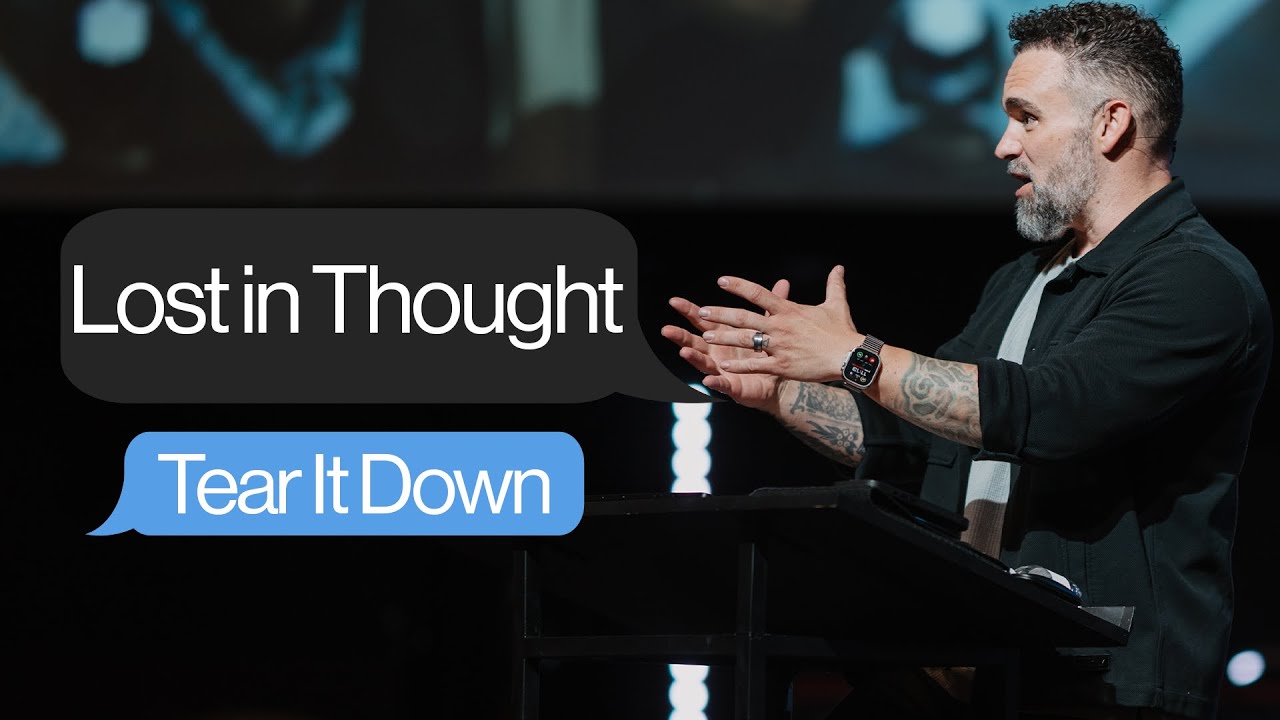
Tear it down
Okay, my title this morning, if you’re taking notes for this week, is this phrase right here. Are you ready? Tear it down. Tear it down. Turn to your neighbor and say that phrase. Tear it down. And so last week we talked about the battle that exists in your mind. And this week, what I want to do is I want to get really practical and specific on what Paul calls strongholds. And you might be thinking, like, hold up, PD. Doesn’t the Bible use stronghold in a positive way also? Yes. You’re right. In fact, the psalmist says this the Lord is my what? Stronghold. What that means, in that case, it’s a good stronghold. It means that God is your fortress, He’s your refuge, He’s your safe place. But Paul in 2 Corinthians chapter 10, he’s talking about a different kind of stronghold. He’s talking about a stronghold that we build in our minds that work against the knowledge of God.
Let me read it one more time. I know I read it a bunch of times last week.
Second Corinthians chapter 10, verse 3. For though we live in the world, we do not wage war as the world does. The weapons we fight with are not the weapons of the world. On the contrary, they have divine power to demolish strongholds.
Wow, look at these weapons. What are we fighting? We demolish arguments and every pretension that sets itself up against the knowledge of God, and we take captive every thought to make it obedient to Christ.
A well-defended lie
So you could write this down if you’re taking notes. It’s a definition. Stronghold in this particular case is this: a well-defended lie. I believe that’s Rick Renner that said it. The stronghold is a well-defended lie. It’s a belief system that’s listen to me, real to you, but not true. It’s real to you, but it’s not true. And John chapter 8, Jesus, he’s talking to his disciples. So he’s talking to followers of Jesus that used to be in the Jewish culture, then they’ve come to follow Jesus, but they’re still Jews, they’re still part of that culture. And he says this, John chapter 8.
John 8, 31, verse 32. He says, If you abide in my word, you are my disciples indeed, and you shall know the truth, and the truth, listen to what he says, shall make you free.
And then look at their response. This is their response to him.
We are Abraham’s descendants, and we have never been in bondage to anyone. How can you say you will be made free?
Listen, never been in bondage, Israel. What about Egypt? What about Babylon? What about Assyria? What about the fact that Rome is occupying them at this very moment? Right? We’ve always been free. So here we have Christ followers who are in denial about their own bondage. That’s the scary part, is that you can be in bondage and you don’t even know it. You have Jesus in your heart, but you’re still a mess in your head. Not because you’re in sin, but because your mind is bound by strongholds.
Let me hit you with some examples of strongholds to try to maybe get some buy-in that this could be you. Ready? I’m too old to start over now. Stronghold. I’m just like my dad. I can’t help it. Stronghold. If I really give God everything, he’s gonna send me to Africa. Stronghold. I tried that once, didn’t work. Stronghold. Nobody in my family ever made it out. Why would I be different? Stronghold. I’m just not a morning person. Okay, that one might be true. People like me don’t get opportunities like that. Stronghold.
And there’s examples over and over in Scripture of people believing the wrong thing and thus living from the wrong place. Look at this, Genesis chapter 3. It’s another example.
Genesis 3, verse 6. So when the woman, this is Eve, when the woman saw that the tree was good for food and that it was pleasant to the eyes, and the tree desirable to make one wise, she took of its fruit and ate.
So the Bible said that Eve saw that the tree was good for food. She saw that, but she didn’t know that. Right? She thought that this was a good choice. Like for all she knew, the fruit could have tasted like rotten trash. She didn’t know. The fruit could have been poisonous. The fruit could have killed her. Right? But Satan told her that the fruit was good. And she looked at the fruit and said, you know what? She’s right. Or he’s right. You know, he’s right. The devil’s right. Right? She bought the lie, and once you buy the lie, you start living the lie.
Neurons that fire together, wire together
I’m gonna hit you with just like a little bit of science here. I hope you brought your thinking caps this morning. So what the Bible calls a stronghold, science calls a neural pathway. Right? So think about it like this. So, like, let’s say you are in your car and you’re approaching an intersection and you see a red light. Without even thinking about it, you’re not choosing, you’re not weighing pro when you see the red light, you know what you do? You move your foot from the right to the left to push on the what? The brake. Right. But then when it turns green, what do you do? Without even thinking about it, you take your foot off the brake and put it on the gas. Because everybody here knows that red means what? And green means what? Go, right.
And so you’re not thinking about, like you don’t have to tell your foot to do that, you don’t have to wait for your foot to do that. The info travels from your eyes to your brain to your body on what’s called a neural pathway. They’re literal grooves in your physical brain that once you’ve done something so many times, it makes a quick route from green means move your foot to the right. Why does green mean move your foot to the right? It doesn’t make any sense, but to you it makes perfect sense because you’ve done it over and over and over and over. You’ve trained your brain to associate green with go, red with stop, and your body responds automatically. And most people that are driving are not worried whether or not they’re gonna be able to perform this. Like you don’t even have to think about it anymore. Why? Because a neural pathway is a path that you’ve walked in your brain over and over and over again.
And that’s like a really obvious example, but I was thinking some of my own life. Like my phone rings and it’s my daughter’s school. I instantly clench up. You know what I mean? What did she do? What happened? That’s just where I’m at. You know, but why? Because I’ve looked at my phone and gotten a call from the school enough times to where I’ve created a neural pathway from APS is calling anxiety. It’s called a neural pathway.
And your brain does this with actions, but it also just does it with thoughts. And the more that you think a thought, the easier it becomes to think that thought more. Because you have these physical grooves in your brain. You could say it like this neurons that fire together, wire together. Neurons that fire together, wire together. And some of you, so for example, some of you have trained your brain to complain. You don’t even think about it anymore. Right? It just has something happens and boom, you’re complaining. You’re not choosing. Okay, I’ve had it enough, I’m gonna finally start complaining. It just flows out of your mouth. Why? Because you’ve created a neural pathway. It’s automatic for you. Some of you have trained your brain to worry. And so before when you wake up, before your feet hit the floor, you’re already worried. Not because you’ve decided to worry, but your brain just went there. Why? Because it’s a path that you’ve traveled over and over and over again.
And so even if you didn’t know you were doing it, I want you to know every single person in this room, you have trained your brain. You’ve trained your brain. And listen to this, you got here thought by thought. And you’re gonna get out thought by thought. But it’s gonna be new thoughts. Right? That’s the good news is you’ve trained your brain to be negative. You can train your mind to go positive. You’ve trained your mind to go fearful, you can train your mind to go faithful. But it’s your job. It’s your job to do it.
God, in fact, He tells Jeremiah, Jeremiah chapter 1, verse 10 again. Listen to this.
See, I have this day set over you the nations and over the kingdoms to root out, to pull down, to destroy, and to throw down and to build and to plant.
So your job is to root out, to pull down, to destroy, to throw down. So that’s like a demolition work, right? So first thing you’re doing is you’re demolishing. But then you are responsible for building and planting. That’s construction work. So the job is this to tear something down and then build something up. That’s not just God’s job, that’s your job. That’s your job to recognize what it is that you need to tear down and what you need to build up.
Brick by brick
You know, I am a product of the charismatic Christian tradition. I’m proud of my charismatic upbringing. That’s how I was raised. But just to let you know, like in the 90s, that was a wild time to be like a charismatic Christian teenager. Someone please tell me you remember the power team. Oh my god, nobody. Okay, three of you, okay, okay, yeah. So the power team, I should have brought a picture. I should have brought a picture. It was these Christ juiced up Christian bodybuilders that would go around and they would do like these revival nights, and they would do these feats of strength. And so they would like get a bar and they would like bend it on their head, and they’d rip a phone book in half, and they had like a hot water bull balloon thing, you know, and they would blow it up. I think one of them even died doing that something. It like came back. Anyways, they do dangerous things. They had a block of ice, like a wall of ice, and they would run through it headfirst. And like we thought, oh my god, it’s the coolest thing. It was ridiculous, but it was super cool to us.
And of course, the climax of it was that they brought out a brick wall, and one of the guys would break down the brick wall with a karate chop. I don’t know what now that I’m an adult, I don’t know what kind of mortar they were using. You know, like I have a cinder block wall at home. I would love to see them come try that. It’s a karate chop through the brick. But it was all about this idea of like demolishing strongholds. That was the idea. They were gonna demolish strongholds. And I remember I would go home and I’m thinking, like, man, if I could just like, you know, I’m looking at my tiny little arms, and I’m thinking, if I could just be big like those guys, just take enough creatine and protein, because I’m sure that’s all it was. It’s just protein powder. Like, man, I could just karate chop my strongholds into oblivion.
But here’s what would happen is I would go to the event, I would go home, I’d be pumped up, and I would wake up and I’m still the same person. I’d still have the same problems, I’d still have the same struggles, I’d still have the strongholds. Because strongholds are not destroyed in a day. And it took years for me to understand this, what I’m about to tell you. That you build strongholds brick by brick, and you’re gonna have to tear them down brick by brick. And I know that’s not exciting, like that’s not as cool as watching a guy karate chop a brick wall. But that’s the truth. You can’t just pray it away. You can’t, and we believe on laying of hands, but we can’t just pray over you and make the strongholds that you’ve built up over the last 20 years magically disappear. You can’t shout it away. You got here thought by thought, and you’re gonna have to get out thought by thought. But it takes time.
And so, what I’ve got for you, I want to be real practical this morning. I’m hoping to be, is I’ve got four R’s for you. Not in the pirate sense, but in the letter sense. Four R’s. And so if you’re thinking, like, okay, so how? How do I tear down a stronghold brick by brick? Well, I’m gonna give you four steps. These are the four R’s. And here they go.
Recognize
If you’re taking notes, number one, I want you to write this down. Recognize. Recognize. You can’t fix what you’re unwilling to see. You can’t fix what you’re unwilling to see. So you have to be able to see strongholds for what they are. And that’s not easy because it’s a lot easier to see strongholds in someone else’s life, in someone else’s mind, than in your own. Like worried Wendy doesn’t know she’s worried. She just thinks I got a backup plan for a backup plan. You know what I mean? Like she doesn’t think that she’s worried. Critical Carl doesn’t know he’s critical. He just thinks it’s like constructive feedback that nobody asked for. Negative Nancy, she doesn’t know that she’s negative. She just thinks like I’m being real. As I told you last week, like a realist sees both the good and the bad. But if you only see the bad, that’s called being negative.
And so let me try to help you recognize a few strongholds, maybe in your life. Some of you might be thinking in here, like, I’ve tried the Christian stuff. I’ve tried prayer, I’ve tried reading the Bible, and like it doesn’t work. But have you really? Have you really tried it? Because it absolutely works. Let me just say that. Right? I’ve tried prayer. Look, it works. Like if you’re still a wreck, I know you didn’t try it that right because it works. Like, but you have to actually work it. Like as long as you actually take in the word, learn the word, apply the word, meditate on the word, pray consistently. But man, if you’re coming in here and you’re thinking, like, man, I tried the church thing and it doesn’t work, you’ve got a bias that’s not helping you. That’s a stronghold. I’ve tried God, I’ve tried that. That’s a stronghold.
Another example would be that some people in here have had negative experiences with the church, right? And your experiences are real, something happened, and you were hurt by that, but you’ve carried that and you’ve focused on that. I guess my question for you is this how’s that working for you? Right? Like how’s that gonna work out for your children? How’s that gonna work out for your legacy? But your brain just keeps going there and going there and going there and going there. And anytime someone brings church up, you’ve got your story ready, you’ve got your explanation ready. But you gotta understand that moments like that are a crossroad, and it’s an opportunity to either stay where you are or engage in what the Bible calls renewing of your mind to be transformed. Because we’ve all had bad experiences. The thing that separates you from other people is not that you’ve been hurt by church. Right? But you have the choice to let that become a stronghold for you, or you can choose to renew your mind, but you’ve got to recognize that strongholds are at work.
You’ve got to take a look at your life, take a look at where you are. And look, just recognize this that the enemy wants to put in you strongholds, wants to hold you back. They’re gonna defeat you, it’s gonna keep you from what God wants for you. And I just want to say to you, to somebody, that you don’t have to live like that. Like you’ve lived with a broken thought system for so long that it’s just become your friend. You know what I mean? Like it seems ridiculous, but like offense can become your friend. Where you don’t want to go anywhere with it, but I want you to know you can leave it behind. You know what I mean? Like you can forgive, you can heal, you can learn new ways of thinking. But the first step is this you have to recognize it for what it is. Recognize.
Reject
Number two is this reject. Reject. So first you recognize the stronghold and then you reject it. It’s just this idea. It’s just like not in my house. You just instantly reject it. And the battle begins when you decide to not let any old thought just hang out in your mind. Martin Luther, famous, famous pastor, famous Bible teacher, part of the Reformation, very influential, he said something to the effect of like you can’t control if a bird lands on your head, but you can control if you let it make a nest there. Right? So like you don’t control all the thoughts that come to your mind, but you can control if you let them linger.
And most people I think will do that, but they don’t do it long enough. Because it takes time. You have to do that, but you don’t just do that for like one afternoon and then write me an email and say it didn’t work. You’ve got to do it for a long time, and it requires mental energy. It’s like trying to run a marathon without getting in shape, right? It takes time to get your mind into shape to build the willpower to keep resisting, to keep pushing back, but it takes time.
You can even see this, and you might be thinking, hopefully, as I mature, I don’t have to fight that battle anymore of getting the bad thoughts out of my head. Bad news for you. You’re gonna fight that battle your entire life, or at least you ought to be. Even Jesus fought that fight. Look at this, Matthew chapter 16, verse 21. That’s an interaction that Jesus has with his disciples. It says this,
From that time on, Jesus began to explain to his disciples that he must go to Jerusalem and suffer many things at the hands of the elders, the chief priests and the teachers of the law, and that he must be killed and on the third day be raised to life. Peter took him aside and began to rebuke him. Never, Lord, he said, this shall never happen to you. And then, but he, this is Jesus, but he turned to Peter and said, Get behind me, Satan.
I don’t know about you. I hope to get through my whole life here on earth without Jesus calling me Satan. We’ll see. But I just want you to know this. Jesus doesn’t say, Yeah, I don’t know, you know, yeah, I appreciate what you’re trying to do. No, no, he’s direct and strong and intentional. Because what Peter did is he picked up information from adversity, he picked up information from problems, and he said something in that wasn’t in line with where Jesus was going. And so Jesus looks him in the eye and says, Get behind me, Satan. Get behind me, and then he qualifies it. The rest of verse 23.
You are a stumbling block to me. You do not have in mind the concerns of God, but merely human concerns.
What’s his issue with Peter here? It’s not what he did, it’s what’s in his mind. And so you can see that Peter has no problem thinking like this, but Jesus rejects it. What one person accepts, another person rejects. And your life will be defined by the thoughts that you accept and the thoughts that you reject. So, number one, recognize, number two, reject.
Replace
Number three, replace. Replace. And this is where a lot of people mess up. Because they think they can just stop thinking negative thoughts. If they just empty their mind, you just push the bad thoughts out. You, at least in the Christian faith, you can’t just empty your mind. You also have to fill it. Have you ever heard the phrase nature abhors a vacuum? You ever heard that? Nature abhors means hates. Nature hates a vacuum. It’s actually Aristotle. And the point is this is that if you don’t fill your mind with something, well, then your mind is gonna fill itself with whatever’s around.
And that’s one of the differences between Eastern meditation and Christian meditation. I want you to know this that meditation is a Bible word. Christian meditation is a Christian practice. But Eastern meditation will tell you to empty your mind, to clear your thoughts, and to become aware of what’s happening in your mind. And listen, that’s not wrong. Just from the Christian perspective, it’s not wrong, but it’s incomplete. So Christian meditation says you have to empty your mind of the junk, but then you have to fill your mind with the truth. You have to fill your mind with what’s good. You have to fill your mind with God’s word.
In fact, Paul tells us Philippians chapter 4 8, what to fill our minds with. She’s so good.
Finally, brothers, whatever is true, whatever is honorable, whatever is just, whatever is pure, whatever is lovely, whatever is commendable. If there is any excellence, if there is anything worthy of praise, think about these things.
Not just once, not just when you feel like it. Think on these things. And so this becomes for the Christian. This is our filter, it’s our checklist. It’s the things that you replace the lies with. And so when a negative thought comes, and it will, you don’t just reject it, you do reject it, but you don’t just reject it, you replace it. And for me, I think replacing it not just with like, God loves me. God loves, okay, God loves me. That’s cool. But I like to find a truth that directly counteracts the lie that is rolling around in my head.
Let me hit you with some examples. Lie. I’m too old to start over. Here’s the truth. With God, it’s never too late. Moses was 80 years old when God called him, for Pete’s sakes. Here’s a lie. Nobody in my family ever made it. Here’s the truth. I’m not defined by my family’s past. I’m defined by the promises of God. Here’s a lie. I tried that once, it didn’t work. Here’s the truth. Every Christ follower who doesn’t quit eventually wins. Eventually. Every Christ follower who doesn’t quit eventually wins. And so it’s not just stopping the lie, it’s replacing the lie with the truth. And so you got to fill your mind with the truth.
My daughter Grace, she’s super into music. She’s eight years old, super into music. And so she’s always humming, she’s always humming all the time. But she listens to a lot of worship music. She listens to it, you know, with Jordan mostly. I’m not a big music listener, but with Jordan, but she’s singing worship songs here. She’s singing worship, she’s a church kid. And so she’s always like singing these worship songs whenever we’re at the house, and she’s gotten super into this guy. Is anybody know him? Forrest Frank. Same of Forrest Frank. Forrest Frank’s what? What is pop? Hip hop? I don’t know. I don’t know what it is. It’s not my kind of music. But it’s like it’s like super positive. It’s super faith-filled. It’s like scripture. And so it’s like I was down, but now I’m up. What’s some other words? I don’t know. Just positive, positive stuff. God’s got my back, right? That’s like always this positive stuff.
And so you might be thinking, ah, music, whatever, whatever. It’s a big deal because her neural pathways are being formed by declarations of faith and the goodness of God, right? And so parents, I just want to tell you like your children are gonna have problems, they’re gonna have struggles, they’re gonna face confusion, they’re gonna face trouble, but they need the knowledge of God that demolishes strongholds. And so they’ll be putting all kinds of like other stuff in their head and making God’s knowledge secondary. Don’t do that. You know what I mean? Like if your kid’s hanging around and he’s singing like I’m all about that bass, bass, bass, no trouble, change it. Some of the old people are like, is that a song? Right? And you can like find a way you can have fun with it, right? But start training their neural pathways to focus on God. To focus on God.
And then it becomes easy for me when I’m walking through the hallway. What am I thinking about? Well, I might be thinking about this, this, but maybe I’m thinking about like God’s got my back, God’s got my back. And the more that you think those thoughts, the easier it is to think those thoughts. Right. And so there’s some people, you might be like, you look at Pastor Shirley, and it’s like, how do you do it, man? How are you like so full of faith all the time? How do you, you know what I mean? Like just scriptures is coming out of her, and she goes through incredibly hard things. You know, she hasn’t had the smoothest life. You know, she’s suffered loss, she’s suffered grief in a profound way, but man, she just keeps bouncing to the top. Why? Because she has trained her mind to go back to the thoughts of God. It’s not work. Your mind always wants to go to the path of least resistance. And so when you have these neural pathways that are closer to each other, that’s the one it’s gonna pick. And so it’s not just for kids, right? That’s true for kids, but that’s true for adults that you have to replace wrong thoughts with right ones.
I was talking this past Tuesday with one of my heroes, Berna Woods. I don’t know if they’re even in here right now. Their son, their grandson’s getting married today, so I think we might be light on woods today. By the way, I gotta scurry out of here. So if you’re open to talk with me, I can’t because I gotta go do the wedding. We’ll talk next week. But I was talking to her about it, and she said, I have a great tool that I use, and she said, I’ve shared with my women’s group and I’ve shared with a lot of people, and it helps. And she says, So, what I do is when I’m awake at 3 a.m. and my mind won’t shut off, it’s what me and Jordan call 3 a.m. brain. When she has 3 a.m. brain, y’all know what that’s like. When 3 a.m. brain is there, what she does is she goes through the alphabet from A to Z and she thinks of an attribute of God with every letter. And so she’ll say, like, and so she’s sleeping, her eyes are closed, but she’ll say, like, God is almighty. God is beautiful. God is my champion. God is my deliverer. And she said, as she does that, she says, I’ve never even made it to Z. Why? Because there’s something about not just stop thinking about work. Stop thinking about work. Stop thinking about that doctor’s diagnosis. Stop thinking about all the things that you don’t just do that. You instead replace those thoughts. You need to recognize them, you need to reject them, but then you need to replace them with something. Why? What’s she doing? She’s replacing 3 a.m. brain with the attributes of God, and she’s fixing her mind on the things of God instead of the things that are worrying her.
I hope this is like I know this is like really basic and really practical, but I do a lot of counseling. And there’s people whose minds are a wreck, and they don’t understand this. That it’s like you are the thinker of your thoughts, and you have the ability when you recognize my thoughts are not my friend right now. Don’t you stop thinking, stop thinking, don’t do that. Start replacing those with the promises of God. Right? Filling your mind with the truth. Number one, recognize, two, reject. Number three, replace.
Retrain
Number four, and I’m done. Retrain. Retrain. You build new neural pathways through repetition. It’s like any muscle. You know, people will like, oh, Pastor David, I want to get in shape, yeah, blah blah blah. It’s like cool, and then you know, January 1st comes, and we all see it, right? Like the gyms are packed. I hate the gym in January, it’s just so annoying because there’s all these people that are like, oh yeah, New Year’s Resolution, cool, cool, cool, January, what, January 20th? Back down to nothing. But people think I guess, they think that like if I do this one time, it’s gonna make it. That’s not how you get in shape. It’s not how you get healthy. One time. It’s not about one time, it’s about what you do repeatedly over and over and over again. And when you do an exercise over and over for like 20 years, well, then you get really strong. You get really good at that exercise.
The same thing with your brain. As you know, so to me, I think everything that happens in your life, good, bad, I don’t believe that God brings bad into your life. I will say this, it’s an opportunity for you to train your brain. And so when you go through something small and annoying, small and frustrating, it’s like, oh, I wish that didn’t happen. I wish the guy didn’t cut me off of traffic. But it’s also an opportunity for you to train your brain. When something happens and it’s aggravating to me, what am I gonna do? I’m gonna jump right to forgiveness and I’m gonna think the thoughts of God. So if you can get that, it’s like your life can take a different flavor. Because I know that what I’m facing now, I’m not going through anything profoundly hard right now. But life, not God, but life will bring hard things into my mind. That’s just gonna happen. And so I’m using today as the training ground. I’m training my mind today. And when something bad happens, and my, you know, I stub my toe, or you know, I’m feeling nervous about a talk I have to get, whatever it is, all of those are opportunities for me to train my brain. I can retrain it, but I gotta practice, do it over and over and over. Because again, your brain craves that path of least resistance. And the more you repeat something, the easier it becomes. You trained your mind to be negative. You can train your mind to be positive.
And I’ll say, if you’re brand new, it’s tough. It’s super counterintuitive. Because there’s just something about like, yeah, I heard something about somebody, and I just rather I want to talk about it with my friend. You know, it says in Psalm, is it Psalms Proverbs, that gossip is like tasty morsels. Like gossip is like a cool ranch Doritos chip. It’s just delicious. It’s like something good, it’s comfort food. You know what I mean? And I’ll say the same thing, it’s like being negative is just something that feels so right about it. Yeah, it’s just something that feels so right about like thinking the wrong things, worrying about stuff. And there’s just something that feels right, but then when you start like changing that, I’m just trying to warn you that it feels kind of weird. It feels like eating broccoli. Like, this is not quite as good. But it just takes time, right? But you’re retraining your brain. I’m retraining my brain.
I was thinking about my friend Solomon, he’s right up here. He has a he’s a barber, he’s a phenomenal barber, and he owns his own barber shop, and so everyone that’s there is his employee, and so but sometimes I’ll go in and he was telling me I’ll go and get my hair cut, and he’s saying, like, sometimes I walk in and there’s like this gangster rap that’s like playing, and he walks in, he’s like, Turn this off, turn this up, we’re turning on hill song worship. I don’t know, whatever. It’s sometimes like hill song worship ain’t the vibe. That’s fine. But did you know that there’s Christian rap? Lecrae, probably some others, I don’t know. Right? But what’s he doing? And so I was talking to him about it. I was in his chair, and he says, I’ve decided, I have to decide what I’m gonna listen to because whatever I listen to is gonna transform my thinking. So he’s always retraining his brain, retraining his brain. But you’ve got to stick with it. Number one, recognize, two, reject, three, replace, four, retrain.
Divine power to demolish strongholds
I’ve got one more scripture for you. I just want to read it one more time. Second Corinthians chapter 10, again, verse 4. Again. It says this
The weapons we fight with are not the weapons of the world. On the contrary, they have listen to this phrase, divine power to demolish strongholds.
Divine power. So, not human power, not willpower, not positive thinking, divine power to demolish strongholds. And I want to declare this over all of you in here today. I want to declare in the name of Jesus the well-defended lies that have kept you bound, they’re being exposed. The strongholds that have held you back, they’re coming down. The arguments, the pretensions, the lies that have set themselves up against the knowledge of God, they’re being demolished. Because you have divine power to demolish strongholds, not human power, not willpower, not positive thinking, divine power. The same power that raised Jesus from the dead is available to you right now to tear down every stronghold in your mind. You’re doing the work. Thought by thought, brick by brick, day by day. You got here thought by thought, and I’m telling you, you’re getting out thought by thought, and I declare this over you, my church family. Freedom is coming. Peace is coming. Joy is coming. Breakthrough is coming. Not because you’re perfect, not because you got it all figured out, but because you have divine power to demolish strongholds. I want to say, as your pastor, you’re gonna use it.
God, I want to pray that the people in this room would have the Holy Spirit’s work. One of the Holy Spirit’s works is to remind us of things. To bring the word back to our remembrance. And I want to pray that this week the people who are tormented in their mind, that even just the four R’s that you would bring that back to our remembrance. That you would help us remember. Man, I’m gonna replace this with something else. Man, that’s bad. That’s not helping me. I’m gonna replace that with something else because I’m retraining how I think. And it’s not in my own power, it’s in divine power.
Here’s my closing statement for you. Strongholds are well-defended lies built brick by brick, but you have divine power to demolish them brick by brick. One, recognize, see the stronghold for what it is, even when it feels real to you. Two, reject, stop it immediately with not in my house. Don’t let it build a nest. Three, replace, fill your mind with God’s truth because you can’t just empty it. Four, retrain, build new neural pathways through repetition until right thoughts become automatic. You got here thought by thought, you’re getting out thought by thought.