Peace When You Can't Find It
Scripture
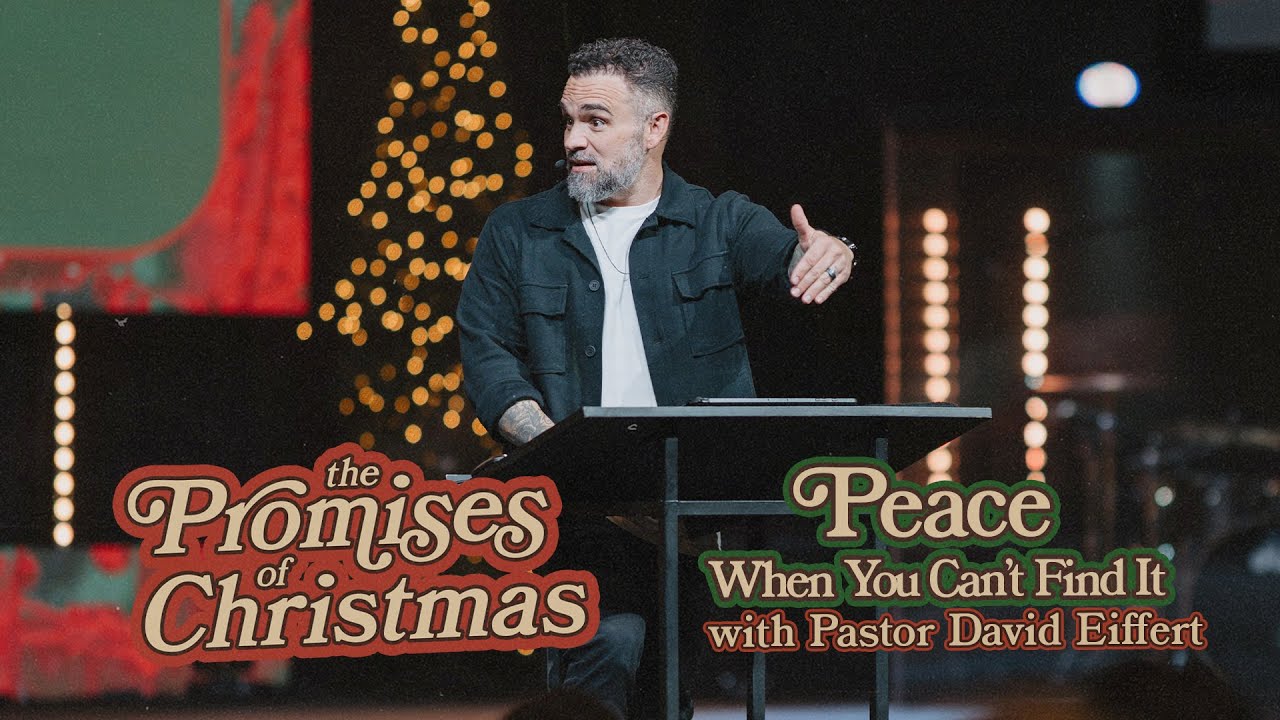
Week two of The Promises of Christmas series unpacks peace through three points: there are two kinds of peace (fragile situational peace versus God's shalom wholeness), peace is a person not a place (Jesus the Prince of Peace), and peace is a practice maintained daily through prayer and disciplined thinking.
Transcript
The Promises of Christmas
Amen. Well, we are in a series. This is week two of a series that I’ve entitled The Promises of Christmas. And last week we talked about joy. It’s talking about all these different things that Jesus came to bring us. Last week was joy, and I had three points by way of review. Joy is spiritual, not natural. Joy is strength, not a feeling, and joy is possible, not automatic. And this week, what I want to talk about is peace. Why don’t you turn to your neighbor and say that word peace? Peace. Let’s do it one more time, but extra loud. Peace. Okay. Sound like y’all are leaving. Huh. Peace.
So something that I never expected of myself when I was in my 20s, certainly when I was in my 30s, was to now that I’m in my 40s to be very into playing sports. Nobody saw that coming. I didn’t see it coming. My wife didn’t see it coming, but I love to play sports. And it’s a great way to have exercise, and I just I just like it because we can be silly and have a good time. You probably know I play volleyball once, indoor sand volleyball once a week, and then I also am on a couple different church, or not all church, but softball teams.
So I play, and I am not as a person that competitive. So, like as far as where things land on the scoreboard, you know, like I want I want to play well for myself. I don’t want to embarrass the family name or anything, you know, but I like I want to I want to play well, but as far as where things ultimately end up on the scoreboard, it’s not that important to me when I’m playing sports. And this bothers my team for sure. Because a lot of them are very competitive. My volleyball team is exceptionally competitive. And like when we’re doing good and we’re winning and we’re three points up, four points up, man. The sun is shining, the birds are saying, like, life is just so they’re high fiving, they’re chest bumping, I love you, bro.
And it’s so so, but man, if we’re down, if we’re down five points, it’s a funeral in there. No one says nothing, we don’t look at each other, we don’t make eye contact, there’s no fives. It’s just, and I and I’m I’m like, I it’s like this is a rec league, you know, we’re not going to the Olympics, just have a good time, you know. But I’m the least competitive on my volleyball team. I’m also the worst player, so I’m not sure if there’s a there’s a correlation there, but I’m at peace with it. I’m at peace with it. But their peace has absolutely in those moments have absolutely everything to do with what’s currently being shown on the scoreboard. And I think that that’s a perfect picture of the world’s peace. That the world’s peace is up and down and up and down, and it’s fragile because it depends entirely on the score of the game.
And so if you’re winning at life, well then the world’s peace would tell you you’re doing great, that you would have peace. But if you’re losing at life, then you’re miserable. And that’s exactly how most people live. Right? So if their balance is up in their bank account, they got peace. If the balance is down, they don’t have peace. The spouse is in a good mood, peace. Spouse is grumpy, not peace. And the world’s idea of peace is all about the scoreboard. And the problem is this, of course, and you probably know this: the scoreboard changes. And it’s not all up to you. And it’s like an exhausting way to live.
There are two kinds of peace
And I think that peace is something that for me is such a precious and core part of how I understand what it means to be connected to the source of the Father. It’s just it’s just huge for me. And I think that peace is unique in the Christian faith because when you go out there, what you do not see is peace. In fact, researchers tell us that America is the most anxious nation in the world. Most anxious. Think about that. That we have we have more money, more technology, more freedom. You got 47 streaming devices. You know, you got next day delivery on anything you can imagine. Your phone will like answer any question that you have in the universe. But the vast majority of people in America will say, yeah, but there’s still something off. And we’re the most anxious. And so we have, as Americans, we have the most stuff, but the least peace.
And I think that’s especially obvious during the Christmas season, because people are trying to find peace with presents, and people are trying to find peace with vacations, but it’s all the same thing. It’s what I call scoreboard peace. It’s looking at something outside of yourself to feel okay. But Jesus comes to bring us something different. And I’ve got three points for you this morning. I won’t take long. Three points about peace that I’d like you to write down if you’re taking notes. Number one, write this down. There are two kinds of peace. There are two kinds of peace.
If you’ve been on this planet for any amount of time, you have no doubt been confronted with a painful reality. And it’s this peace as the world defines it is fickle, fragile, and fleeting. Why? Because the world’s peace is situational peace. It’s a byproduct of things going your way. Right? And so your relationships are great, like they’re all great, they’re all healthy. Of course you’ll have peace. That makes perfect sense. If your career is heading in the right direction, well, then of course you’d have peace. That makes sense. If you’re physically healthy and you feel great, well, of course you’d have peace. That makes sense. But Jesus comes to bring us a peace that doesn’t make sense. It’s not situational peace, it’s it’s peace that transcends understanding.
“This peace I leave with you. My peace I give to you. And then look at this phrase. I do not give to you as the world gives.” - John 14:27
So Jesus is saying, I’m giving you peace, but I’m not giving you peace the same way the world gives you peace. So I’m using the word peace, but you gotta understand that just because we’re saying the same word doesn’t mean we mean the same thing. Right? That there’s that there’s a kind of peace that’s out there, situational peace, scoreboard peace, but there’s a different kind of peace that Jesus says he comes to bring that’s different than the world. And what Jesus comes to offer is superior in quality to what the world offers.
Jesus understood something that I think we all need to understand, and it’s this situational peace is fragile peace. Because when the situation changes, so does your peace. What is fragile mean? Fragile means it crumbles under weight. So like if let’s say you have a you have a dried leaf on the floor and you step on it, like what happens? It crumbles. Why? Because it’s because weight has been applied and it’s fragile.
You know, my a while back, my daughter, I’ve got an eight-year-old daughter, she came in from the backyard. She was very alarmed. And I was sitting in my recliner, and she she came over. Dad, can be a bad thing. So I came went outside, and what had happened is she had found in the backyard a dead lizard. But this was not just any dead lizard. This was clearly a lizard that had been dead for a long time. It was like a lizard mummy. It wouldn’t move. It was just like it almost looked like a stick, but in the shape of a lizard. It’d been there for so and so like I told her, I was like, Well, throw it away. She she wouldn’t throw it away. She didn’t want to touch it, I didn’t want to touch it. So I had one of those little grabbers, you know, those little grabbers. So I went and got the grabber and went and tried to pick up the lizard. And when I did, this lizard shattered into like a million pieces. So we just had like lizard dust on everything. Why? Because the lizard was fragile. And so when something’s fragile, and that’s maybe your peace, maybe that’s your joy, maybe that’s your contentment. If it’s fragile, it’s fine until pressure is applied. And then it crumbles under the pressure.
And I just want to tell you, I don’t want my peace hanging on a relationship. I’ve got a great relationship. I have a wonderful wife, but you know, but but that’s not where you find peace. Right? I I know I know plenty of people that are married to great people that don’t have peace. It’s not the spouse’s fault. Because your peace, if you want real spiritual, biblical, Christ first peace, it’s not based on a relationship. I don’t want my peace hanging on looking successful. I don’t want my peace hanging on the stock market. Have you seen that thing? Up, down, up, down. It’s like first day, like we’re all gonna be rich. Next day, we’re all gonna die. I don’t want my peace hanging on the stock market. I don’t want my peace hanging on a fat bank account. I want a peace, listen to me, that the world didn’t give and the world can’t take away. And that’s exactly what Jesus offers us. God’s peace is spiritual, not situational.
I’m just trying to teach you. That it’s something there’s people that’ll follow Jesus their entire life, and they don’t understand that it’s not okay to get your peace through external things. And it seems like it’s so obvious to say, but it’s actually difficult to live. Because Sunday, let me tell you what I think about Sundays. Sundays are like practice. Right? So you like you come, you know, and I go to the batting cages, man, I can crush the ball. I can murder the ball. But then it’s like, you know, when it’s actually game time, then it’s like all of a sudden it’s like I don’t even know how to hold a bat, I don’t remember how I’m supposed to stand. That’s kind of like what Sundays is like. Right? That you can come in here and you can be like, yeah, peace of God, peace of God, peace of God. That’s when it actually comes time to express that you have peace out of something else.
Biblical peace is not situational, it’s spiritual. In fact, biblical peace, it’s this amazing word. It’s this shalom. Why don’t you say that word? Can you say that word? Shalom. Shalom means wholeness. Completeness. It means it means you don’t need something from the outside to make you feel complete. Right? So I’m not, I’m not, I’m not looking for my bank account. I’m I’m not looking for you to think I’m cool. I want you to think I’m cool. I’m not looking for a great relationship. I want a great relationship. But I’m not looking to any of that to complete me. You know, Jerry McGuire, you complete me. That’s earthly peace. Right? What if she dies? You know what I mean? What if she breaks up with you? So external peace is the world’s peace. But wholeness, it’s not, it’s not, it’s not because you’re whole in and of yourself. It’s not, it’s not self-actualization. It’s that God comes and makes you whole. And so you’re not looking for external things.
And watch this the peace that Jesus gives is unaffected by inconveniences and adversity. It’s unaffected. It doesn’t mean that things don’t happen. It doesn’t mean you ignore what’s happening. It doesn’t mean you’re in denial. Faith doesn’t deny reality. But faith believes God to overcome it. And there’s a huge difference. And so you’ve got two options. You’ve got the world’s peace, which is wholeness through external things, and then you have shalom, which is wholeness regardless of external things. And you got to understand the difference. Peace that comes from the outside versus peace that God puts on the inside. And it’s easy to agree at church. Amen. Amen. Amen. But tomorrow, where is your peace? Wednesday, where is your peace? I want a peace that stays with me even when situations change.
Peace is a person, not a place
Number one, there are two kinds of peace. Number two is this peace is a person, not a place. Peace is a person, not a place. See, the world thinks that peace is a destination. So you and you arrive at peace if you can make enough right turns. You know, so like if you can arrive at the right tax bracket, then you got peace. You can arrive living in the right zip code, then you’ll have peace. Some of y’all are like, if I could just get to Friday, I’d have peace. Friday comes. If I could just get to Saturday, I’d have peace. It’s like if I I just I just need a new job. I just need a new house. I just need a new spouse. Don’t say amen to that. No one way to go. Peace is not a place. Peace is not a zip code, it’s not a number in your bank account, it’s not a brand of vehicle, it’s not a vacation in Hawaii. Peace is a person.
And you might be thinking, what does that even mean? Peace is a person. Well, there are dozens of names for God in the Bible. I don’t know if you know that. Lots of different names. How he reveals himself and how other people refer to himself. But one of the most significant is in this book called Judges and Judges chapter six. There we meet this man named Gideon. And I was gonna say that Gideon was having a bad day, but really he was having a bad life. His whole life. No, it’s just a hole. He’s just he’s just hiding in a hole. He’s so scared that he’s in a hole. And then God arrives on the scene and addresses him, and he says this, hey, mighty warrior. To the man in the hole, and you might be thinking, like, God’s being sarcastic. But sometimes God addresses us not based on our current actions, but by our future potential. And so he says, mighty warrior, and I’m sure Gideon is thinking, like, me? I’m literally in a hole right now. I’m hiding in a hole. But God comes and calls him a mighty warrior.
And Gideon, in response to that, he builds an altar, and in doing so, he gives God a name. Look at this, Judges chapter 6, verse 24.
“So Gideon built an altar to the Lord there and called it the Lord is peace.”
The Lord is peace. In the Hebrew, it’s this phrase, Jehovah Shalom. Jehovah Shalom. The Lord is peace. But I want you to notice what Gideon does not say. Gideon doesn’t say, Well, you know, the Lord gives peace, the Lord has peace, the Lord offers peace. He doesn’t say any of that. He says the Lord is peace. And also notice when he said it, he didn’t say it when the war was over. He didn’t say it when they had won the battle, not like when it was calm and perfect and there was no problems. He declared, the Lord is peace when he was still in the middle of the battle.
So how could he possibly do that? Well, he realized that peace is not about circumstances changing, and then you’ll have peace. Peace is about who’s standing with you in the situation. It’s about being in a battle, but not being in a battle alone. And when you get the person, you get the peace. But if you don’t have the person, you don’t get the peace. Look at what Isaiah, he prophesied it 700 years before Jesus was born. He comes and he says this as he envisions the coming Messiah. Look at this, Isaiah 9, 6.
“For to us a child is born. Did you know that this was written 700 years before Jesus came? For to us a child is born, to us a son is given, and he will be called wonderful counselor, mighty God, everlasting Father, Prince of Peace, Prince of Peace.”
And if you don’t have the prince, you don’t get the peace. So many people in the world, what I’m trying to get at is that so many people are trying to manufacture peace. They’re trying to buy peace. Medicaid to peace. Some of y’all tried to vacation to peace. You know what I mean? Like you’re in Hawaii and you’re you’re not having any fun because you’re just thinking about how expensive Hawaii is. You’re like trying to eat a steak, and you’re like, every bite of this steak costs me four bucks. That’s that that’s not peace. You’re looking in the what, and you should be looking at the who. And when the who doesn’t change, the what can change. And that’s fine. The what can change, the what will change. Right? I’m in a season where life’s good for me. It won’t always be like that, right? I’ll go through try, I’ll go through loss, I’ll go through hardship, I’ll make mistakes. Other people will make mistakes, other people will hurt me. That will happen. But I’m not looking to the what to find my peace. I’m looking to the who. And the good news is he goes with you everywhere you go.
And so if tomorrow you have a bad day, he’s still there. The Prince of Peace is still there. Or tomorrow you have a great day, praise the Lord. He’s still there. But so, but so long as you’re attaching your peace to the what, you’ll have peace 50% of the time if you’re lucky. But the who, I don’t, and I, and so this is this is what I want you to get. I don’t I don’t chase peace, I chase Jesus. And when I chase Jesus, peace follows me. I don’t I don’t chase blessing. I chase Jesus. And when I chase Jesus, blessing follows me. It says in scripture that blessing, the blessing will overtake you. What does that mean? It means it like hits you from the side. Not because you’re chasing blessings, but you’re chasing Jesus. And peace follows you.
Look at this, Isaiah chapter 26, verse 3.
“You will keep in perfect peace. Oh, perfect peace. What? You will keep in perfect peace, those whose minds are steadfast. Why? Because they trust in you.”
So we gotta stop looking for peace in the paycheck. Stop looking for peace in it in the situation, in the relationship, in the status. I had a friend, a great friend, he doesn’t live here anymore, but he would post on Instagram and he would give it one hour, and if he didn’t get a certain amount of likes, he’d delete it. That’s not peace. That’s looking for external validation. And it sometimes it’ll be there, sometimes it won’t. But if you could understand that that peace is standing right next to you, with you, no matter where you go.
Peace is a practice
There are two kinds of peace. That was number one. Number two, peace is a person, not a place. Number three, and I’m done. This is me trying to be practical. Peace is a practice. Peace is a practice. You know, there was a quote that you know went, you know, went around for a while a few years back, and I it was a good quote, but I but I feel like I changed it a little. I changed it to peace because I think it’s even more true when it comes to peace. Here’s here’s the quote peace is not owned, it’s rented, and payment is due every day.
And I’m not making a theological point here. I’m not just saying, oh, you’re saying you’re no, I’m not saying that. I’m making a practical point, is that that peace is not something that you achieve one time. Like, woo, you know, and then it’s just autopilot. You know what I mean? Like you did it, you felt peace, you prayed, God came and helped you, and now just you’re set, and now you can do whatever. You can’t get peace once in 1998, and you’re good forever. You you can’t have peace today based on what happened five years ago. Peace is something that you have to work at. Day after day after day.
And you might be thinking, like, PD, I’m so tired. I don’t I don’t want I don’t want to hear about all this stuff that I gotta do. Look, Paul gives you a very simple pattern for peace that I’m gonna give. I got two little sub points here, but this is a very simple, you’re like, okay, so how do I how do I do it? I just visual visualize Jesus next to me. Okay, does that magically happen? I mean, that that’s better than not visualizing him next to you. But there is a pattern that scripture gives us. Let me let me show you in Philippians chapter 4.
Before I read these verses, I wanna say this that Paul, when you read these verses, you might be thinking, well, easy for you to say, Paul. You know what I mean? Like you’re you’re you know, you’re in the Bible, you’re a saint. And then like I’ll I’ll read these verses, and they almost like rub me the wrong way, because it’s like, who are you to say, buddy? Who are you to talk to me about like joy and peace? Who are you to say? Well, keep in mind that that Paul is in year four of a possibly indefinite prison sentence. And so, and so he knows, right? And that’s and that’s why he can write to the church in Philippi and tell them, because he knows that it works. He’s not telling them to do something that he doesn’t do. And in and in this prison cell, he write he writes the most joyful, peaceful letter, right in the middle of the trial, right in the middle of the struggle, he writes these words. And so, a little context for you. Philippians chapter 4, verse 6.
“Do not be anxious about anything, but in every situation, by prayer and petition with thanksgiving, present your requests to God. And the peace of God, which transcends all understanding, will guard your hearts and your minds in Christ Jesus.”
So here’s here it is. This is the rule of thumb. If you’re thinking about it, pray about it. If you’re worried about it, pray about it. If you’re anxious about it, pray about it. And you might think, oh, it’s not that important, it’s not that not that big of a deal. I probably don’t need to bother. He’s very busy. He’s very like, no, if it’s big enough to worry about, it’s big enough to pray about. I know people, I know people in the room that pray about parking spots. You know what I mean? They’re like, Lord, you parted the Red Sea, so you will part these cars, and like, and sometimes it works, and other times God says, You need the exercise. But either way, it’s communication. Right? If you care about it, talk to God about it.
Because because when you keep this is just true. If you keep things in your head all the time, then they just kind of get bigger and bigger. Am I the only one that’s ever experienced that? You’re just thinking about it, you’re stewing on it, you’re meditating it, just thinking about it over and over and over, and you’re not communicating it, and it just like becomes this huge monster in your head. But the moment that you verbalize it to God, what happens in in the spiritual, but also happens in our hearts and our minds, is that is that we’re transfer the burden of the situation from our shoulders on to his shoulders. Let’s just pray about it.
You might be thinking, like, I just feel, you know, I feel like you talk about the same thing over and over. Good. I’m glad you noticed. Right? It’s like, I feel like 75% of your sermons end in learn how to pray. Yeah. It’s boring. It’s not boring once you do it, but it’s a boring point. But I’m I’m just trying to tell you what worked. Prayer absolutely works. And if you’re facing anxiety, you’re facing worry, you just feel like you don’t have that peace, and you don’t pray. I’m just telling you, you’re missing it. Because I have been an anxious person. Am I an anxious person right now, 2025? I can’t. No, I’m not anymore. But I have been a lot. And so I can tell you, prayer works.
And I’m, you know, like here’s a good prayer. I’m just feeling like anxious about something. I don’t even know what it is, God. But I but can you help me with that? I I know that you you want to bring me peace, so God help me. Help me experience your peace. Right? What is that? Brilliant? No, it’s just it’s just something. But just saying what you’re feeling to God, expressing, verbalize. That’s what Paul says. He says, pray about all things. All things and then the peace of God. Pray about all things and then the peace of God. So pray about all things.
Number two is this watch your thoughts. Again, you’re thinking, like, oh, here we go. Same David stuff. This is this is Paul’s stuff before this is David’s stuff. Look, the very next verse, Philippians 4, verse 8.
“Finally, brothers and sisters, whatever is true, whatever is noble, whatever is right, whatever is pure, whatever is lovely, whatever is admirable, if anything is excellent or praiseworthy, think about such things.”
Isn’t it interesting that Paul, when he’s telling you how to have peace, he tells you to think about certain things. He doesn’t say feel certain things. He doesn’t say feel these things. He says think about these things. Why? Because your thoughts produce your feelings. Some of y’all ain’t ready for that. But that’s the truth. Your thoughts produce your feelings.
Like, like, let’s say you have a loved one and they’re flying on a plane today somewhere. And then you get a bing on your phone that says like there was a terrible plane crash. Right? And let’s say your family member was perfectly safe the whole time. But as soon as you see that headline, your body is gonna feel something. You’re you’re gonna you’re gonna your chest is gonna tighten up, your mind is gonna start racing, you’re gonna tighten your jaw, right? You tighten your neck. Like that’s gonna happen. Why? Because your body is so ready to respond to the things that you think.
If you think about, think about like a scary diagnosis from a doctor. Right? That you were just as sick before. You know what I’m saying? Like, it’s not like the diagnosis made you sick. It’s not like something happened, but but the thoughts changed. And and and your emotions, how you’re feeling, if you’re feeling at peace, peace is more than a feeling, but peace includes a feeling, which is a feeling of wholeness, completeness. And so if if you don’t have that, just understand that your thoughts are linked to that.
So if you’re thinking, like, man, I’m such a m I’m such a screw up, nobody, nobody likes me. I can’t ever do anything right, and people don’t, you know, my life is so hard. And you’re thinking that, well, how you feel is gonna be affected by that. And many people, many good Christian people who I really like struggle with anxiety because they don’t ever address their thoughts. I’m not saying you saying you’re saying depression is just think. No, I’m not saying that. That’s a medical don’t come to me for medical advice. That’s something different. But what I am saying is this is that Paul teaches us if you want to have peace, you have to be deliberate on what you think about. You just you just you just have to.
And the good news is this, and we talked about this in October, is that you’re the thinker of your thoughts. That’s so cool. You’re the thinker of your thoughts. That you’re you’re the devil doesn’t choose your thoughts. You choose them. Your spouse doesn’t change your thoughts. Tucker Carlson doesn’t choose your thoughts. Morning Joe doesn’t choose your thoughts. At least I hope he doesn’t. Because I hope he doesn’t. You choose your thoughts. And if you want peace, this Christmas, you have to start taking responsibility for what you let live in your head. Some some apartments, apartment complexes are trashed because they have bad tenants, and some minds are trashed because they let people and let things live in there that shouldn’t be in there. And so you have to you have to evict the thoughts that are stealing your peace. Peace doesn’t happen accidentally, it happens with intentionality.
One, there are two kinds of peace. Two, peace is a person, not a place. Three, peace is a practice. Here’s my closing statement. Jesus offers a peace that the world didn’t give and the world can’t take away. One, there are two kinds of peace. Situational peace crumbles under pressure. But God’s shalom is spiritual wholeness that’s available regardless of external circumstances. Two, peace is a person, not a place. Stop chasing peace through zip codes, paychecks, or vacations. Chase Jesus and let peace follow you. Three, peace is a practice. Peace is rented, not owed, and the rent is due every day through prayer and choosing what lives in your head. Someone say amen. Amen.