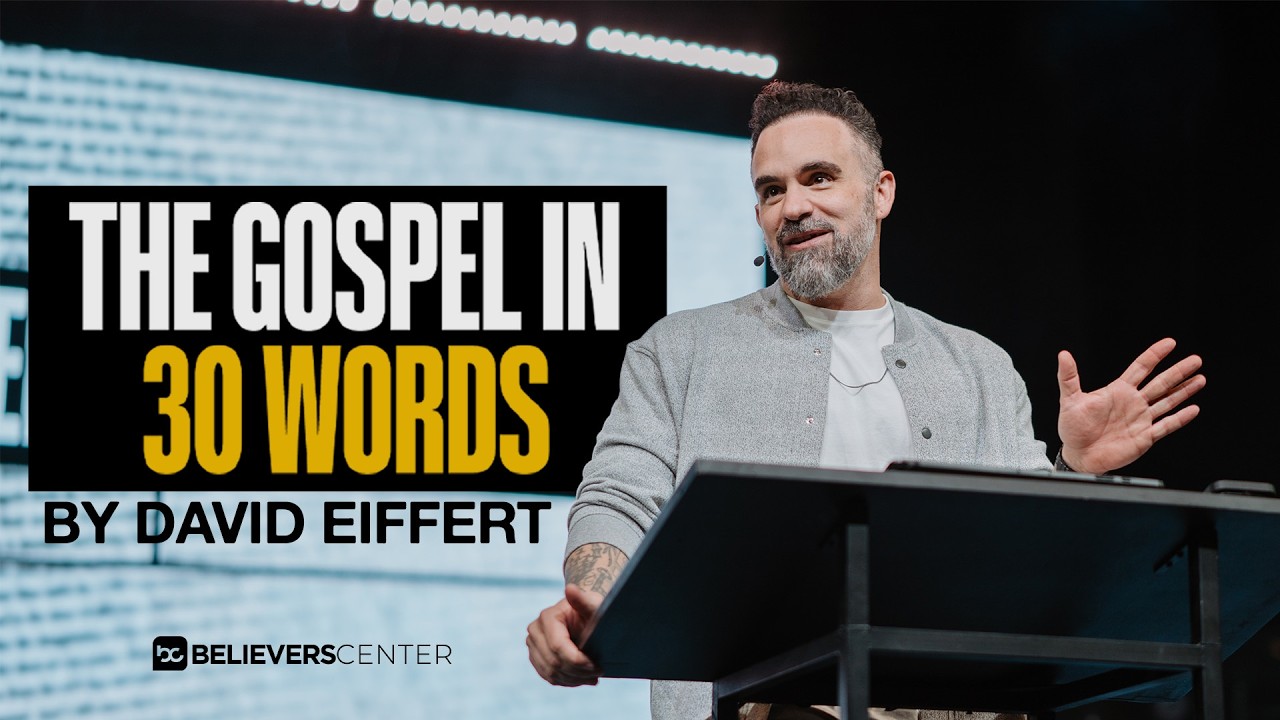
The Gospel in 30 Words
Scripture
Opening a series called The Gospel in 30 Words, this message reframes the gospel as a person rather than a plan - Jesus himself, who reveals what God is truly like. It presses three points: the gospel is Jesus, calling him Lord means surrendering control, and faith is believing enough to actually follow.
Transcript
The Beginning of the Good News
Mark chapter 1, verse 1, it says this. The beginning of the good news about Jesus, the Messiah, the Son of God. I’m just gonna read one that one verse. The beginning of the good news, what good news? About Jesus, the Messiah, the Son of God. Heavenly Father, we’re so grateful for you. We’re grateful for your Son who makes all of this possible. And Holy Spirit, we’re so dependent on you to lead us and to teach us and to grow us. And so we would ask that you would speak to us your truths, reveal to us your truths, and that you would help us to implement these truths and realities into our life. Again, we say thank you. We love you. It’s in your sons, let me pray. Everybody said, Amen.
The Gospel in 30 Words
So we are starting a series this morning that I’m very excited about called The Gospel in 30 Words. The Gospel in 30 words. And I know some of y’all might be thinking, like, I’ve been following Jesus for 40 years. So like I don’t, I already know the gospel. I’m looking for something more advanced. Here’s what I’ve learned, though. I bet other pastors in the room have learned this too. But there’s a difference between knowing something and really knowing something. It’s just it’s just a little bit different.
And so, like if you were to imagine, if you would imagine you’re downtown, and imagine you’re waiting in line for a concert, let’s say, and the guy in front of you in line, let’s say he’s some young dude, spiky hair, tattoos, face piercings, and looks a little angry, but you start a conversation with him, and somehow it comes up in the conversation that you’re a Christian. And he says, Well, I’m glad you mentioned that because I had a question for you. And you say, What’s that? And he says, What exactly is this good news that y’all talk about? What is this good news?
And I would say this that for a lot of people, they would struggle to answer that question in a very clear way. And that’s what the series is about to understand the gospel for ourselves, but also to understand and get clarity on what the gospel is and what the gospel isn’t, so that when you have an opportunity to share it, you can actually communicate it in a way that is in fact good news and in a way that makes sense to someone who hadn’t heard it before.
Richard Dawkins and the Atheist Bus Campaign
So by way of introduction, what I’m wanting to do is I’m wanting to show you. So in 2009, there was this guy named Richard Dawkins. Some of y’all know him, he’s probably the most famous atheist alive today. He wrote a book called The God Delusion and some other books is very influential. But he and some other famous, well-known atheists funded what they called the atheist bus campaign. What, Pastor, what is that? Well, if you were in 2009, if you were in London as you drove around the city, you would see that there were a lot of buses that looked like this. It says this. There’s probably no God. Now stop worrying and enjoy your life.
There’s probably no God, so stop worrying and enjoy your life. Now, a couple things I want to say about this. Number one, this is classic Richard Dawkins nonsense. He’s always done things like this, but I do think that what he chose to have on the bus is a little bit revealing. That for Richard, let’s leave it up just for one minute, if you don’t mind. That for Richard Dawkins and his associates, the idea of there being a God is something to worry about. Right? That the idea of there being a God produces in them anxiety. And the anxiety, the solution to the anxiety is atheism. That they actually find atheism to be a more worry-free existence than believing in God.
And let me say this. This is my opinion. This is not this is this is what I think. I think that Christians do do or ought to own maybe a tiny bit of the blame when it comes to this. Why? Because we as Christians have not always done a good job at communicating the gospel as good news. Right? That when we when we speak of the gospel, when we talk about the gospel, it feels like news, but for lots of people, it doesn’t feel like good news. But did you know that the word gospel literally means good news? That’s what that word means. The gospel means good news, not bad news, not scary news, not threatening news. The gospel is good news.
The Gospel is a Person, Not a Plan
I want you to know that the gospel is good news for the world, but it’s also good news for you. I know it’s good for me. But the gospel is good news. And over the years, Christians have tried, they’ve made attempts to try to like communicate what the gospel is in clear ways. You’ve probably heard some of them, but I’m gonna just review a few different ways that Christians have tried to be succinct about what the gospel is.
First off, we have the four spiritual laws. This was made by in the 1950s by the campus crusade for Christ. And they would say it like this. I wonder if you think this is pretty good. God loves you and has a wonderful plan for your life. Our sin has separated us, separated us from God. Jesus is God’s only provision for our salvation. We must receive salvation by faith in Christ. It’s pretty good, right? I think it’s I think it’s it’s an aunture question. I think it’s pretty good.
Next we have the bridge to life. This is famously by the navigators. They say this. By the way, these are all these are all good. So if you’re thinking, like, can I say amen? Are you gonna do a gotcha? Just an o gotcha at the end of these. They’re good. God loves all people and wants them to know him. But we’ve sinned and are separated from God, leading to death and judgment. Jesus died on the cross and became the bridge between us and God. Only those who trust in Christ can cross the bridge.
Lastly, we have steps to peace with God. This is by Billy Graham Association. Four steps. He calls them steps. I don’t find them to be steps, but that’s what he says. Step one, God’s plan is peace and life. Again, I don’t know how that’s a step, but it’s a statement, so it’s fine. Step one, God’s plan is peace and life. Step two, our problem is separation from God. Three, God’s remedy is the cross. Step four, our response is to receive Christ.
And so these, of course, have been like around for a really long time. And I do think that they’re helpful. They’ve they’ve helped lots of people understand and respond to the gospel, so we’re grateful for them. But what I’m hoping to do in this series is I’m hoping to present the gospel to us so that it would help us, but also it would help us help other people. I want to present the gospel in its most compressed, pure, organic form. And I’m gonna present the gospel to you in one word, in three words, and then in 30 words. Are you okay with that?
Okay, so to give you a full picture, you probably I was thinking like I don’t need to like wait till the end of the series. I’m just gonna give you the 30-word version of the gospel, and you can know that that’s what we’re gonna be going through for the series in different ways. Okay, here’s the gospel in 30 words. Jesus is God with us. Come to show us God’s love, save us from sin, set up God’s kingdom, and shut down religion so we can share in God’s life. That’s the gospel.
And you might be thinking, I hope you’re not suggesting that I memorize that. I’m not suggesting that you memorize it. But I’m hoping that you can get the heart of what I’m trying to say so that you can share it in your own words. And I’ve got three points I want you to write down briefly this morning. And the first one is this I want you to write this down. The gospel is a person, not a plan. The gospel is a person, not a plan. You could you could write this down the gospel in one word, Jesus. That’s it.
So down you’re downtown, you know, and the guy says, What’s the good news? You say that, oh, it’s easy. Jesus. That would be a better answer than he’s gonna get from 999 other Christians to just say the good news is Jesus. And that’s not that’s not our language, that is the gospel in Scripture. Again, Mark chapter 1, verse 1. We just read it. I’m gonna read it one more time. Look at this. He’s writing a letter and he says, the beginning of the good news. What’s the good news? About Jesus the Messiah, the Son of God. So the gospel is a story of a person.
The gospel is not a set of principles. The gospel is not religious dogma that you have to abide by that you would somehow achieve something in the faith. You could agree or disagree with all kinds of different principles and dogmas and rule. You can agree with all of that. The point is that’s not the gospel. The gospel is the story of Jesus.
Jesus is the Final and Ultimate Picture of God
And then if you jump down to Mark chapter 14 in the same book, it’s this cool story. So Jesus is at Simon the Leopard’s the leper’s house, and there’s this woman, and she comes and she pours this whole bottle of perfume on Jesus’ head. And the disciples find this to be wasteful. They say, Well, you know, you can’t believe that. That was that was expensive stuff. You could have sold it. You could have you could have given it to the poor. You could have done a million other things. Why did you waste that perfume? And look at what Jesus says, Mark chapter 14, verse 9.
Truly I tell you, wherever the gospel is preached throughout the world, what she has done will also be told in memory of her.
Isn’t that interesting? You might be thinking, like, what in the world? He’s just trying to say she did a good thing. That’s not what that’s not what he’s saying. He’s saying she did a good thing. But Jesus is saying this that what this woman did is part of the gospel. Isn’t that interesting? Like, how to added the perfume and the head, and like how’s that part of the gospel? Well, if the gospel is just, you know, like, well, you’re sinners and God’s mad, but if you ask Jesus nicely, he can get the Father to cool down. Well, well, then that has nothing to do. That story is not the gospel. Right? But if the gospel is the story of Jesus, which it is, then that’s a part of the gospel. Why? Because the gospel is the story of the life of Jesus. That’s what the gospel is. The gospel is the good news of Jesus.
Did you know this? That Jesus not only proclaimed the word of God, Jesus is the word of God. Jesus wasn’t just pointing the way, Jesus is the way. Jesus is truth. He didn’t just show you the way to life, he is the way to life. Jesus is both the messenger and the message. Simultaneously. And so the gospel is the news not of an event, but of a person. Jesus can’t, and so so what is the good news? The good news is Jesus. And listen to me, it’s Jesus plus nothing. It’s not Jesus plus your religion. It’s not Jesus plus your political affiliation. It’s not. It’s not Jesus plus your philosophy plus your nationality plus your worldview plus your righteousness. It’s not. The gospel is the story of Jesus. The good news that Jesus came to reveal the heart of the Father.
Did you know that? Did you know this? That Jesus is the final and ultimate picture of God. Did you know that? Did you know that? Like before Jesus, Scripture says no one had ever seen God. We didn’t really know that there were moments, of course, in the Old Testament where we would kind of encounter God. But until Jesus, we as humanity didn’t know what God was like. We didn’t know. But but then but then Jesus shows up and he makes the heart of the Father known. Give me chapter and verse, you got it. John chapter 1, verse 18. Listen to this.
No one has ever seen God. But the one and only Son, this is Jesus, who is Himself God, and is in closest relationship with the Father, has made him known.
Right? So he’s saying, He’s saying no one’s ever seen the Father. But then Jesus comes and he makes the Father known. This this phrase made him known. It’s this word exegio. It means to explain. So it’s saying it’s saying this, that Jesus came to explain the Father. And he did that by what he said, but he also did that by how he lived. I need another verse. You got it. Colossians chapter 1, verse 15.
The Son is the image of the invisible God, the firstborn over all creation.
So if you want to see what God is like, you look at Jesus. I need more scripture. You got it. Hebrews chapter 1, verse 1.
In the past, right? So this is the Old Testament. In the past, God spoke to our ancestors through the prophets at many times and in different ways. But in these last days, he has spoken to us. How did how does God speak to us? By his Son, whom he appointed heir over all things, and through whom also he made the universe. Listen to this, verse 3. The Son, Jesus, is the radiance of God’s glory and the exact representation of his being.
So, like if you, you know, if you want to see what you look like, you know what you do? You look in the mirror. Some of y’all are like, no, thanks. I looked 30 years ago. I’m good. My wife will tell me if anything changes. If you want to see what you look like, you look in the mirror. If you want to see what God is like, you look at Jesus. Because he has come amongst other things to show us the heart of the Father.
See, you got to understand, the Father is not the dark shadow behind Jesus. See, people think, oh, God, thank God for Jesus. No, no. No, Jesus didn’t come to save us from the Father. Jesus came to reveal the Father. Right? We and He taught us things about the Father that we thought we knew, but we were wrong about. Because Jesus comes. And you might say, well, people say that about Jesus, but I don’t know if he says that. Okay, John chapter 14, verse 9. He says this.
Anyone who has seen me has seen the Father.
Anyone who has seen me has seen the Father. And you may be like, well, maybe, maybe it’s just one side of Jesus. Maybe it’s just the highlight reel. Maybe it’s the Instagram reel. Like it’s just, it’s just the His good side. Well, Paul says this, Colossians chapter 2, verse 9.
For in Christ, all the fullness of the deity lives in bodily form.
So it’s not Jesus is not showing us part of God, he’s showing us the entire reality of the Father. We see that in Jesus. Point number one: the gospel is a person, not a plan. Pastor David, what’s the gospel? The gospel is this. God looks like Jesus. And that’s good news. That’s good news for me, and that’s good news for you.
You Can’t Call Jesus Lord and Stay in Charge
Point number two: you can’t call Jesus Lord and stay in charge. I should have said this point differently. I should say you can, but you’d be a liar. Right. You can say whatever you want, but to really express that Jesus is Lord means that you are surrendering control of your life. And this is the gospel, the gospel in three words. What’s the gospel in three words? It’s this Jesus is Lord. Jesus is Lord.
You know, there’s lots of creeds. Christians love creeds. We like creeds. Um, there was the band creed. I didn’t love creed, Jesse did. Uh lots of creeds. Of course, we recite our believer center creed every Sunday. You know, we put it on the screen just like we did, but there’s lots of creeds throughout Christian history. Of course, you have the Apostles’ Creed, which is very famous, you have the Nicene Creed, you have the Chalcedonian Creed, there’s all these different creeds that come through the Christian faith as us trying to express a reality about our faith.
But the earliest creed in all of Christianity, what how the apostles would summarize everything that they were trying to bring was those three words. And those three words you can memorize right now. Jesus is Lord. They say it over and over and over and over. You go to the book of Acts. That’s how Peter preaches, Jesus is Lord. You go to Paul. That’s how Paul preaches, Jesus is Lord. And notice this that, and this is this is after Jesus had been crucified, buried, resurrected, and ascended. But they so they still say Jesus is Lord. They didn’t say Jesus was Lord. Nor did they say Jesus will be Lord. Right? They say Jesus is Lord right now.
Right? And it’s and the confession of Jesus as Lord is the thing that separates the Christian from the non-Christian. Maybe thinking, oh, okay, yeah, got it. Romans chapter 10, verse 9 says this.
If you declare with your mouth Jesus is Lord and believe in your heart that God raised him from the dead, you will be saved.
Oh, okay. How do I get saved? If you confess, declare with your mouth, Jesus is Lord and believe in your heart that God raised him from the dead. Notice it didn’t say you need to confess Jesus as Savior. We don’t say that. Right? Just confess that he’s your savor. Just say, oh, you’re my savior. He doesn’t say that. That’s an easy thing to say. Who doesn’t want to say that? A lot of people want to keep their life their own and put Jesus in charge of aftermarket affairs. You know what I mean? But that’s not what Lord is.
The prayer that Paul teaches us to confess that saves us is not about Jesus being your Savior. It’s about Jesus being your Lord. So what does Lord mean? Well, in the Roman world, when this was written, Caesar was Lord. In fact, that in fact that was his title. It was Lord. And so when the early church was coming in, they were saying, you know what? Jesus is actually Lord. You know what? They’re saying, Jesus is Lord and Caesar isn’t. That’s what they were saying. It wasn’t like a bumper sticker. They’re just proud of. Like it was a dangerous thing to say. It was treason to confess that Jesus was Lord. It would get you thrown into the lions. You can read like Fox’s Book of Martyrs. It would get you boiled alive, skinned alive. To confess that Jesus is Lord.
And so what do you mean when someone says Jesus is Lord? What does that mean? It means this that Jesus has the final say. That’s what it means. Jesus is Lord. He has the final say. Right? So so not Caesar. Caesar doesn’t. Right? But you know what? You can even personalize it, you know? Like Jesus is Lord. And so he has the final say. Not your career. Right? Not how you climb the clipe, the corporate ladder, not your comfort, not even your fear. Jesus has the final say in what I believe and what I do. And that’s the good news.
And you might be thinking, okay, how is having a boss good news? Right? Here’s why. He’s the only one remotely qualified for the job. Like outside of him, you don’t know what’s best. Can we be honest? You don’t know what’s best for you. You think you do? Oh, I know what’s but no, you don’t. You don’t know what’s best for you. Right, like like my I’ve got an eight-year-old daughter I talk about all the time. Well, on Friday, she was next to her guinea pig cage and she was messing with her guinea pig. So she was like tapping on the little house and it was stressing the guinea pig out. And so I told I told my daughter Grace, I said, Grace, back away from the guinea pig cage. And she said, why? And I said, back away from the cage. And she said, why? And I said, because I told you so. And she said, well, maybe if you maybe if you tell me why, I will. And I’m like, oh Jesus, Lord, give me patience. I’m like, I don’t, I don’t want to tell you, I don’t need to tell you why. And she was like, well, then I don’t need to back away from the cage. Oh my god. So I cooled down.
Right, but but y’all understand the point here, right? That if I backed away, if she backed away from the cage only when she was convinced, that’s not obedience, that’s just agreement. You see what I mean? Like if you if you have agreement, you don’t need obedient obedience. You you don’t need that. And so like I’m thinking, I’m thinking, looking at my daughter, I’m like, you’re eight years old. Like if you only obey adults when you agree with them, you’ll be dead in two hours. You know what I mean? It’s just like I didn’t need her to understand. I needed her to obey. And what what I needed her to do was recognize that there was a differential in wisdom. That she’s eight. And I’m 43. There’s things that I know that she doesn’t know. Right? A kid without leadership’s just gonna like eat batteries. You know what I’m saying? Like, like, like, like they don’t know.
And let me just, I hope you can appreciate the illustration. Here’s the point I’m making you’re not much better. Like you, that’s why you need a Lord. That’s why you need a master. So he’s not just savior, he’s Lord, someone who you obey. You need that, believe it or not. And you know what? Like sometimes I’ll I’ll be honest. Sometimes I read this book, and I’m like, I don’t care for that. That’s not the real world. Doesn’t apply in America in 2026. You know what I mean? And it’s just like, yeah, I don’t think he’s looking for agreement. I think he’s looking for obedience. Jesus is Lord. Either that’s true or it’s not.
But Jesus is Lord is actually profoundly good news if you understand that he is the one who will help you live your life well. And the principles that he provides is not just because he’s a control freak, it’s not because he’s uncool, it’s not because he wants you to not have any fun. Like you gotta understand that he gives you the rules that he gives you because he knows what’s best for you. And everything that he does is motivated out of love. And so it’s great news that he’s willing to be Lord. It means that he’s willing to work with you. He’s willing to have relationship, he’s willing to love you, he’s willing to lead you in the way that you should go. That’s not control, that’s you receiving help that you so desperately need.
I made a couple pie charts. The graphics team love when I make my own graphics. Just kidding, because I don’t make them very well, but here’s a graphic. So most people, when they think of their life, they think of it like this. So this is a pie chart, and you’ve got all these different areas of your life, right? So you’ve got your career and you’ve got your family, and you’ve got your money, and you’ve got politics and your hobbies and your friends and your health, and oh, yeah, there’s the church, you know. So it’s like the Jesus-y kind of part of you. Maybe that’s you come to church and you have a little quiet time. And people really like having a pie a slice of Jesus in their pie. Why? Because they think it makes their life sweeter. So you add a little bit of Jesus to make the whole pie sweeter. But he’s just a part of your life.
I would say the Christian faith, though, is a different proposition, and it’s more like this Jesus. Right? There, there’s no part of me that he doesn’t have access to. There’s not, there’s not, oh no, that’s kind of the this part of me talking. It’s like, no, Jesus is welcome to infiltrate every part of my life. Look, nobody does it perfectly. We all do it imperfectly, but I need you to at least recognize the standard of like he gets to decide what you think about everything. You know, a question I like to ask people is this what would you be unwilling to change if you became convinced that Jesus taught something else? The answer ought to be nothing at all. There’s not a single belief that I have that I’m not willing to change if Jesus comes and says something different.
But that’s not that’s not how people people live because they want Jesus to be in charge of heaven. They want to be able to go to heaven, they want the favor, and I believe in favor. Right? They want the blessing, I believe in blessing, right? They want the healing, I believe it, I believe in all of that. But they want Jesus to stay in his pie because they have so much fun in the rest. You don’t. Right? So it’s like, man, I reckon, you know, you know, you look at like geopolitics, you look at how the world, and you’re like, and you’re like so quick to call shots based on like what you reckon. The mature Christian says, What does God say about this? Is it did Jesus put on display anything that I might be able to incorporate into my life? Right? So it’s like my life isn’t divided into like the spiritual side and the real side. The whole thing is is influenced by, controlled by how I understand Jesus to live and how I understand Jesus to lead me.
Right? And so your life kind of changes, so you’re not so much like a CEO, you’re more like a manager. Right? So because when you’re a CEO, let’s say it’s your business, you can change whatever you want. But if you’re a manager, if I’m like, let’s say I’m a manager working for art here, it’s like it’s not about what I want for this restaurant, it’s about what he wants for the restaurant, and it’s my job to implement his vision. That’s how it ought to be when it comes to Jesus. If you say Jesus is Lord, then everything you do, what you do today, what you do tomorrow, how you conduct yourself in relationships, God Almighty, what you do with your money, all of that is like, look, that’s and that’s why we say, like, when it comes to our money, it’s like this ain’t mine. It’s not mine. I’m just a manager. Right? He’s the one who can influence, he has the final say in what I believe and what I do.
Faith is Believing Enough to Follow
The gospel is a person, not a plan. Number two, you can’t call Jesus Lord and stay in charge. Lastly, number three is this faith. What’s faith? Faith is believing enough to follow. Faith, what’s faith? Faith is believing enough to follow. So let’s say you, let’s say you go on a walk this afternoon, and you go out in the woods, and it’s beautiful, and you just get caught up because everything’s like so super nice. And so much so that you get lost in the woods, horribly lost, and you’re not sure what to do, you don’t know where to go, and you’re so lost after some time, you just sit down next to a tree and you start to cry. That’s what I would do if I was lost. I would shoot a flare gun and then cry.
Well, let’s say after a little bit of time, let’s say someone comes up, comes up to you and says, Hey, what’s wrong? I’m so I’m so totally lost. And they say, Oh, where are you going? And you tell them where you’re going, and they say, Oh, no problem. This right down the hill. That’s where I’m going too. And they say this, follow me. Maybe they say that. So let’s say you believe this man. Let’s say you have faith in this man. Well, then what do you do? You follow him, right? So in that case, to have faith is to follow. It’s the same thing. Right? So let’s say you’re sitting there by the tree and you say, like, I believe you. And then he says, like, come on, and you say, no, thank you. But I do believe you. Look, you’re you’re either lying to him or you’re lying to yourself, but it’s one of those two. Right? Because if you if you believe it, you follow him. And that that’s what faith is. Faith is believing enough to follow.
Having faith is to follow. Is this works, righteousness? No, no, no, no, no. No. It’s it’s understanding that faith is not a mental trick where you psych yourself up to have an 80%, God only accepts requests, 8%, 79% and above. Faith is believing enough to follow. Did you know actually in in scripture, when you come across the word faith and you come across the word faithfulness, that oftentimes that’s the same word. It’s this, it’s this Greek word pistis. Not a great thing to name your kids. Pistus. But it’s interesting because the word pistis, it translated in our English language, is translated both faith and faithfulness. Isn’t that interesting? Because in the English language, we kind of think of those as different things, right? That faith is something that happens up here and faithfulness is something that happens out here. But in the Greek, it’s the same word.
So so in this Greek language, to have faith, faith is expressed in faithfulness. Faith is believing enough to follow. And I and for me, I can tell you, one of the ways that that I think God really moved in me over the last couple years is in how I understand faith, is I no longer think of faith as just something that happens in my brain. Because I used to think, and it wasn’t because of this church, it was just it’s just the world. It’s just it just you get into this works idea. Did you know that faith can be a work? That you fit faith in your own faith is called works. So what so what is faith? Faith is believing enough to follow it.
And so now when I’m praying, when I’m doing things, when I’m stepping out in faith, I’m no longer like trying to psych myself up by turning on worship music and trying to get a prayer, and it’s like, oh God, that felt that felt great. That was an 85%, or that was a that one’s definitely gonna work. Or you pray and you’re like, yeah, but then I started thinking about all the ways it couldn’t work out, and so that that one wasn’t a faith prayer, so it didn’t work. Faith is believing enough to follow. And so I tell people sometimes, like if they come into my prayer line and they say, Oh, I’m believing for this, but I’m not sure I have enough faith. You know what I’ll tell them? I’ll say, Well, you came up for prayer, didn’t you? Right? Because if if you’re taking a step, you have to believe in some way that that’s true. And Jesus says the faith of a mustard seed. Right? So so if I pray about something, I believe I have faith for it. Why? Because I prayed.
Like if you make me pray for it, then maybe I it wouldn’t work. But but if I if I believe enough, I have enough faith to follow him and how I’m supposed to play, you know, play this out. Okay, I got sick, so now I’m gonna go to the elders of the church and they’ll anoint me with oil and pray over me. And I’m pursuing that. Well, then I’m happy I have I’m believing in the words of Jesus enough to follow him. And and it’s such a it’s such a different way of seeing yourself, and I think it’ll help it’ll help you not feel like you’re such a disaster all the time. If you can feel like my brain’s gonna do all kinds of things. Like, I don’t know if you know this. Even you can be following God for a long time and you still have doubt. That’s true. Right? That there’s still things, it’s like, well, maybe it doesn’t work, and then you know, I’m planning all that out. But look, my but my feet are still walking in the direction of following Jesus. I’m still doing what I need to do. I’m still praying, I’m still confessing the right things with my mouth, and I’m not letting the devil come in and tell me that I didn’t have enough faith for that, didn’t have enough faith.
Look, faith is it believing enough to follow, to follow him, to follow him in what you do in small ways, but also just to follow him with your life. I said, What was the invitation to the disciples? Where Jesus said, Follow me. And they either had faith for that or they didn’t. But their faith was expressed in walking. Right? That’s how to me that the book of James, right? You show me your faith without works, is it’s imaginary. It’s your imaginary friend. Um, he says, I will show you my faith by my works. I will show you my faith by following Jesus. And and that, and that’s what we mean.
So when we say, let’s let’s make Jesus Lord of our lives, we’re not saying I’m gonna try I’m gonna say that so that I can go to heaven. I’m saying, no, I’m gonna orient my life around following him. That’s what it means to be a Christian, a small Christ. Used to be a derogatory term. They used to say they would call people Christians as a way to mock them, which means little a little Christ, but for us it’s a compliment. Because everything that I do, the way that I live, is oriented around following Jesus and living the Jesus way.
So again, what is the good news? What is the good news? That’s what I’m trying to answer this morning. What is the good news that y’all keep talking about? Here’s the good news God is like Jesus. God has always been like Jesus. We haven’t always understood him, but now because of Jesus, we do. And he makes this incredible invitation, not to not to convert to another religion, but to follow him. And so, like, you know, the atheist bus campaign, like, don’t worry because there’s probably no God. Well, if you if you perceive God to just be like this angry, judgmental lightning bolt throwing God, well, then the statement is kind of reasonable, right? Like the reality that at the angry deity you’ve always been picturing doesn’t exist, for you that could be good news.
But the real good news is this is the good news is that Jesus comes and he shows us that God is real and he looks like the cross. The ultimate expression of God’s love for you, love for me, is he comes and willingly lays down his life so that he could so that he could have relationship with you, so that he could lead you in the way that you need to go. What is the good news? The good news is this God’s not mad at you. And Jesus shows us that. No open arms on the cross, ready and willing and eager to embrace you. And he’s done everything that he can so that he could have relationship with you. And he even sent his son to die on the cross to prove it and to make a way for you. That’s the good news. True lordship means surrendering control and letting him lead. Three, faith is believing enough to follow. Real faith isn’t just agreement, it’s movement. Believing him enough to actually go where he’s going. The gospel is the best news you’ve ever heard. Can someone give me an amen on that? Amen.