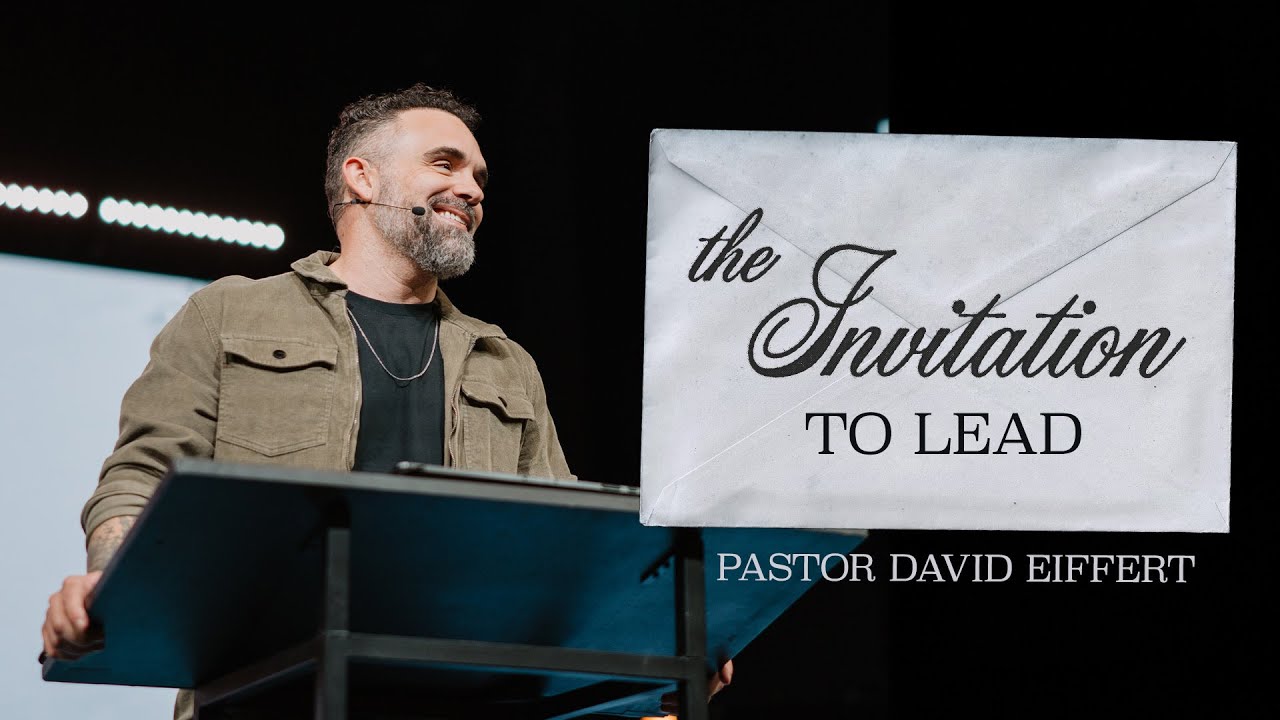
The Invitation To Lead
Scripture
From Gideon's call in Judges 6, a charge that every believer is invited to lead by using their influence on purpose. Walks through four common objections - I'm not a leader, I don't have a title, I'm not ready, I don't know where to start - and answers each with examples from David, Nehemiah, and Jesus.
Transcript
Judges Chapter Six
Judges chapter six, verse eleven. It says this pray for me that I get all these names right. Here we go.
The angel of the Lord came and sat down under the oak in Ophrah that belonged to Joash the Abizarite, where his son Gideon was threshing wheat in a wine press to keep it from the Midianites. When the angel of the Lord appeared to Gideon, he said, The Lord is with you, mighty warrior. Pardon me, my Lord, Gideon replied. But if the Lord is with us, why has all this happened to us? Where are all his wonders that our ancestors told us about? The Lord has abandoned us in the hand of Midian. The Lord turned to him and said, Go in the strength you have and save Israel out of Midian’s hand. Am I not sending you? Pardon me, my Lord, Gideon replied. But how can I save Israel? My clan is the weakest in Manasseh, and I am the least in my family. The Lord answered, I will be with you.
Can I get a good amen on that? So we are in week three of a series that I’ve entitled The Invitation. And the idea of the invitation is this is that God has invited you into a big life. We would say the abundant life. But like any invitation, you don’t receive the benefit of the invitation unless you say yes and actually show up.
The Invitation to Lead
And so if you’re taking notes this morning, what I’d like you to write down is this the invitation to lead. The invitation to lead. Heavenly Father, we’re so grateful for you this morning. We’re grateful for your amazing church. We’re grateful for your son, most of all, and we’re grateful for your word. We ask that you speak to us and help us to listen and to obey. And heavenly Father, I’m sorry for jinxing the Jacksonville Jaguars last week. That’s on me. That was my bad. In Jesus’ name we pray. Amen. Amen.
Okay, so Gideon. Somebody pointed out last week to me that the last time I mentioned the Jaguars, they lost like three games straight. So I’m over it. Now I wore the wrong socks, and they lost. There’s this amazing man in Judges chapter six that we just read about. His name is Gideon, and I want to set the scene so Israel, this is God’s chosen people, they’re in survival mode. These people known as the Midianites, they had been oppressing Israel for seven years.
Every time Israel would go and they would plant something to try to provide for themselves and the families, the Midianites would come and destroy it. And so they had people that were living in caves, and they were just trying to survive. And so there’s this man, Gideon, that we encounter, and he’s a man that’s hiding in a hole. He’s hiding in a hole, and God shows up and he says this, the Lord is with you, mighty warrior, which is a surprising thing to say to a man in a hole. You know what I mean? Non-sarcastically.
God Sees Gideon as a Leader
But the reality is this is that Gideon sees himself as a coward, but God sees Gideon as a leader. He sees himself as a coward, but God, when he looks at Gideon, he sees something different. But Gideon pushed back, he says, This well, if the Lord is with us, then why is all this bad stuff happening? Why is that? And also, God, while I’m at it, where are all these miracles that you are promising our ancestors? I don’t see any miracles. All I see is people starving.
And then he goes on and he says this, and how can I save Israel? He says, I’m from the weakest clan, and I’m the weakest person of my family. So he’s like coming up with every excuse in the book on why he’s not the man to lead Israel. And God simply responds with this. He says, I will be with you. Not, well, Gideon, you’re actually more qualified than you think. Or he didn’t say, Well, I wrote this little book, 12 laws of leadership that I thought maybe you could read. He just says, I will be with you.
Leadership is Not What You Think
And so what we’re reading when we read this is God is calling Gideon to become a leader. And Gideon responds the way I think that a lot of people do, and maybe what you’re even thinking about right now as I’m talking, which is this, I’m not a leader. I’m not a leader. But I want to encourage you and maybe push back on that, that leadership is not necessarily what you think.
And if you were to honestly look at like the world today and the nation today, if you’re to really think about it, I would say truthfully, that a whole lot, I’ll just say a whole lot. I was gonna say majority, but a lot of the problems that we’re facing today as a nation, as a world, if you zoom out and think about it, are either a failure in leadership or a lack of leadership.
Think about it, right? What do y’all think about what do you think about public education right now? The vast majority of you are gonna say, it’s terrible, it’s horrible, it’s not good. Okay, why? Because the kids are bad. The kid, okay. Well, that’s probably true that the kids are in fact bad. But that’s not why schools are bad. The reason schools are bad, if that’s what you think, is certainly coming down to either a failure in, and by that I mean bad, bad leadership or a failure in leadership.
God Appointed Leaders in Our Communities
And so I’m just thinking about the world. I’m thinking about our city, Albuquerque. And if you were to say, like, what do you think that we can do to like help make this place better? Well, I’ll say one of the things that we can do is to start to see ourselves as God appointed leaders in our communities. Come on. You’re not just someone who’s just there to raise a family. Like you’re not, you’re not there. There’s more, God has called you to be a representative of his kingdom. To be an ambassador of his kingdom, to be a builder of his kingdom.
And so long as we just like look at ourselves and think, well, I’m not a leader, I could never do anything like that. All I do is I just like to sit, you know, and watch TV. Like if you don’t see yourself as a leader, you’ll never lead, and you’ll never make the influence that I believe that God has called you to have influence over.
And so when people think about a leader, what they immediately think about that I want to push against is they think about titles. Right? Boss, CEO, supervisor, it’s like a corner office. That’s what we think about when you know what I mean. And so for you, when you think about like leadership, you’re like, why are you doing a leadership talk right now? I’m not a leader. That you just think that’s not me, but I want to give you a definition of leadership that I hope will include you and convince you that you are or at least can be and ought to be a leader.
Leadership: Using Your Influence on Purpose
Here’s the definition. Leadership. Using your influence on purpose. Using your influence on purpose. That’s it. And I want to tell you that you already have influence. Not me. Yeah, yeah, you. Your kids are already watching you. Sir. Ma’am, your kids are watching you. Your co-workers are watching you. Your friends are watching you. You might be in here and you’re like, I’m 15. Okay, well, there’s 11 year olds that are watching you. Your siblings are watching you.
And so the question is not whether or not you’re a leader. The question is whether you are leading on purpose or by accident. That’s right. Because you do influence. Every single one of you. Husbands, I know like being a husband’s pretty hard. Being a dad’s pretty hard. I’m sure I would assume being a mom and wife is also hard. But being a dad is for sure hard. Being a husband is for sure hard.
But so far as you just pull away and say, nobody wants to hear what I even think. You know what I mean? And you just become, you become nothing, you give away your God-given place to be a leader. And that doesn’t always mean you’re in charge, but it means you’re using your influence on purpose, with purpose. It’s like I’m part of this family, and so it becomes what? Right? I’m a part of this church, so what? What is the imprint that I’m gonna bring when I’m here? Because I’m here, my kids are more what? Because I’m here, my wife is more what? Because I’m a part of this marriage, my husband is more what? That’s your influence.
Reluctant Leaders are Often the Best Leaders
That you can be a leader no matter where you are. And again, I’m just wanting to fight this morning the inclination for you to think that doesn’t apply to me because I’m not a leader. We come up with all these reasons, and I’ve got four objections for you this morning that I’d like for you to write down. You might be thinking three? No, I’m branching out, Pastor Marshall. Four. So buckle up. Here’s the objections.
Number one, I already said it, it’s the big one is this. I’m not a leader. I’m not a leader. Here’s the truth. Are you ready? Reluctant leaders are often the best leaders. Reluctant leader. Why? Why? Because they’re not in it for the spotlight. Leaders who are always wanting the spotlight are very suspicious. But a reluctant leader, you know, someone who’s doing it, they’re taking it serious, they’re not in it, chasing the title, they’re not trying to prove something.
And you might be thinking, well, David, that’s just like your opinion about what kind of personality you like. Actually, not. You see this over and over in scripture. Think about the people that God uses. There’s this guy, Moses. I don’t know any of y’all heard of Moses, but you know, when God first came to him, he says, like, I don’t speak so well. Can you send somebody else? He literally says, Can you please send somebody else?
There’s this man Jeremiah. God calls him to be a prophet. You know what Jeremiah says? I’m too young. He literally says that to God. God, I’m too young. There’s this man Gideon, I’m the least in my family. Jonah. What happened to that guy? Why? Because he was running from his calling. He didn’t want to lead. He didn’t want to be a leader and became fish food. Why? Because he was running from it.
But all of these excuses, then so I just want you to know that that God often uses people that aren’t campaigning for a job. And then probably the best example of this in the entire Bible, in my opinion, is the man I was named after, and that’s David. And so David, if you know this scene, it’s an incredibly important scene in scripture. But this prophet Samuel, he shows up to anoint the next king.
And so David’s dad, his name is Jesse. He has all these sons, and so he starts parading his sons out one by one. I don’t know why. I always think of like Cinderella here, you know, like them all trying the glass slipper on and flying off their foot. But they’re all like trying to impress the, you know, oh, look, look how muscly this one is. Look how tall this one. Wow, look at this guy’s so handsome.
And meanwhile, there’s this son named David, not even there. The father didn’t even think to bring him. Where was he? He was in the field tending his father’s sheep. And what I love about that is that David becomes king, but he was not auditioning to become king. He had zero ambition to become king. He was just faithfully doing what was in front of him. Just faithfully doing. And even when people didn’t see him, God saw him.
The Lord Looks at the Heart
Look at this for 1 Samuel chapter 16, verse 7.
The Lord does not look at the things people look at. People look at the outward appearance, but the Lord looks at the heart.
And that’s a great general principle. But he thought this is specifically about David, right? That he’s not outwardly impressive, even though we know he was a good looking guy. He wasn’t outwardly impressive the way his brothers were, but God doesn’t look at that, God looks at the heart. See, God’s criteria is different than ours.
You know what I’m saying? That, like we look at, you know, we’re, you know, put a job, job application out. Like, who are we gonna hire? Well, who has the most charisma? Who’s the funniest? I love funny people, right? Who are handsome? Who has the best hairline? You know what I mean? Like, like we’re looking at outside external stuff, but God looks at the heart.
And it almost seems to me like God prefers, this is my opinion, that I hope you’ll agree with. It’s almost like God in scripture prefers to use the overlooked. He just wants to. He just likes to work with underestimated people. People who aren’t trying to climb the ladder. And I just want you to know that it doesn’t matter if God, if nobody sees you, God sees you. And God’s not looking at outward appearance. Who has the title? Who looks the most impressive? He’s looking at the heart.
And I want you to know, unseen does not mean unimportant. Unseen does not mean unimportant. Just because nobody’s noticing, it doesn’t mean that God’s not using you, and it doesn’t mean that God’s not preparing you. And later in scripture, we see the story progresses, and now we have David, he’s getting a recommendation to King Saul. And look at this first Samuel chapter 16, verse 18.
I have seen a son of Jesse who is skillful in playing, a mighty man of valor, a man of war, prudent in speech, a man of good presence, and the Lord is with him.
So listen to that resume, right? He’s skillful, he’s courageous, he’s wise, and best of all, the Lord is with him. That’s a reputation. Listen to me. That’s a reputation that David built as a shepherd, as a nobody. He didn’t have a title yet. He wasn’t a soldier. He wasn’t a commander. He was a shepherd.
Leadership is an Action, Not a Title
And so I want you to hear this. I want you to hear this, young people, that his reputation existed before his position did. His reputation existed before his position. And so David, like Gideon, like Moses, like Jeremiah, he’s a reluctant leader. Right? So he’s not taking himself out, oh, I’m not a leader. Just understand that the more you say I’m not a leader, the more God wants to use you to be a leader. That’s just how he does it.
And so, so number one, I’m not a leader. Number two is this. Here’s an objection for leadership. I don’t have a title. Darn, I don’t have a title. Truth is this leadership is an action, not a title. Leadership is an action, not a title. See, a lot of people think like, well, I don’t have a title, I’m not a leader. I’m not, I’m not in charge. I can’t be a leader. But leadership is not a position you sit in, it’s an action that you take.
And I’ll just tell you this like as someone who’s in charge a little bit. I’m not ultimately in charge, but I’m in charge of my own little arena. You know, I got staff, I got people, there’s you know, volunteers, there’s people who are wanting all this. Just understand this that for me, as an employer and as a pastor, people who are always chasing titles are a red flag to me. Just know that, know that. Because why? Because if you can’t lead without a title, you can’t lead with one. You can’t.
Trust me. As someone, I’ve been doing this, I’ve been doing the believer center thing for 43 years, my entire life. You know how I started? As a baby. But as an attender. I started I started this church. I’ve just I was just an attender for I don’t know, 15 years, something like that. And then I became a volunteer. What were you doing? I was running sound, and then I learned how to play guitar. My mom was giving me guitar lessons, and so then I was on worship team, and then I was on the serve team in youth, and then and then I got hired on.
It was so exciting as a part-time web developer. Because I could do websites. That was that was that was that was my thing. And then I eventually got hired on full-time as a youth, it wasn’t pastor, it was youth youth team lead. That was my first full-time job here at the church, youth team lead, and then eventually youth pastor, and then eventually executive pastor, and now as lead pastor. So I’m just I’m telling you, I’ve I’ve I’ve led with and without titles.
And so I want you to know that if you can’t lead without a title, you can’t lead with one. That’s that it the title is not the thing that makes the difference. Why? Because people don’t even know your title, and they don’t even care. And I understand there’s like certain positions and stuff that like a title is important, I get that, but for the vast majority of the people, they follow the leader, not the person with the title. And that’s not always the same person.
So leadership is not just about having a title, and I think that for a lot of people, young people maybe in particular, is that they feel they spend so much time chasing the title, they wouldn’t even know what they would do if they got it. It’s like a, I like to joke, it’s like a dog chasing a car. You ever seen a dog chasing a car? It’s like, what would he do if he even got the thing? You mean like just slam into the back? He hadn’t even thought that far. All he’s thinking about is chasing the title.
And that’s how it is with leader. It’s like, okay, yeah, you got the office. You got the position. You got you got the title, and you’ve got no idea what to do with it. Because you were so concerned with chasing the title that you were chasing instead of preparing. And so like this is, I think this is a word for somebody. Maybe it’s a young person, maybe it’s not. Like instead of being a person that chases a title, become a person who is prepared enough to wear the title well.
Right? So like you want to be a pastor. Okay, don’t spend your time trying to become a pastor. Take your time to prepare yourself so that when you actually might become a pastor, you might actually have something to say. He might actually be able to lead people well. Leadership is not a title. Leadership is about serving people. That’s what it’s about.
Private Battles Prepare You for Public Battles
Even if you think about Nehemiah, he’s this guy. Like, so when Nehemiah, if you know his story, when he was called to rebuild the walls of Jerusalem, he didn’t have a title. You know what his title was? Cupbearer. He brought the drinks. He brought the drinks to the king, but he goes to Jerusalem, and you know what he does? He just starts leading. He just he just starts, he starts doing something. He didn’t have a title, but he just gathers people around a vision, and eventually he becomes the governor.
And what’s so cool about Nehemiah is that is that he’s still a servant, even when he’s the governor. Because when you have the right attitude, a title doesn’t change you. It’s it like like for me, you know, I have become, we finished our transition last year, and so my wife and I became, I guess it was a year, 15 or 16 months now, it’s been. And so if someone were to come to me and say, like, Pastor David, ever since you became a lead pastor, you’re like, you’ve changed. You’re totally different. Maybe they would mean that as a compliment. That’s not a compliment.
Here’s my point. You don’t get caught up in the whole, I don’t have a title, I can’t change anything, I don’t have a role, I don’t have a position, like, like, and so I so I can’t lead. No, leaders are initiators. That’s what I talk about to our staff all the time. Someone that is a leader is someone who can initiate, who can see something that needs to happen, and just does it. But you have to be willing to put in work that wasn’t asked of you.
I don’t know if you’ve heard this, there’s this new thing going around that I learned about recently called quiet quitting. Y’all familiar with this? Hashtag quiet quitting. Some of the older folks are in here, they’re like, I got no idea what that means. The young people they know. Here’s what it means: it means it means you quit your job, but you don’t actually quit your job. You just start doing the bare minimum of your job. That you just you just show up, you but you don’t stay late, you don’t do any extra work, you don’t take any initiative.
And they talk about quiet quitting like it’s a good thing, like it’s somehow it promotes work-life balance, blah, blah, blah. And I just want you to know, as one of your pastors, that’s not who we are. Here that’s not the spirit of a Christ follower. It’s not the Jesus way, the Jesus’ way is different. Jesus said this. If someone forces you to go one mile, go two. Right? Do more than expected. Give your best, even when nobody’s watching.
Look at this, John chapter 13. We see this in Jesus’ life.
Jesus knew that the Father had put all things under his power. So he got so what did he do? Oh my gosh, I’m the boss. Jesus, I’m the boss. Like in a cosmic sense, I’m the boss. So he got up from the meal, took off his outer clothing, wrapped a towel around his waist and began to wash the disciples’ feet.
Isn’t that amazing? That Jesus knew that all things were under his power, but nothing was beneath him. Come on. That’s right. You hear that? All things were under his power, but nothing is beneath him. So I just want to encourage you. We want to encourage you. Man, pick up a towel. It’s like, man, I want to do something cool. Like, pick up a towel. CEO, pick up a towel. Serve. Stay at home mom, pick up a towel. Student, pick up a towel.
This is something you can write down, and I’ll move on to my next point. If you’re too big to serve, you’re too small to lead. If you’re too big to serve, you’re too small to lead. Objections. Number one, I’m not a leader. Number two, I don’t have a title. Number three, I’m not ready. I’m not ready. Here, well, let me tell you how you get ready. Here’s the truth. Private battles prepare you for public battles. Private battles prepare you for public battles.
So you think about David. This guy, he’s a he’s a kid, right? So how did David, the shepherd, become this fearless man who could stand in front of a nine foot giant and like talk trash? Well, well, how did he do that? Well, he didn’t he didn’t train for Goliath in a gym. As much as I like gyms. He didn’t do that. He didn’t he didn’t go to giant slaying school. No, he he developed his character when he was doing what? When he was fighting lions and bears when no one was watching, no one was applauding.
And so for David, the shepherd field became the proving ground, preparing him for the battlefield. The shepherd field was the proving ground. And he look at what he says, he says when he’s talking to the king. First Samuel 17, 34.
Your servant has been keeping his father’s sheep. When a lion or bear came and carried off a sheep from the flock, I went after it, struck it, and rescued the sheep from its mouth. The Lord who rescued me from the paw of the lion and the paw of the bear will rescue me from the hand of this Philistine.
So King David, when he was about to do the scariest thing that he had ever done, what he did is he he pictured the things that he had already seen God do. And he drew courage from for his present battle by looking at his past victories. And no one saw the victories, no one was watching when he killed the lion, no one clapped when he killed the bear. But but God was using that time to form him and to prepare him.
And scripture says this it says, do not despise the day of small beginnings. Hear me. Don’t allow yourself to be too big to do something small. Because because testing always precedes promotion. Always, and some of y’all are stuck in a season, and you’re thinking, I can’t believe this season is taking so long. Listen, just because it’s taking longer than you think doesn’t mean it’s taking longer than it needs to. The delay, a lot of times, is for your development.
And there’s some things that God wants to give you that would crush you before you’re ready. And so, and so the space is for your benefit. And so, what do you do in the waiting? Well, you fight the lion. You fight the bear, you stay faithful in the small things. You develop your character when nobody’s watching. And so when your moment comes, you’ll be ready. When your moment comes, you’ll be ready.
Take Ownership of a Problem You Didn’t Create
Number one, I’m not a leader. Number two, I don’t have a title. Three, I’m not ready. Number four, lastly, I don’t know where to start. So maybe you’re thinking, like, okay, Pat, I’m in, I’m in. Okay, okay, let’s do a leadership thing. I don’t know what to do. Do I just go to my house? Do I start bossing around my dog? So like I just start bossing around my wife. Like what? Like, what is what is leadership do? Okay, so I’m gonna. That was a bad, that was an extra bad idea, that second one. You can do the dog.
Here’s where you start in leadership. Are you ready? Take ownership of a problem you didn’t create. Take ownership of a problem you didn’t create. So maybe like you would look in Albuquerque, I don’t know if you see the same city that I see, but there’s plenty of things to fix. And none of them are my fault. I didn’t, I didn’t do I didn’t do any of this, but I do know that for me to be a leader, I can see a problem and I can fix it even though it wasn’t my fault. I didn’t, I didn’t build it, I didn’t do it, I didn’t mess it up. It wasn’t my bad. But I’m gonna take ownership of it to make it better.
The perfect example of this again is Nehemiah. He’s a cupbearer for the king of Persia. So it’s a good job. He’s got he’s got a he’s got a comfortable life, but then he gets the news that the walls of Jericho or excuse me, Jerusalem have been broken down and the gates had been burned down. And so Nehemiah, just know this, he didn’t break the walls. He didn’t he didn’t burn the gates. He wasn’t even there when it happened. But when he heard about it, you know what he did? He sat down and he wept.
So he wept over walls he didn’t break. That it was something that he saw that was wrong, and he thought, well, maybe someone should do something about that. And he did something, and that was the beginning of God using him. There’s a lot of people, a lot of people like will look at a problem and they’ll say, somebody ought to do something about that. Pastor Shirley, somebody ought to do something about that. I’ve told you this before, but like if you ever see a problem and you think to yourself, somebody ought to do something about that, the odds are exceptionally high that that person is you.
So if you say, so every some sometimes like I’ll say, I’ll be like, man, someone should do something about it, and then the Lord will be like, oh, dang it. Because because if I’m noticing it and I’m thinking someone should do something, maybe it could be me. There’s this pastor Danny Green, he’s a great friend of the church, but he years ago he was invited, he was a pastor of a church. He was invited to speak at a little church in the town that he lived in.
And so he showed up to this little church and he noticed, he’s like, Man, this place is a disaster. He says it’s like the grass wasn’t mowed, there’s all kinds of weeds everywhere, the curbs all chipped up and not painted. And so he went and preached, you know, and then it was as he was leaving, he like looked back and he said, like, man, someone ought to do something about that. And then in that moment, the Holy Spirit was like, Oh, dang it.
So Danny Green pastor’s a big church. But what he did is he got some tools together, he got some people together, and then he showed up at this church and he mowed their lawn. He pulled their weeds, he painted their curve. Why he’s not just noticing what’s wrong, anyone can do that. Well, oh boy, this city, oh, yeah, yeah, yeah, yeah. It’s not hard to just notice when something’s wrong. But what a leader does is see something that’s wrong. He’s not waiting for someone to ask you to do it, but just doing it, seeing a need and meeting it.
So even maybe like this is this is way more than just about church, but you can think about church. So think about church, like maybe you show up and you’re like, man, there’s a lot of weeds over here. Someone ought to pull them right on. You know, we’re open Monday through Thursday. 8:30, 4:30. Love to have. But that’s what leadership is. If you if you want to be a leader, you know what you need to do. You need to see a need and fix it. It starts by looking around. What’s broken that I can fix?
You know, you know what I mean? Like, guys are great at this at their own house. You know what I mean? They’re just walking around with WD 40 looking for something to spray. It’s like, why don’t you walk around with WD 40 in the city? See something that needs fixing and just fix it. Walk around with WD 40 at your church. Man, this place needs this. You know, Preston, stop using you, you’re sitting too close. I’ll keep using you as examples.
But Preston, you know, a couple years ago, he’s like, Man, I we we need a men’s small group, and we didn’t have small groups at that point. So you know what he did? Well, he pouted about it and he complained about it, and no, you know what he did? He started a group. Men of purpose. And now years later, he’s even passed it on because now he’s doing recovery. But it was just it was just a need that he saw and he just filled it.
He didn’t go go to lunch and say, Man, I can’t believe I might go to another church because I really need a men’s group, but he didn’t do any of that. He just saw a need and filled it, but you just have to care enough to do something about it, and you know, I’m done. But as you think about church, so of course, there’s a lot of metaphors and illustrations when it comes to church and what we do here. One of the things that we talk about when we come to church, we talk about getting fed. Anyone familiar with that phrase? Getting fed, right?
So you come to the church, you get fed. I get emails, people go to a different church because they’re not getting fed. So it’s like, okay, getting fed, and it’s it’s a great metaphor, right? Because because you come here and you receive spiritual food. It’s a great metaphor, but but I want you to know this you can only sit at the dinner table so long. Eventually, God requires you to use all that great food energy that you got from eating all that great food to go and be a blessing to somebody else.
And some of y’all have been sitting at the table for years, learning, growing, preparing, and that’s great. But eventually, dinner’s over. And at some point, you gotta get up and you gotta serve. And that’s not limited to church, but it certainly is true for the church. And so I think I would ask you like, yeah, if you’ve been coming here for like lots of years and you don’t serve or give back in any meaningful way, I guess the question would be why because you’re not just here to be a consumer. If you’re new, man, I’m glad just come come and eat. You know, come and receive, come and get healing. But at some point, like if you really want to do the Jesus thing, you also gotta lead.