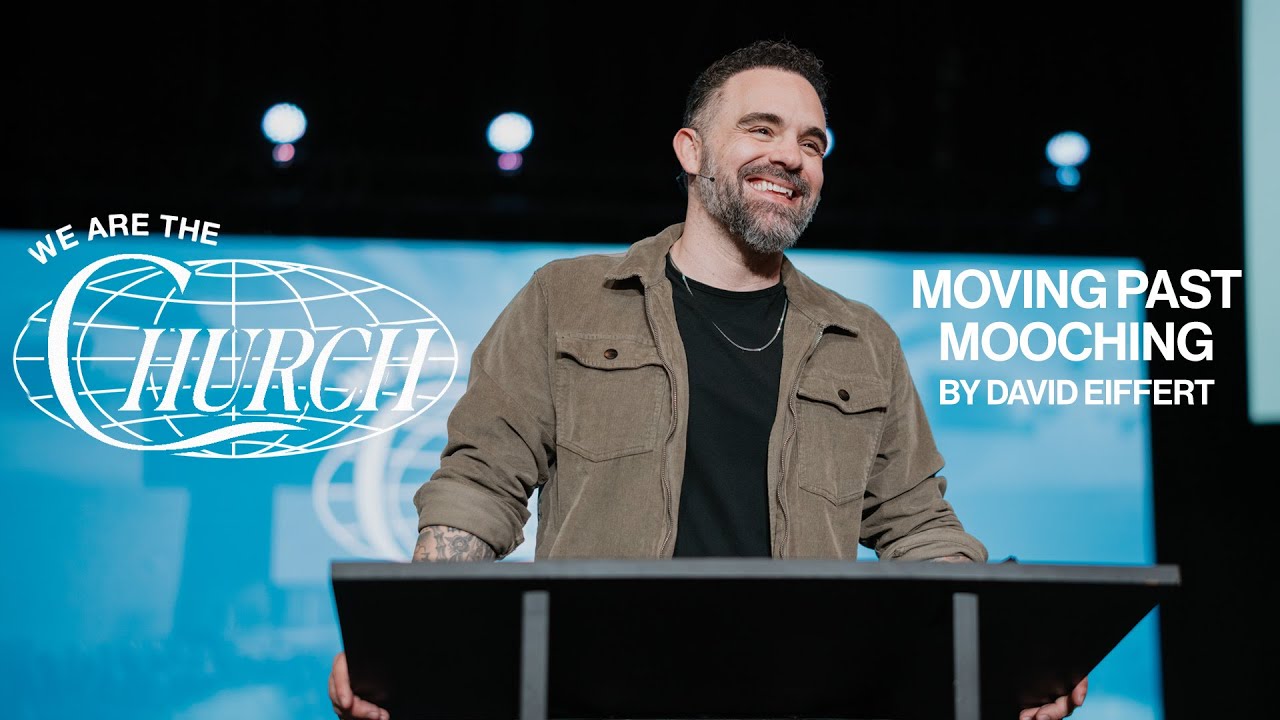
We Are The Church: Moving Past Mooching
Scripture
A practical call for church members to move from consumer 'mooching' Christianity into contributing family membership, walking through six responsibilities: praying for the church, attending faithfully, giving consistently, volunteering regularly, inviting others, and championing the church by speaking well of it and building unity.
Transcript
Okay, so we are in week number two. There was a lot of handouts to do. Thanks you guys. You guys are working really hard. We’re in week two of a series that I have entitled, We Are the Church. In fact, can you say that phrase with me? We are the church. And last week, just by way of review, we kicked off the series talking about what the church is and what the church is not.
The church is not a place, the church is a people
The three points, just to hit them real quick, for review, we said this the church is not a place, the church is a people. And so when we say church, a lot of times people will think a building or maybe an address. But the truth is that the church is not somewhere you go, nor is it something that you are individually, but the church is who we are together. And then we also talked about how the church is not perfect. And you might think that’s bad news, but that’s good news because that’s what lets you be in it. Right? The church, we’ve said this, the church is imperfect people, imperfectly following a perfect God. His part is perfect, our part is never perfect.
Something that you can see throughout scripture over and over and over is something doesn’t have to be perfect to be of God. Are you there? Right? There is no perfect sermon. There has never been a perfect sermon. If there was ever a perfect sermon, Pastor Marshall would have probably preached it. It’s as close as he can. But there’s no perfect sermon, but God can still use imperfect sermons perfectly to spread the gospel. That’s how the church is. The church is not a perfect group of people, but God’s able to use it to accomplish his will because he’s a perfect God.
Number three is we said that God has great affection for his church. We read that Paul says that the church is not peripheral, peripheral to the world to the world. The world is peripheral to the church. What’s what does that mean? It means that the center of God’s work is not the world, it’s the church. And the center of God’s focus is not the world, but it’s the church. And so if you missed any of that, I invite you to go online. Of course, you can go on YouTube or whatever, and you can catch up with whatever you missed.
The church is a brand new concept
First Timothy chapter three, just a little context. So in the first century, that’s where we are in scripture here in the first century, the idea of the church, the church of Jesus Christ. Well, that’s a that’s a brand new concept. Right? For you, y’all probably grew up in church like I did, and so you know what church is supposed to be, what church is supposed to look like. Oh, we’ve got, sir, and then someone’s gonna do the announcements, and then there’s gonna be a sermon, and then they’re gonna do all like they don’t know what any of that is yet because the church is a brand new concept. There’s no blueprint, there’s no manual. You know, they couldn’t just like search YouTube on, you know, how to plant a great church, like they couldn’t do it. It was a totally new thing.
And what’s interesting about the church is the people that were forming the church that were called to come together, they were super diverse, different backgrounds, different cultures, different traditions. And now all of a sudden, these people are supposed to come together and do life together as God’s people. And these people, I mean, they had the fire, right? They had passion, they had enthusiasm, but clarity on what the church is supposed to be, not so much. And so a number of the New Testament writers, well, they write these letters, you know, people like Paul, people like Timothy, people like James, they write these letters to help the early church know what church is supposed to be like. And so they say things that are like really practical that we kind of take for granted, you know, how we’re supposed to treat each other, they talk about. How what worship looks like. Yes, there’s supposed to be a leader, stuff like that like they talk about all these really practical things, because how we form is not just instructed by passion, it’s also instructed by wisdom. That as we form and as we and as we consider what it’s like to be a church, what it’s like to be a growing church, we have to consider with wisdom what it means for us to be not just observers, not just beneficiaries of the church, but members of the church. And so there’s a lot in the New Testament that talks about exactly what that is.
So 1 Timothy chapter 3, verse 14. This is Paul. He’s talking to his young protege named Timothy. He says this, although I hope to come to you soon, I am writing you these instructions so that if I’m delayed.
although I hope to come to you soon, I am writing you these instructions so that if I’m delayed… so that you will know how people ought to conduct themselves in God’s household, which is the church of the living God, the pillar and foundation of the truth.
So he’s saying, I’m writing this letter. Why are you writing the letter? So that you will know how people ought to conduct themselves in God’s household, which is the church of the living God, the pillar and foundation of the truth.
Now, if you turn with me to Ephesians chapter 2, Ephesians chapter 2, here Paul switches. He switches from talking to his protege, Timothy, to the young church in Ephesus. Ephesus, if you don’t know in the first century, is a huge deal. It’s one of the most influential cities in the Roman Empire. And so Paul is talking to a young church on how they’re supposed to be the church. Verse 19, he says this:
consequently, you are no longer foreigners and strangers, but fellow citizens with God’s people, and also members of his household, built on the foundation of the apostles and prophets, with Christ Jesus Himself as the chief cornerstone.
He’s saying the church is built not on any pastor, not on any leader, certainly not on any building. The church of Jesus Christ is built on Christ Himself. Verse 21,
in him the whole building is joined together and rises to become a holy temple in the Lord.
And then listen to this, verse 22.
And in him, you two are being built together to become a dwelling in which God lives by his spirit.
He’s talking to church members, in him, you two are being built together to become a dwelling in which God lives by his spirit. Isn’t that interesting? Here, it’s amazing. Paul here, he says that we’re being built together. And when we do that, we’re being built to become a dwelling place for God Himself. It’s amazing. And so while it’s true that God lives in us as believers individually, it’s also true that when we come together, we build something that God himself lives in.
And that’s why, that’s why the enemy works so hard in the area of division. Because when we’re divided, it’s like we’re tearing down the house that God is trying to live in. Think about this way. I am terrible with building stuff. Nails, saws, some of my thing. But just imagine. Imagine you’re building a house, and someone is coming behind you and pulling out the nails that you just put in. And that that’s what division in the church does. That’s why the enemy works so hard to divide us. Because he knows, listen to me, he knows that there’s something powerful when we’re not just followers of Christ individually, but that we’re collectively followers of Christ as a community. That there’s something unique. And there’s this synergistic thing that happens in scripture that one of us can do so much, but two of us can’t just do twice, but we could do ten times. And so there’s something that can never be replaced by us coming together, not just following God as people individually, but following God as a family.
And I don’t know if you notice, but it’s a process. Notice that Paul says that we’re being built. We’re being, not that we have been built, so it’s ongoing, right? Because God’s not finished with us yet. He’s not finished with me, He’s not finished with you. He’s actively shaping us and fitting us together and making us into something beautiful and holy. And it’s a process. And so for us to do that well, we don’t just need passion, we don’t just need enthusiasm, but we need clarity on what it means to be the church. And like, and we can’t, let me tell you this: we can’t look at worldly organizations to show us how we’re supposed to be the church. Because the church is in the world, but the church is not of the world. Right? And so that like the lessons on being the church isn’t going to be learned from the world. It’s gonna be from Jesus and the people that Jesus had commissioned to show us how to be. Right? And so it’s like if we’re thinking, how ought we be the church? Like you can read leadership stuff, we can learn like team building stuff. That’s all cool, that’s all helpful. But at the end of the day, there are unique particularities of being the church that we’re only gonna learn through scripture. Right? And it’s and so that’s why it’s so important that for me, for Pastor Jordan, for Pastor Marshall, for Pastor Cindy, that we have an intimate relationship with this book. Because without this book, we don’t know what we’re doing. Right? Without this book, I’m a politician. You know, I’m a motivational, I’m Tony Robbins up here. The thing that separates the church that makes us unique is how this book teaches us how to form and how to function.
You’re not foreigners, but you’re citizens
And notice that the first thing that Paul says is that we’re not foreigners, but we’re citizens. We’re not foreigners, but we’re citizens. What does he mean? Well, being a citizen means you belong. And I’m not making a political point here. If y’all think stop it. Think someone higher. To be a citizen means you belong. And Paul’s point to these early Christians is that, hey, y’all are part of the church, and you’re not just visitors. You’re part of God’s family. And you share, now listen to me, you share the rights and the responsibilities that come with being members.
Because how many people know like that when you become a part of a family, when you’re in a family, there’s certain rights that you have. Like you don’t have to knock when you enter the front door. When me and Jordan go to Marshall and Cindy’s up, we don’t knock. When you go to my folks up, we don’t knock. Just come in. Because we’re family. Because that’s our right as family. Like we know where mom keeps the good snacks. That’s our right. We have a right to those snacks. She hides them from Marshall, but she’s got to tell us. You know, like you go, like I put my feet up on the coffee table at my parents’ house. I don’t do that at your house, but I do that at their house because it’s family. I belong there. But now listen, like now I’m thinking me and Jordan here. Like, it’s nice, but but when you’re family, you have all the privileges of the family. But when you’re family, like if the dog poops on the rug, you clean it up. Right? Right? Why? Because you’re not a guest. You’re not a guest here. You know what I mean? Like you’re part of the family. And so you share, as part of the family, you share both the rights, both the privileges and the responsibilities. It’s not one or the other. It’s both.
That being a part of the church is something that is a great privilege. And there are so many blessings that come along with it. But there are also, hear me now, responsibilities that also come with it. Right? Like some of y’all have family members that want the rights of the family, but don’t want to share in any of the responsibility. I believe they’re called teenagers. Right, they want the privileges of being in the family, but they don’t want any of the responsibility of being in the family. And listen to me, that’s fine when you’re seven. Right? But when you’re 27, if you want access to the rights of the family, well then you have to share in the responsibilities of the family. You know, and I was a teenager. If there were people who wanted the privileges of something and they didn’t want any of the responsibility, we had a word for them. Are you ready? A mooch. There are mooch. I don’t even know if that’s politically correct. It’s probably not. It’s probably offensive. We’d call them a mooch, right? And so someone would be like, hey, well, they wouldn’t say Pastor David, hey, you know, give me a bite of your hamburger and be like, quit mooching. Like, will you mooch it? And they’d be like, give me, give me, give me a bite of your sandwich. It’s like, why am I the only one paying for food that we both eat? But we call them a mooch. It’s like, man, you’re a mooch.
And I gotta tell you, like, I don’t know if I don’t want this to get uncomfortable, but churches have lots of mooches. Like, is that okay if I talk real? People that got no problem with me giving up my Friday and my Saturday away from my family so that I can prepare the sermon so that they don’t have to study, right? So that I just I can spoon feed them a message, they got no problem with that. They got no problem with with Dov and all these worship, you know, all these volunteers. It’s a room fit of stage full of volunteers. You got no problem with them spending their week learning all these parts so they can lead us in worship. You ain’t got no problem with that, right? Like they got no problem coming in here to receive the rights of this family, communal worship, spood-fed word of God, right? And like when they’re in crisis, they got no problem calling us at 3 a.m. so that we can do whatever we gotta do to come and help them. And it’s a privilege. Like we love it. That’s not what I’m saying. I’m not, I’m honored to do all of that, but don’t misunderstand me. But here’s what I’m saying is that some people love the rights of the body of Christ and don’t want to share in the responsibility. Right? And so, and so if we want to be a healthy and growing church family, well, then we gotta shift our mindset. We gotta shift our mindset from being consumers to being contributors. We got to stop asking, like, what’s the minimum I have to do here? Right? And you start asking, how can I be a part of what God’s building here? Right? Because this isn’t just, I’m not just a guest at a concert. I’m a member of a family.
You know, foundational, a foundational teaching in the Christian life. You if you hear Mark, if you hear any of us for any amount of time, you’ll hear us talking about identity. That’s foundational to Christianity, how you see yourself, and how God comes and offers you a new identity. But did you know that God doesn’t just give you an individual identity, He also comes and gives us a collective identity? And so the goal of this brief series is to help you maybe take seriously both the privilege and the responsibility of being the church.
Can I tell you something Taylor Swift taught me? Haters are gonna hate. Like that’s gonna happen. The church is always gonna have to be, is always gonna have haters. We’re gonna always have to like hear haters. That’s just the reality of, but that’s not who we are. Right? Like, and you might think, well, I don’t know, Pastor David, the church isn’t perfect. Yeah, well, no kidding, neither is your mom. Well, some of y’all are like, don’t talk about my mom. Your mom’s not perfect, right? But you still defend her, we still honor her. You still speak well of her. If someone asks you about your mom, you don’t start with her flaws. You start with what’s beautiful and good. And that’s how it should be with the church. Because the church is not just an organization that you’re part of, it’s who we are collectively together. What’s wrong is always available. So is what’s right. And the church, in spite of all of its imperfections, is still what God has chosen to use to reach the world.
Moving past mooching
And so if you have your hand out, let’s get into it. Again, you should have some fill-ins. If it’s underlined on the screen, it’s a fill-in on your paper. Okay, so your first one, it’s the title of the message this morning, and it’s this first fill-in. Moving past mooching. Moving past mooch. Like, again, if you’re new to a family, like you’re like you’re a baby and you just came back from the hospital, you’re one day old, you can be a mooch. That’s fine. Right? Like, like you contribute nothing but noise and expense. And that’s totally fine. But the goal of a healthy parent, just like the goal of a healthy pastor is to help you develop at the right pace, develop from a mooch to a contributing family member. That’s the goal of healthy parenting. Also, it’s the goal of healthy pastoring. Right? That it’s like, yeah, I know that we used to clean up all your trash, but now you can clean up your own room. You know, I know I used to mow the lawn, but now you know what? You mow the lawn. Because you can’t just mooch off the family forever. As you grow, young person, you have to be a contributing family member, not just a mooch. The same is true with the church.
So, like, if this is your first time here, this was my concern with this message. I didn’t want you to think like I’m just calling you. Like, if this is your first time here, just come and receive. Fantastic. You are a guest. You’re our guest. And we and you ain’t gotta, you know, the offering. Just don’t worry about it, right? Like you’re a guest, we just want you to come and receive. But the goal, if you’ve been coming to this church for any amount of time is to grow from the mooch status to a contributing family member status. You might be thinking, well, why does that even matter? Because if the member to mooch ratio is off, the church doesn’t grow. The church doesn’t advance. We’re not fruitful. We don’t accomplish our purpose. And so, so I know that there’s a number of people because you talk to me after service, you know, we just got through this transition, and you know, it’s going good and it’s exciting and it’s a new year, and we’re having good, and you’re just thinking, like, past let’s do this. Y’all, let’s do this. I don’t know if anybody’s feeling like let’s just do this. Let’s do the thing. Let’s grow the thing. You know what I mean? Let’s let’s do something that matters in this city. If that’s you, this sermon is for you. Because these are the things that we’re wanting you to contribute to. Moving past the mooch status to a contributing member of the church.
Pray for the church
So here we go. Number one, you got it on your notes, pray for the church. Listen to this. Every major move of God starts with prayer. Every move of God starts with prayer. How does that play out? Here’s your next fill-in. Pray for church leadership. Pray for church leadership. Ephesians chapter 6, verse 19, Paul says this,
pray also for me, that whenever I speak, words may be given me so that I will fearlessly make known the mystery of the gospel.
So Paul is saying, in all of your praying, church, pray for me as one of the leaders. Pray for me. You know, playing golf, right? That like that’s not what being a pastor. Being a pastor is about seeking God’s wisdom and direction for what he has called us to do. Right? So, like, we have the work of here’s what the church is, and we believe that God has called us to be a church for this city. So, what do we do about that? That’s what the pastors have to, and so that’s why that’s why we are studying scripture. That’s why we have to pray. If a pastor doesn’t pray, they got no business being a pastor. Because a pastor is someone who lives their life in a way that we can understand what’s happening between God and man. You know, so prayer is not optional for the church. It’s central. And that includes certainly our prayers, but it’s also prayers that you pray for us. It’s like an Exodus. I don’t know if you remember the story, but Moses was in battle and he needed his hands held up, and these people came and held his hands up. So, like me and Jordan, Marshall, Cindy, the rest of the leadership, like we know that your prayers are one of the things that hold us up. Holds us up. And so like Bobette, every time, just about every time I see Miss Bobette, she says, I pray for you guys every day. And you know what I tell her? Oh, we need it. Because we do. So pray for church leadership.
Continuing on, pray for church fruitfulness. Pray for church fruitfulness. First Corinthians chapter 3 and verse 6. Paul says this,
I planted the seed, Apollos waters it, but God has been making it grow.
See, church growth is something that we participate in, but it’s not something that we’re ultimately responsible for. Because we plant seeds, we water seeds, but then we trust that it’s God who comes and makes things grow. And church fruitfulness, just understand, it’s not just about numbers. Church fruitfulness is about real people and real lives being changed, real people finding hope, real families being restored. It’s like, think about like this. Every person that walks through these doors has a story. Some of them are carrying wounds, some of them are searching, some of them are from running from something. Hopefully, not the police. And when and when you’re praying for fruitfulness, you’re not praying that we would have impressive crowd shots on Instagram. Right? What you’re praying for is that God’s redemptive power would come and meet people where they’re at. And I believe this that when the church functions the way that it’s supposed to function, God brings promotion. Right? So we’re gonna do what we know to do in this season of the church. And we believe that God is bringing about fruitfulness. And so it’s something that we share in that responsibility, but it’s ultimately up to Him. So that’s why we pray for fruitfulness.
Next, pray for church unity. Pray for church unity. Ephesians chapter 4, verse 3, Paul says this.
Make every effort to keep the unity of the Spirit through the bond of peace.
Unity doesn’t just happen. Unity is fought for. Pray for church unity. That’s number one. Pray for the church.
Attend faithfully
Number two, attend faithfully. Attend faithfully. How does this play out? Well, this is your next fill-in. Come to service consistently. And all the pastors in the room said, Amen. Come to serve. Don’t just come to service, come to service consistently. Hebrews chapter 10, verse 24 says this.
And let us consider how we may spur one another on towards love and good deeds. Not giving up meeting together as some are in the habit of doing.
No, this was not written in 2025, but it applies to 2025.
Not giving up meeting together as some are in the habit of doing, but encouraging one another. And all the more as you see the day approaching.
Listen, it’s not about perfect attendance. It’s about making church a priority. It’s not just coming when it’s convenient. Right? Some people say, like, I can worship God anywhere. Well, that’s true. You can also eat dinner in your car. That’s not the best way to do a family dinner, is it? Right? So come to service consistently.
Next, be present for special events. I hope this is okay. I’m just trying to be practical. I’m trying to help you. Be present for special events. Acts chapter 2, verse 44.
All the believers were together and had everything in common. They sold property and possessions to give to anyone who had need. Every day they continued to meet together in the temple courts.
Listen to this unity. They sold property and possessions to give to anyone who had need. Listen to this. Every day they continued to meet together in the temple courts. Every day. Think about it like this when family has something important, you show up. Maybe it’s not convenient. Maybe you gotta move things around, but you make it work. Why? Because you’re family. Right? And so, same with church. Like when something is special happening, make it a priority. You know, and like if we don’t give you enough notice, that’s our bad. But if we give you plenty notice, you know, men, just we need you to help with women’s conference. Make it work. You know. Call it, call in for, I don’t know, do what you gotta do. Well, me and the buddies, we’re gonna do it another time. But you should come, be faithful, not just for the weekly services, but also for anything special. Pray for your church, attend faithfully.
Give consistently
Number three, give consistently. Give consistently. So, how does this play out? Two things, these are your fill ins. Give as an act of worship. Give as an act of worship. Second Corinthians chapter 9, verse 6. Paul says this.
Remember this whoever sows sparingly will also reap sparingly, and whoever sows generously will also reap generously. Each of you should give what you have decided in your heart to give, not reluctantly or under compulsion, for God loves a cheerful giver. And God is able to bless you abundantly, so then all things in all times, having all that you need, you will abound in every good work.
Here’s something incredible. It doesn’t say God loves a wealthy giver. I think God loves that. That’s just not what Paul’s saying. You know, he doesn’t say God loves a perfect giver. No, what does he say? He says God loves a what? Cheerful giver. I could say this. God loves it when we’re happy to give. When we’re happy to give, like bringing him our first and our best. We’re not sour, we’re not bitter, we’re not selfish, we’re not complaining. Like if it’s like, if you like putting money in the offering container, and you’re like trim, believe this stupid, stupid church, blah, blah, blah, blah. Keep your money. God loves a cheerful giver. And so we give primarily as worship. And there’s tons of scripture that says that when you give, your needs are provided for. That is a spiritual reality. That’s a spiritual principle that God bless God gives more seed to the sower. That’s that’s true. But listen, our primary motivation for giving is not getting. Our primary motivation for giving is worship. It’s like King David said, he says, I will not give a gift that costs me nothing. He says, I won’t do that. He says, I don’t give a gift that costs me nothing. And so it’s a sacrificial gift as an act of worship. Give as an act of worship.
Number two, give to advance the gospel. Philippians chapter 1, verse 4 says this,
in all my prayers for all of you, I always pray with joy. Because of your partnership in the gospel from the first day until now.
Isn’t that beautiful? Because of your partnership. Listen to this. He’s talking to a church. Because of your partnership in the gospel from the first day until now. So Paul is here saying that their financial partnership is it’s not just, it’s not just like, oh, it’s so cool that you that you give me money and that lets me advance the gospel. He says that their partnership is their partnership in the gospel. Right? And so it’s not just about Paul spreading the gospel, it’s about all of them spreading the gospel. Because as people give, that’s what enables the gospel to go forward. You know what I mean? Like we’ve got like all these different little things that are required for us, first off, to do what we do. I’m so blessed, I’m so grateful that this is my vocation. So I’m able to study the word of God, I’m able to go to hospitals, I’m able to go help grieving families. I’m able to counsel people, I’m able to prepare sermons, we’re able to prepare services. And all of that is a blessing, and all of that is something that it’s not that I do, it’s something that we do. Right? Like we had an unbelievably beautiful funeral this past weekend. Right? And that’s not something that me and Pastor Martin, like it’s not that what something that we were able to do together, it’s something that we all did. Because everything, every time that you give in big ways, in small ways, what you’re doing is you’re first off, you’re worshiping God, but you’re also contributing to the gospel.
I can tell I’ve been tithing for years now. I was trying to think, I think probably about like 25 years now, I’ve been tithing. And I have never once regretted it. I think you’ll be hard pressed to find a tither who regrets it. Like I’ve regretted that gym membership that I only use twice, right? I regretted that 2 a.m. Amazon purchase. It seemed like such a good idea. But I have never regretted being faithful with giving. Never. Giving is not transactional. It’s saying, I believe the message of Jesus is still a message worth spreading. The world has changed. The world has decided that it’s time to move on from faith. But one thing I’m doing in my giving, I’m saying, I think this message is still worth it. I think this thing still has value here. And so it’s not just gonna be something I’m cheering on from the sidelines. It’s in my own way, I’m gonna be partnering in advancing the gospel, getting this book into this city. It’s one thing that happens when you give. So pray for your church, attend faithfully. Three, give consistently.
Volunteer regularly
Number four is this volunteer regularly. Volunteer regularly. How does this play out? Well, you could say it like this as you’re feeling. Join a department. By the way, if you heard amens of that, those were the department leaders. Amen. First Peter chapter 4, verse 10. Peter says this,
each of you should use whatever gifts you have received to serve others as faithful stewards of God’s grace in its various forms.
Isn’t that amazing? He thought he says, whatever gift you have, that’s God’s grace in a various form. And that you’re supposed to use that to serve other people. I don’t know if you remember, but like, you know, your mom, if you ever can think back and she’ll say something like, you know, this house doesn’t clean itself. Well, church is a little bit like that, except it’s not cleaning the house, but it’s building something eternal. And it doesn’t happen by itself. And every department in this church, I’m thinking through all the different departments that we have at this church. They’re all solving problems together as family. And so, like the creative team, I don’t know if you think about any of these people, but like this is Michaela running the camera right here. She’ll never be on the camera. You just have to imagine it if you’re watching online. But y’all can see Michaela right. There’s people, her husband is in the sound booth. We’ve got Jared, he’s running set. All these people, then there’s people who are like coming taking photos, and there are people that have set up these lights and done these graphics and all of that. And it’s like, man, these are not just graphic designers and camera people. Like these are experts in spreading the gospel in 2025. They know way more than we do on what it takes to use every avenue and every method that we can to spread the gospel in creative ways. You not we’re not, we’re not of the world, but we redeem things of the world. We use things of the world to advance the gospel. And so they’re the experts in that. BC kids, like that’s not daycare back there. Those are ministers of the gospel. And they’re partnering with us as parents in the project of raising our kids up in the ways of the Lord. So those aren’t just not just baby watchers, right? Those are ministers. The coffee bar team and like the host team. Like these are not just nothing, they’re not door holders, right? These are people who are ambassadors of the welcome of God. And that’s important because there’s people coming on this onto this facility asking this question. What does God think about me? Well, the first thing that happens is they come and they see Gail. Thank you, G. You know what I mean? Like, and she’s an ambassador of the welcome of God. Plus, these are people that give us our coffee, and that’s sacred work. Join a department.
Next, discover and use your gifts. Discover and use your gifts. First Corinthians chapter 12 and verse 5. Paul says this,
there are different kinds of service, but the same Lord.
There are different kinds of service, but the same Lord. Here’s a wild thought. Are you ready? You are not an accident. God didn’t accidentally give you abilities. No, you are intentionally made by God with talents, with a personality, with passions that you can use to serve the church. And maybe you’re thinking, like, well, I don’t have a church gift. Listen, like, can you make someone feel welcome? That’s a gift. You’ve got a gift. Can you hold babies? You got a gift. Can you stack chairs without throwing your back out? That’s like a spiritual superpower. We need you. And so if you’re not currently a volunteer, here’s our recommendation to you is that in two weeks from today, remember we’re having the volunteer team night. Well, that morning service, that’s what we call serve Sunday. Serve Sunday, if you don’t know what that is around here, what it is is we in the foyer, all the departments get set up, and there’s people there that answer any questions you have about the departments, and they’re ready for you to volunteer. And then what you do is you sign up to volunteer on Serve Sunday, and then you come that night and get the vision further and maybe even win a great prize. But volunteer regularly. Volunteer regularly.
Invite others
Number six, only got two more. Invite others. That’s what we want you to do. Invite others. And you may be thinking, oh man, I was on board. Are you saying I gotta get out of my comfort zone? Yeah. I’m saying, I’m saying we have to get out of our comfort zone to reach the city for the gospel. That is what I’m saying. But I’m also saying this, it’s not as hard as some of you have built it up in your head. Right? Because we’re a team. That you have a part to play. Right. And so what I can say is this: every service, we pray and believe that when the people come onto this property, that the Spirit of God would somehow connect with something on the inside of them in a way that we can’t. You know what I mean? And so it’s like when when you bring your neighbor, just know this. It’s not all up to the worship team. It’s not all up to the sermon giver, which is a great thing, right? But we also know, and you’ve all experienced this, that when you come here, there’s a supernatural power of God that can melt the wax that has built up over hard hearts. And so your job is to get them here, right? That’s the job. Get them here. Invite, invite people, right? That’s how invite people. Did I say that that was the fill in? Invite people. But just invite Luke chapter 14, verse 23.
Go out to the roads and country lanes, and compel them to come in so that my house will be full.
Go out to the roads and country lanes and compel them to come in so that my house will be full. Evangelism isn’t about being a professional door knocker. It’s not about having the perfect theological argument, right? It’s saying, hey, this thing I found, I think you might love it too. It’s like the woman, the woman at the well, she says, like, hey, come see a man. Right? That’s your job. Hey, come see a man. Right? And then you’re partnering, and then you say, like, oh Jesus, please reach them. And then we pray, and then, but the first thing is inviting people.
Number two is this bring people. Invite people, and then bring people. Listen to this verse, John chapter 1, verse 42.
Andrew brought Simon to Jesus.
Oh. Andrew brought Simon. It’s one thing to invite, it’s another thing to actually bring. Pick them up, walk in with them, sit with them. Andrew didn’t just tell his brother about Jesus, he brought him to Jesus. Sometimes people need more than an invite, they need a friend to walk through the doors with them. By the way, this Andrew, you know, he brought his brother Simon. Some of y’all may know Simon as his given name, Peter. Peter wrote two books in the Bible, and he shaped the faith of billions of people for thousands of years. You never know when the person you bring will change the course of history. It all started with someone bringing him to Jesus. So bring people, invite people, bring people.
Third, welcome people. Romans chapter 15, verse 7.
Accept one another then, just as Christ accepted you in order to bring praise to God.
So welcoming, it’s not just about being nice, it’s about creating space where someone new feels like they might belong here. Right? And so you can think like, do you remember what it was like being the new kid? That’s why being welcoming is important. So a smile. Hey, welcome. You want to sit with us? Are you new? Oh, my name is Bob. It’s great to meet you. Where are you from? You’ve been coming for a long time. There’s a lot of testimonies that we hear as the pastors of this church, but I’ll tell you that when someone comes to me and says, I went to your church and it was this was the most welcoming church I’ve ever been in. That does something in my heart. Because I believe that’s when we’re putting on display properly the welcoming of God. Right? That God’s what’s God’s posture towards sinners? Open arms. And so what is our posture towards guests? Open arms. Maybe they smell like smoke. Move on. Hug them anyway. You know what I mean? Like the world. Where do you want them to go to get ready to come here? This is where. And so we have to be welcoming. Right? Those little moments, welcome. Come with me. Sit with can change the trajectory of a person’s life.
Champion the church
One, pray for your church. Two, attend faithfully. Three, give consistently. Four, volunteer regularly. Five, invite others. Number six, and I’m done. Champion the church. Champion the church. How does that play out? All right, this is second to last fill-in. Speak well of the church. Speak well of the church. Ephesians chapter 4, verse 29, Paul says this,
do not let any unwholesome talk come out of your mouths, but only what is helpful for building others up according to their needs, that it may benefit those who listen.
He’s talking to a church, by the way. And so we’re not talking about being like in some weird cult where you’re not allowed to question anything. Like that’s crazy. But it’s a simple point that it’s real easy when culture is hating on the church just for you to do the same thing. Right? Or maybe, or maybe when they’re hating on the church, it’s real easy for you just to hush up. But it takes courage to publicly acknowledge that the church, while imperfect, while imperfect, is a force for good. Like I’ll get choked up about that, but this place isn’t perfect, but we are on the good side. We are on God’s team. The church isn’t perfect, but this is still God’s plan A. And there is no plan B. The church will always have critics. Always. You go on Facebook, it’ll always have critics. But that’s not our job. Our job is to be champions of the church. And that when others are tearing down the church, you know what we do? We build up the church. We could say, well, I don’t know what church you went to, but my church is incredible. I don’t know what church, I don’t know anything about that that you’re people combat generalities with specifics. Oh, churches are always blah, blah, blah. It’s like, well, I don’t like all I can say is that’s not the case for my church. Just say it. It takes courage. It’s like, I don’t want, I don’t argue. You don’t have to argue. But courageously stand up for the church. Because it matters. It’s your family. Right? When others criticize, we celebrate what God is doing. You can say, like, man, my well, it’s interesting because my church, we just had baptisms and people are giving their life to the Lord, and it sure seems like they’re all happy and celebrating, you know? Like, we’re celebrating sobriety with people. We’re giving our money to LA. Are you? You know? Like defend the church. Don’t you have to argue, but defend the church. It’s not because the church is perfect, but you recognize that without the church, the gospel of Jesus Christ suffers. And we can’t have that. Because the church of Jesus Christ still matters, because the gospel still matters. Speak well of the church.
Lastly, your last fill-in is this build unity. Build unity. Paul says this Romans chapter 14, verse 19.
Let us therefore make every effort to do what leads to peace and mutual edification.
Make every effort to do what leads to peace. Social media, news, politics, thrive on splitting people apart. But the church is supposed to be different than that. That we prioritize unity. And so that may mean like forgiving, even when the person didn’t say they’re sorry. I don’t know why people think that like forgiveness hinges on apologies. Apies are nice. Forgiveness is not about them, it’s about you. It’s about you seeing yourself as a forgiven person. Right? But that because unity matters, I forgive. Because what we’re doing here matters, I forgive. Maybe it’s saying something kind when you could say something technically correct and still be in the wrong. You know that, right? Like you can you could say truths in the wrong way and still be a divider. But we prioritize unity. Maybe it’s reaching out to that person when you could have waited for them to reach out to you. I don’t know why they ain’t texting me anymore. Text them. You know, because we need unity. We’ve got work to do. And so we don’t have time to be dealing with all of our inner personal strife while the world is dying. And so what we do is we prioritize unity. Not because we think exactly the same. We don’t, right? Unity doesn’t mean we think exactly the same on every it means it means loving each other in spite of differences. It means that we’re committed to each other more than we’re committed to being right. Right? Well, where did you put people people church splits happen for the dumbest things? It’s just like it starts with like I put I did clean the platters. No, you didn’t clean the platter. And then before you know, fast forward, and no one, and now now people like hate each other. We’re not gonna let that happen here. Right? So if we got issues, we’re gonna squash them. Right? We got forgiveness to give, we’re gonna give it because we have work to do. Pray for your church, attend faithfully, give consistently, volunteer regularly, invite others and champion the church.
Here’s my closing statement. Moving from being consumers to contributors, we embrace both the rights and responsibilities of being God’s family. One, pray for your church for leadership, for growth and unity through consistent prayer. Attend faithfully. Make church gatherings a priority, showing up for both regular services and special events. Give consistently. Worship through giving and partner in advancing the gospel. Volunteer regularly. Join a department and use your God given gifts to serve. Five, invite others. Invite, bring, and welcome people into our church family. And number six, champion the church. Speak well of the church and actively build unity as God’s people.