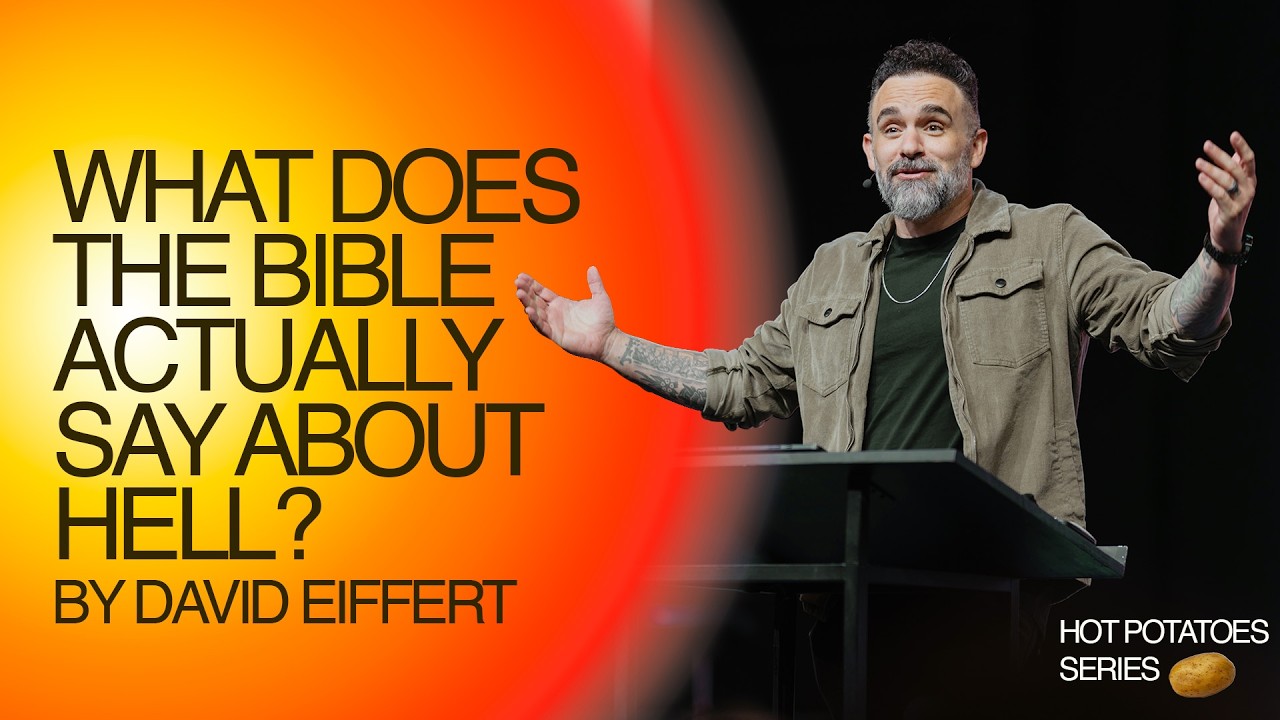
What Does The Bible Actually Say About HELL?
Scripture
An explanation of what the Bible actually teaches about hell, unpacking the four Biblical words translated as hell (Sheol, Hades, Tartarus, Gehenna), Jesus's use of vivid imagery, and how hell was made for the devil, not people, since Jesus already defeated it.
Transcript
We are in a series, and we’re coming near the close, I think. It’s called Hot Potatoes. It’s our summer series, and we realized that a lot of people are in and out during the summer. So we wanted it to be a series where each week kind of stands alone. The idea of a hot potato is that it’s something too hot to handle, so you don’t want to hold onto it for very long. Each week addresses a specific issue just for that week, and this week I’ve got a very spicy one for you.
If you’re taking notes, this is what I’d like you to write down: What does the Bible actually say about hell?
Lock the doors - they’re going to make a run for it.
It’s funny, this past week someone said, “Hey, what’s your hot potato for Sunday?” And I said, “What does the Bible actually say about hell?” And they said, “Ew, why?” And I said, “Because I’m a pastor. It’s our job.”
I want to recognize right off the bat that it’s a touchy subject. It’s an emotionally charged subject for a lot of people, for very good reasons. I think there are a lot of pastors who will spend their entire ministry and never talk about hell, and I get why - it’s because they wish it wasn’t in there. And if I could be honest, I don’t know if this is too real for y’all, I wish it wasn’t in there either. But as a church that’s committed to the Jesus way, being Jesus first, we don’t skip it, because Jesus didn’t skip it.
So what I’m hoping is that we can be adults for like 30 minutes. There are a lot of different ideas, a big variety of people who come from different places and land in different directions when it comes to the idea of hell. I just want to set the playing field here and say that we’re all doing the best that we can. Bible-believing preachers are doing the best that we can, so we study the best that we can, we follow Jesus the best that we can, and at the end of the day we’re just going to read these differently and come to different conclusions. And that’s okay.
So if you’re thinking, “Well, he’d better use my favorite hell scripture or I’m ticked” - just cool that down for 30 minutes, because what I’m trying to do is talk about what Scripture says, not all the different things that we pile on top of it, as far as “this must mean this” and “I take this to mean this.” I’m trying to do a study for a few minutes about what Scripture actually says about hell. Are you okay with that?
We don’t skip it, because Jesus didn’t skip it. Did you know that Jesus talks about hell more than anyone else in the whole Bible? If you’re thinking, “Well, thank God Jesus never talked about hell” - actually, he talked about hell more than anybody. He talked about it more than Paul. He talks about it more than the Old Testament prophets. That surprises a lot of people, but we, as followers of Jesus, don’t just skip the verses we’d rather skip.
I would love to not have to talk about hell. I would love that. But I’m committed to being a person who is real, and I want you to understand that for some of you, you can treat a subject like hell as a theology debate - a way to divide lines between you and other people. But I understand that for me, as a pastor, I can’t talk about hell like that, because for me it’s not a theological subject - I’m talking about real people, and people are forming real decisions and opinions about where their loved ones are, or will go, based on the things that we say here.
Also, let me just say this: if this is your first time with us, we’re glad you’re here. You picked a great week to be here. Some of you all are probably going to leave and tell your friend that he was funny - well, I’ll try. I’m really glad you’re here, and I hope this will be an encouragement to you as well.
Matthew 25: Real Judgment
Matthew chapter 25, if you’ve found your way there. This is - if you want to find Jesus at his scariest, you would definitely go to Matthew chapter 25. This is where you’d look at what Jesus says, beginning in verse 31.
When the Son of Man comes in his glory with all the angels with him, he will sit on his glorious throne. All the nations will be gathered before him, and he will separate the people one from another as a shepherd separates the sheep from the goats. He will put the sheep on his right and the goats on his left.
Understand right off the bat that that’s Jesus. That’s not some medieval painter. That’s not Dante. That’s not a cartoon. He’s talking about real separation. He’s talking about a time when all the nations will be divided into two groups. This is real judgment that Jesus talks about.
I remember a while back I was talking to a friend of mine, not really a believer, but a nice guy, and he asked me, “How is it good news that people go to hell?” And I thought about it, and I said, “Well, the good news is that you don’t have to go.” That’s the good news.
I think there are a lot of people who have lots of different opinions and pictures. For me, I’ve had opinions about hell, but what I’ve had probably more than opinions is pictures of hell. I’m a video game guy, so years ago I used to play a video game called Doom, and that’s pretty much how I pictured hell - weird goblins, lava everywhere, a big lake of fire. Some of you, when you think about hell, think of something that looks a little bit like that: people being speared, screaming, torture. Some of you got that from a movie, some from a cartoon, some of y’all even got that from a preacher.
I’ll give you a good example. In 1741, probably the most famous American sermon of all time, a man named Jonathan Edwards preached a very famous sermon called “Sinners in the Hands of an Angry God.” I read it when I was getting my degree, as does everybody. Here’s a little excerpt from Jonathan Edwards, the famous preacher, from his sermon:
The God that holds you over the pit of hell, much as one holds a spider or some loathsome insect over the fire, abhors you and is dreadfully provoked. His wrath towards you burns like fire. He looks upon you as worthy of nothing else but to be cast into the fire. You are ten thousand times more abominable in his eyes than the most hateful, venomous serpent is in ours. You hang by a slender thread, with the flames of divine wrath flashing about it, and ready every moment to singe and burn it asunder.
History tells us that people were fainting in the pews and holding onto the pillars of the church. That’s the picture a lot of people have - that God is dangling you over the flames like a bug he can’t stand, and the only question is when he’ll choose to finally drop you.
You know me, I hope, and I don’t like to speak badly about preachers. I go out of my way not to. But I just want to say that some preachers think that scaring a kid and teaching a kid is the same thing. It’s not.
So here’s my deal before we get into it. I’ve got four points for you. Here’s the deal: are you ready? This is our commitment for the morning - as much, and as little, as the Bible says. That’s the deal. And that commitment goes two ways. Some of you are like, “Yes, pastor, scare them into the kingdom” - I will say what’s in there. But others of you are scared to death of being dangled over the fire like a loathsome spider - I’m also committing to you that I’m not going to tell you about what’s not in there. Are you okay with that?
I always like to wrap my sermons in a nice pretty little bow, but this sermon probably won’t be wrapped as clearly as some of the others. I think that’s important, because one of the things I’m trying to do as a pastor is be your tour guide on this book - I want to set you up for success so that when you read it, you know how to read it correctly, not just the words.
Okay, I’ve got four points for you. The first one is long, and the next three are short - I just wanted to tell you that in case you hear the first one and think, “I can’t do three more of these, there’s soccer today.” Here we go. Learning about hell.
One: Hell Is One Word in English, but Four Words in the Bible
Hell is one word in English, but four words in the Bible. You’re saying, “My Bible just says hell.” Well, that’s precisely the problem - translators of the Bible, especially the King James, took four words that have four different meanings and flattened them into one word: hell. Some medieval painters were inspired by a poet and writer named Dante, who wrote about all the different layers of hell - all this famous imagery that is no doubt the inspiration for the video game Doom that came from it.
So the question is: is that fiery picture what the Bible actually says about hell? What we’re going to do is not my opinion - just what the text actually says. So, four words that are translated “hell.”
Sheol
The first one is Sheol. This is Old Testament, Hebrew. Sheol just means the grave - it’s the realm of the dead. In the Old Testament, everybody goes to Sheol. It’s not punishment, it’s just where the dead go.
David, King David, the poet, says this about himself in Psalm 16:
For thou wilt not leave my soul in hell, neither wilt thou suffer thine holy one to see corruption.
David is the man after God’s own heart, and he expects that when he dies, he’s going to go to Sheol. So Sheol is just the grave. Thankfully, newer translations - if you have a King James Bible, and you have an NIV, a New King James, an ESV, an Amplified - they’re going to say the word “hell” a lot less than the King James, because they’re wising up and adding more clarity on the four different words. Some translations will just say “the realm of the dead.” David says, “Even if I make my bed in hell, you are there” - what’s he talking about? He’s just saying, “Even if I die, you’re still there.” That’s Sheol.
Can you see how conflating that word with the word for the eternal bad place people go would confuse people? If you come across something David says in the Psalms about hell, you have to understand he’s not talking about hell - he’s talking about the place of the dead in the Old Testament. Sheol.
Hades
Number two: Hades. It’s not the Old Testament, it’s not Hebrew - it’s Greek, the New Testament. Hades is basically the same as Sheol - it’s the place of the dead between death and resurrection. We can prove that, because in the book of Acts, Peter is quoting that verse we just read in Psalms, but he’s quoting it not in the original Hebrew - he’s quoting it in Greek, the language the New Testament is written in. Look at what word he uses when he’s quoting David. Acts chapter 2, verse 31:
He, seeing this before, spake of the resurrection of Christ, that his soul was not left in hell, neither his flesh did see corruption.
Peter’s word for Sheol is Hades. It’s interesting that Peter says Jesus’ soul was in Hades from Friday through Sunday. You might be thinking, “So did Jesus go into the lake of fire and get tortured for three days?” No. The way to think about it is this: Hades isn’t the prison, it’s the holding cell before the trial. Catholics have some purgatory ideas going on, but there’s some semblance of this holding cell.
You might be thinking, “Okay, but is the waiting room nice?” Well, apparently it depends who you talk to. Let me show you - Luke chapter 16. It’s talking about the same realm, but two very different experiences. There’s a man named Lazarus, comforted at Abraham’s side, called Abraham’s bosom, and a rich man in torment. I’ll read it from the King James, just to show how confusing it can be. Luke chapter 16, verse 22:
And it came to pass that the beggar died and was carried by the angels into Abraham’s bosom. The rich man also died and was buried, and in hell he lift up his eyes, being in torments, and seeth Abraham afar off, and Lazarus in his bosom.
“Bosom” - it’s a weird word. Some people read Abraham’s bosom as the seat of honor at the feast - like when someone would rest their head on Jesus’ bosom, the same kind of idea. Some separate this into another idea of paradise, which is more comfortable. Either way, you’re talking about different language for the comfort side of the waiting room.
Some will wrongly read this verse - especially since the King James says “hell” - and think there’s someone in hell talking to someone in heaven, this whole conversation going on between people in hell and people in heaven. That’s for sure not what it’s saying. Also, if that was the plan, that would be hilarious - it’s just Grandma yelling over to Grandpa across the chasm for all eternity. It’s separated by a ditch, and I’m just thinking, why doesn’t anyone try to jump over it? If you’re in hell, what’s the worst that could happen? I would try.
Tartarus
Word one: Sheol. Word two: Hades. Word three: Tartarus. You might be thinking, is that the time machine in Doctor Who? Close - that’s a TARDIS. Tartarus is a word that comes from Greek mythology, describing a deep pit under the underworld in old mythological language. It’s used by Peter exactly one time in all of Scripture, translated “hell.” 2 Peter chapter 2, verse 4 - read carefully who it’s about:
For if God did not spare angels when they sinned, but sent them to hell, putting them in chains of darkness to be held for judgment.
Tartarus, as he’s using this word, is for angels, not for people. It’s one verse, and it isn’t about you.
Gehenna
Sheol, Hades, Tartarus, and word four: Gehenna. This is the one to focus on - it’s the one Jesus uses. It appears twelve times in the New Testament, more than any of the other words combined, and eleven of those twelve times it’s Jesus himself talking about it. Let’s look at one. Matthew chapter 10, verse 28:
Do not be afraid of those who kill the body but cannot kill the soul. Rather, be afraid of the one who can destroy both soul and body in hell.
The interesting thing about Gehenna - and I’m not saying what you might think I’m saying - is that Gehenna is first and foremost a place on earth. Gehenna literally means Gehennom, “valley of Hinnom.” It’s a real valley right outside Jerusalem - you could take a day hike to Gehenna and be home for dinner. Today it’s a park. I’ve got a picture - this is Gehenna, modern day. They actually do concerts there now, which is funny. If you were in a metal band, you know - “Where are you playing?” “Hell.” That’s the joke.
When he’s saying Gehenna, you have to understand that’s a physical place. But it’s not just about a physical place, because this place has a dark history - kings of Judah burned their own children there as sacrifice, and God cursed that place. So in Jesus’ day, this cursed valley became a standard image for the final judgment.
If you read the last verse of Isaiah, you can see this is God speaking judgment specifically not on hell, but on that specific place. Isaiah chapter 66, verse 24 - remember, this is after they’ve burned their children in sacrifice:
And they will go out and look on the dead bodies of those who rebelled against me. The worms that eat them will not die, the fire that burns them will not be quenched, and they will be loathsome to all mankind.
When Jesus comes and warns about Gehenna, he quotes this exact verse. Mark chapter 9, verse 47:
And if your eye causes you to stumble, pluck it out. It is better for you to enter the kingdom of God with one eye than to have two eyes and be thrown into hell,
Gehenna - and then notice the quote: “where the worms that eat them do not die, and the fire is not quenched.” He’s literally quoting Isaiah 66. Jesus takes a real place with real history, real judgment, real fire, and uses it as a picture for the very real judgment to come.
You might be thinking, “So is the word ‘hell’ in the New Testament just the English word for Gehenna?” I wish it were that easy. Hell is actually a different word - it comes from pagan Norse mythology, a cold, shadowy underworld. The word wasn’t even around for about 700 years after Jesus was resurrected. So he was definitely not saying “hell.” Unfortunately, translators took these four words and merged them into this one big picture called hell - a word that didn’t even exist when Jesus was here.
So Jesus uses a real valley to paint a picture of a real judgment that is still to come. That’s number one: hell is one word in English, but four words in the Bible - Sheol, Hades, Tartarus, Gehenna.
Two: Jesus Describes Gehenna in Pictures, Not Floor Plans
Number two, if you’re taking notes: Jesus describes Gehenna in pictures, not floor plans. What does that mean? Jesus uses a picture of a physical place as an illustration for the judgment to come - it’s a word picture. Some people will say, “He’s only talking about the city dump.” No, he’s not - but he does use it as a picture for the judgment to come.
So what does he say this judgment is like? Does he say there’s fire there? Darkness? That the people who go there just perish? Actually, he uses all of them. From Jesus’ own mouth, let me give you some examples. These are all Jesus. Matthew chapter 18, verse 9:
And if your eye causes you to stumble, gouge it out and throw it away. It is better for you to enter life with one eye than to have two eyes and be thrown into the fire of hell.
“The fire of hell.” Maybe he thinks it’s more like darkness. Matthew chapter 8, verse 12:
But the subjects of the kingdom will be thrown outside into the darkness, where there will be weeping and gnashing of teeth.
Maybe it’s destruction. Matthew chapter 7, verse 13:
Enter through the narrow gate. For wide is the gate and broad is the road that leads to destruction, and many enter through it.
But here’s one idea that unites them all together. Matthew chapter 7, verse 23:
Then I will tell them plainly, I never knew you. Away from me.
So one thing we understand about hell for sure is that part of the anguish of hell is that you are away from God. Just like David says - even if you die, God is still present. But when Jesus speaks of the coming judgment, that separation is the one place where you are truly, absolutely outside the presence of God.
One thing that’s a great challenge when it comes to reading Scripture, especially when Jesus talks, because he’s such an artistic speaker, is understanding when he’s saying something literally versus figuratively. He does both. If you take it all as figurative, like some of my generation does - “oh, it’s all just symbol” - you end up with this fluffy idea that nothing is real, just poetry, and it becomes a foundation you can’t even stand on. On the other hand, if you take it all as literal, you get very confused, because some things clearly aren’t literal.
Give you some examples. God is a rock. How many of you believe God is a rock? I do - but not a literal rock. He’s not a stone in the yard. It’s a word picture that communicates he’s dependable, reliable, able to be built upon. In the book of Revelation, Jesus is finally revealed as a lamb with seven eyes and seven horns. When you finally encounter Jesus face to face, do you think he’ll have seven eyeballs? No - but he will have perfect insight, perfect wisdom. Seven literal horns? No - but he does have perfect power. It’s a word picture. That doesn’t mean you take it lightly, it just means you have to read it correctly.
More examples: Jesus says, “Why are you worried about the speck in your neighbor’s eye when you have a plank in your own eye?” Have you ever seen anyone with a literal two-by-four in their eye? No, but you understand what he’s communicating. “If your eye causes you to sin, gouge it out.” I’ve never actually met anyone who’s done that, and I don’t recommend it - but you still understand the warning.
We do this in English too. “It’s raining cats and dogs.” “I could eat a horse” - no you can’t, but we understand it’s communicating something. Some people take the fire and the dark and the maggots and the worms all literally, and others don’t. That’s just the truth. But even if you don’t take it literally, we still must take it seriously. You can land where you want on the worms, but we can all agree that Jesus is warning us that’s not where you want to go.
One image Jesus uses over and over when it comes to hell, that follows him everywhere he goes, is the phrase “weeping and gnashing of teeth.” He uses it in Matthew 8, Matthew 13, Matthew 22. The scenery keeps changing when he’s making these pictures, but the grief of hell never goes away. Gnashing of teeth just means gritting your teeth because of such anguish, or anger, or intense emotion. He uses that image over and over. That’s not up for debate.
So don’t argue about the furniture. Maybe you think there’s a third level reserved for someone - fine, you can wonder about it, have fun with it, as long as you’re not dividing over it. But don’t argue about the furniture and miss the warning that Jesus is giving: whatever it is, it’s going to be terrible, and whatever it is, you don’t want to be there. Whatever it is, it’s a place of loss and grief and sorrow.
Three: Hell Was Made for the Devil and His Angels, Not for People
One, hell is one word in English but four words in the Bible. Two, Jesus describes Gehenna in pictures, not floor plans. Three, hell was made for the devil and his angels, not for people. The Bible is super clear on that. Matthew chapter 25, the parable of the sheep and the goats:
Then he will say to those on his left, “Depart from me, you who are cursed, into the eternal fire prepared for the devil and his angels.”
Prepared. It’s a place that’s been prepared for the devil and his angels. If you back up two verses, look at what he says to the sheep, verse 34:
Take your inheritance, the kingdom prepared for you, since the creation of the world.
Same word: prepared. There’s a kingdom prepared for you, and a fire prepared for the devil and his angels. Do you catch the difference? There’s a place with your name on it, and it’s not hell. I think that’s good news. Hell was never plan A for any single human being. Nobody in this room is on the guest list when it comes to hell, and the only way to get there is to climb over Jesus to crash a party you weren’t invited to. It’s like, “Who invited Steve? How do you even know about him?” That’s you in hell. “What are you even doing here?” He’ll say you can go, but it wasn’t a place created for you. Heaven was created for you.
Another thing I want to clear up: some people think that when you picture hell, the devil is in charge - like he’s the manager down there, doing performance reviews, hiring and firing, that’s his domain. That’s not what Scripture teaches. You could write this down: the devil isn’t hell’s manager, the devil is hell’s first inmate. It’s not the devil’s domain, it’s the devil’s judgment. It’s not his kingdom, it’s his sentence.
Quick clarification too - in the book of Revelation, you’ll come across a phrase called the lake of fire. You might be thinking, “I just learned four words, I’m not going to learn a fifth.” It’s almost certainly not a new fifth place. The Bible never explicitly says that the Gehenna Jesus describes is what John calls the lake of fire, but just about every serious theologian reads them as the same. Jesus says Gehenna, the cursed valley - he never uses “lake of fire.” John, in Revelation, never uses “Gehenna” - he uses “lake of fire.” Most people would think those are two different words for one reality, or Jesus forgot to mention the lake of fire, which I doubt. I believe it’s two words for the same reality.
Revelation chapter 20, verse 10:
And the devil, who deceived them, was thrown into the lake of burning sulfur, where the beast and the false prophet had been thrown. They will be tormented day and night forever and ever.
So the devil and his angels will be cast into the lake of fire, and there they will be tormented forever and ever. A few verses later, the people show up. Verse 12:
And I saw the dead, great and small, standing before the throne, and books were opened. Another book was opened, which is the book of life. And the dead were judged according to what they had done, as recorded in the books. The sea gave up the dead that were in it, and death and Hades gave up the dead that were in them, and each person was judged according to what they had done.
By the way, you can be judged by what you’ve done, or you can be judged by what Jesus did. I recommend the latter, but you do you. Revelation chapter 20, verse 14:
Then death and Hades were thrown into the lake of fire. The lake of fire is the second death.
Pause here - if you’re reading the King James and thinking “lake of fire equals hell,” when you get to Revelation 20, hell itself is cast into the lake of fire. Think about that. It’s saying that the holding cell will be emptied, and it too will be thrown in. Verse 15:
Anyone whose name was not found written in the book of life was thrown into the fire.
You might be thinking, I’ve got questions. It doesn’t say that humans are tortured forever and ever - it says the devil and his angels will be tortured forever. It says the lake of fire is the second death. So are humans tortured there forever and ever? I wish I had a crystal clear verse to settle that, but we don’t. Some people take this to mean that since the devil is tortured there forever, humans are too. Others say it doesn’t say that - it says it’s the second death, so they believe people simply perish. There are Bible-believing people on both sides of that.
Some people think the judgment reserved for people whose names aren’t written in the Book of Life is what’s called eternal conscious torment - that whatever agony you’ve experienced in life will be a thousand times worse, and it won’t be for a thousand years or a billion years or a trillion trillion years, it will be for all eternity. Other people - lots of others - would be called annihilationists. They take other verses that talk about how the wicked will perish, that the life force God offers is withdrawn from them. There are Bible-believing people on both sides. But the point is this: the fire is made for the devil, not for you, and the devil doesn’t hold the keys of hell. Jesus does.
Four: Jesus Defeated Hell So You Don’t Have to Go
One, hell is one word in English but four words in the Bible. Two, Jesus describes Gehenna in pictures, not floor plans. Three, hell was made for the devil and his angels, not for people. And number four: Jesus defeated hell so you don’t have to go. Finally, some good news.
Revelation chapter 1: Jesus shows up to a man named John in a vision, and says something wonderful for all of us to hear before some of the imagery that comes later in the book:
Do not be afraid. I am the first and the last. I am the living one. I was dead, and now look, I am alive forever and ever. I hold the keys of death and Hades.
I love that - in all of this, what he wants you to know is, don’t be afraid. It means you don’t have to be scared. No one ends up in the fire without having had an opportunity with him. He’s got the keys.
Hell was never made for you, the kingdom was. And the keys belong to the one who died for you, and loves you, and pursues you. People will argue until Jesus comes back about all the different compartments and how all the different holding cells work. There’s one thing not in dispute: Jesus defeated death, Jesus defeated hell, and he gives you a way not to be in eternal agony or to perish, wherever you land, but to have real, lasting, living, eternal life.
The keys of hell do not belong to the devil. They do not belong to your worst enemy. They don’t even belong to your own past. The keys of hell are in nail-scarred hands.
So again, the question is: how is it good news that people go to hell? The good news is this: you don’t have to. Remember the book of life we just read about? The names that weren’t written in it got cast into the fire. You might be thinking, “I want my name in that book. How do I do this?” Let me tell you - it’s not about being good enough, trying harder, or deserving it. You go through the door that’s already open for you, trusting the one holding the keys.
What you need to do to get your name written in the Lamb’s Book of Life is believe that he died for you, confess that he’s Lord, and turn to him. There’s a word in the Bible for that - repentance. It just means changing directions. That’s the whole entrance exam: did you put your faith in Jesus Christ, and did you let your life be changed by him? It doesn’t mean you’re perfect - no one’s ever perfect. It’s not about works, or doing the right thing. It’s about trusting Jesus.
Think about the thief on the cross. Luke chapter 23, verse 42:
Then he said, “Jesus, remember me when you come into your kingdom.” Jesus answered him, “Truly I tell you, today you will be with me in paradise.”
“Remember me” means, “Put my name on the list.” This guy didn’t have a resume. He didn’t have time to clean up his life. He didn’t have any good works. And Jesus says, “Today you will be with me in paradise.” Paradise there means the king’s garden - it’s the Bible’s word for Eden. A dying man who was never welcomed anywhere is welcomed into the king’s garden.
And by the way, in the book of Revelation, it’s not just the Book of Life - it’s the Lamb’s Book of Life. The Lamb keeps the list. Jesus keeps the list, and he writes the names with nail-scarred hands.
Listen to Jesus’ heart here. 2 Peter chapter 3, verse 9:
The Lord is not slow in keeping his promise, as some understand slowness. Instead, he is patient with you, not wanting anyone to perish, but everyone to come to repentance.
Anyone - not “except that one guy.” Any anyone. He’s not willing that any should perish. Ezekiel chapter 33, verse 11:
As surely as I live, declares the Sovereign Lord, I take no pleasure in the death of the wicked, but rather that they turn from their ways and live.
Here’s what God says: “Turn. Turn from your evil ways. Why will you die?” I love that - God’s saying, why would you choose death? And of course that’s true in an eternal sense, but it’s true today too. Why do you choose death? God’s saying, don’t choose that.
1 Timothy chapter 2, verses 3-4:
God our savior wants all people to be saved and to come to a knowledge of the truth.
All people. And some of you may know this one, John 3:16:
For God so loved the world that he gave his one and only son, that whoever believes in him shall not perish.
What’s the gift? Eternal life. Verse 17:
For God did not send his son into the world to condemn the world, but to save the world through him.
I remember a little while ago I had coffee with a guy, new to the church, and he told me, “Growing up, I always had the idea that God was just angry, just always angry and disappointed.” He said, “It wasn’t until I started coming to your church that I learned God actually loves me and cares for me.” I said, “Well, first off, you’re not alone in that. But it’s actually more than he loves you - God pursues you.” He chases after you. God does everything he can, outside of taking your free will, to ensure that he can be with you forever. That’s the whole point.
You could write this down: every warning Jesus gave about hell, he gave on his way to a cross to make sure you would never go there. Every one. He didn’t do it to scare you - he did it on the way to the cross to tell you, “You don’t have to go here. You don’t have to live like that. You don’t have to die like that. Just come and receive this free gift.”
Closing
Hell is one word in English, but four words in the Bible. Jesus describes Gehenna in pictures, not floor plans. Hell was made for the devil and his angels, not for people. Jesus defeated hell, so you don’t have to go.
I want to go back to the beginning. Remember Jonathan Edwards? “The God that holds you over the pit of hell hates you, and you’re a thousand times more despicable to him than a vile serpent, and you hang by a slender thread.” The good news is that Jonathan Edwards was wrong. I’m wrong about all kinds of stuff, but he was wrong. That’s not the God of the Bible. Edwards got that picture from somewhere, but he did not get it from the Bible. You’re not hanging by a thread - you are held safely in the hands of a loving Father who says, you don’t have to be afraid.
The real question isn’t “what about hell.” The question is: what about Jesus? He’s the one with the keys, and he’s not at hell throwing people in - he’s at the door of the kingdom, compelling people to come. All are invited. Just receive the free gift.
Here’s my closing statement: the good news about hell is you don’t have to go there.
One, hell is one word in English but four words in the Bible - Sheol, Hades, Tartarus, Gehenna, four words flattened into one. Two, Jesus describes Gehenna in pictures, not floor plans - whatever else hell is, Jesus says it’s a place of real and terrible loss. Three, hell was made for the devil and his angels, not for people - the kingdom was prepared for you; the devil is not hell’s manager, he’s hell’s first inmate. Four, Jesus defeated hell so you don’t have to go - the keys of death and Hades are in nail-scarred hands. Every warning he gave, he gave on his way to the cross.