A pastoral answer to whether Christians can get tattoos, working through three lenses for reading Scripture: the context of Leviticus 19:28 as ceremonial law, the shift from old to new covenant fulfilled in Jesus, and Romans 14's category of disputable matters where personal conviction governs without becoming a rule for others.
Transcript
Can a Christian get tattoos?
Well, did you know that can a Christian get tattooed is one of the most Googled questions about Christianity. And the reason I think a lot of people are asking that is because they’ve heard lots of conflicting things when it comes to what Scripture says is okay and what Scripture says is not okay. So they maybe they’ve been told that getting tattoos is a sin. Maybe they want one and they’re not sure if they should. Maybe they have one and they’re feeling bad about it.
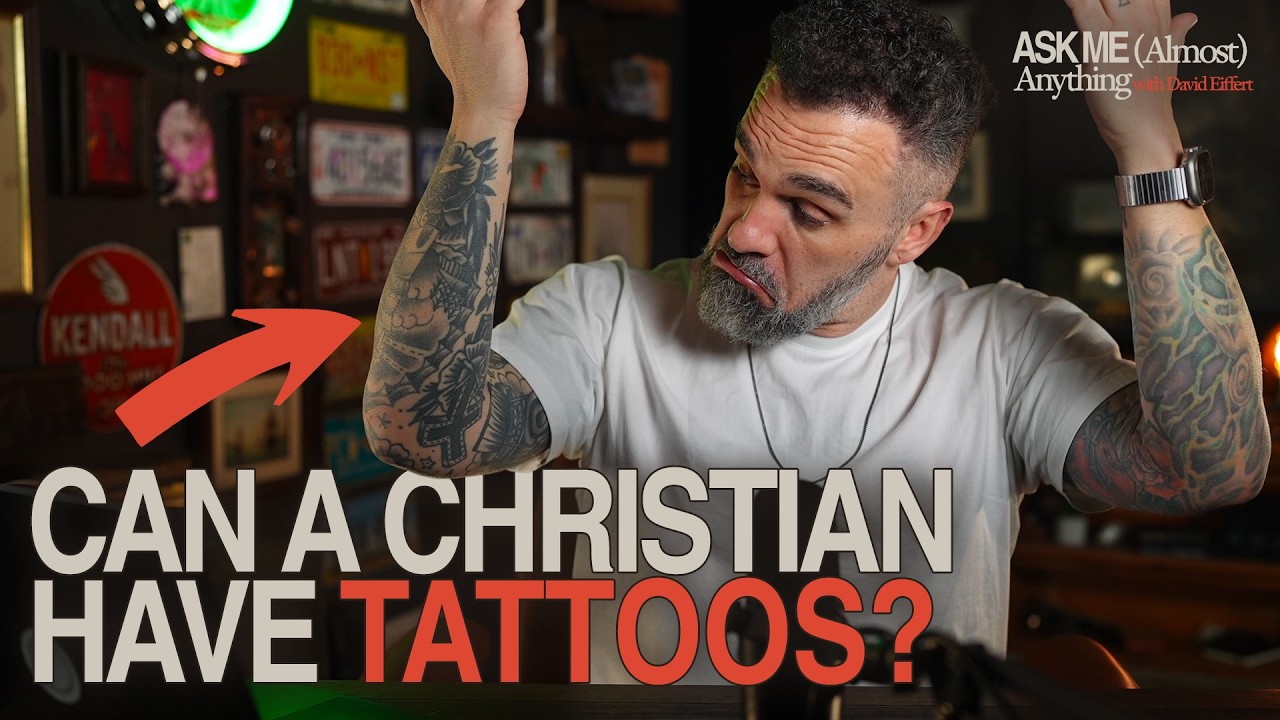
Well, I’m a pastor, and I’m sure by looking at me, you can tell where I land on the topic. But I probably get this question about tattoos more than any other question in the world. I go to conferences, people ask me about my tattoos. I go to coffee shops, I go to the gym. But people see my tattoos and they hear I’m a pastor and they want to talk about tattoos. And so unsurprisingly, I have given it a lot of thought, and I want to give you the full answer, not just a yes or no, but my reasoning behind it.
Context
So the way that I think about it when it comes to tattoos and scripture, it’s basically around three things in particular on how you read scripture. Number one is this context. So the scripture that everyone uses, of course, about tattoos is Leviticus 19:28. And I’d like to read it for you. It says this:
Do not cut your bodies for the dead or put tattoo marks on yourselves. I am the Lord.
Seems pretty straightforward, right? Do not put tattoo marks on yourselves. I am the Lord. So it’s like right there in the Bible. And some people think, well, it’s pretty, pretty straightforward. But when you read a verse of scripture, what you have to always do is you have to read the verses around the scripture to understand where you are in Scripture.
And if you go up just two verses to verse 26, so it’s this same list. Verse 26 says, Do not eat meat that has not been drained of blood. So let me ask you a question. Have you ever ordered a steak medium, medium rare? And then the very next verse, verse 27, so that’s the verse right before the tattoo verse, it says, do not trim the edges of your beard or your hair. Let me say, I do both. I just got a haircut, so I do both.
This is all part of the same list, though, in the Old Testament. It’s called ceremonial law. I know it’s like a big ceremonial law. It’s not moral law, it’s ceremonial law. And there was a reason that these laws existed. To catch you up to the story, God is in process of separating his people from the pagan cultures around them. And so all these things, tattoos, beard styles, blood rituals, well, they were all tied to pagan rituals and worship practices. And so the prohibition’s not really about ink, it was more about worship.
And again, Bible scholars will call this ceremonial law. These were instructions given specifically to Israel during a specific time in history. And very few Christians, in fact, I don’t think I know any Christians today that think we’re supposed to follow ceremonial law. We already live like that. So you already probably eat non-kosher foods. You already trim your beards if you’re a guy. And there’s plenty of things in that chapter that are addressed in there that we do not follow.
Old Covenant vs New Covenant
And while we’re in the neighborhood, just so you can get an idea of the section of scripture we’re in, if you go to Deuteronomy chapter 25, I’d like to read you another example. This is Deuteronomy chapter 25, verses 11 and 12. It says this:
If two men are fighting, and the wife of one of them comes to rescue her husband from his assailant, and she reaches out and seizes him by his private parts, you shall cut off her hand.
So if two men are fighting and the wife of one of them comes to rescue her husband from his assailant, and she reaches out and seizes him by his private parts, you shall cut off her hand. Let me ask, are you still applying that in your life today? In fact, just go read all of Deuteronomy chapter 25. I’ll just leave it there.
The point I’m trying to make is this. There’s lots in the old testament law that we don’t apply today, and we don’t apply it for really good reason. And you might be thinking, it’s not so much about that, it’s just I thought there was a verse about, you know, isn’t your body a temple? So some Christians will take that verse, it’s 1 Corinthians chapter 6, where Paul is talking about how our body is a temple of the Holy Spirit.
And let me say that that we want to take that seriously. Like we it’s not wrong to want to care for our bodies and take care of them. But is that what Paul is actually talking about? Let me read the verse in the context of what he’s saying. This is 1 Corinthians chapter 6, verses 18 and 19. Says this:
Flee from sexual immorality. All other sins a person commits are outside the body, but whoever sins sexually sins against their own body. Do you not know that your bodies are temples of the Holy Spirit who is in you, whom you have received from God?
So the context is what’s Paul talking about? He’s talking about sexual immorality. That’s what he’s addressing. And so I just think pulling this one verse to be like, whoa, see, so you’re not supposed to get tattoos. I think you’re asking Scripture to say something that Scripture is not trying to say. So context.
Personal Conviction
Number two is old covenant versus new covenant. You might be thinking, what in the world? Well, this is a framework that will help you make sense of a lot of scripture, but certainly this issue. The book of Hebrews in the New Testament spends a lot of time on this one idea that the old system was real, the old system was from God, but it pointed forward to something better. And so Jesus came and he fulfilled it.
We can see that lots, give me an example. Okay. Hebrews chapter 7. It talks about how the former regulation was set aside because it was weak and useless. Hear that? Weak and useless. Next chapter, Hebrews chapter 8. It says, by calling the covenant new, God has made the first one, ready, obsolete. It’s pretty direct. In fact, Jesus himself says it, Matthew chapter 5. He says he didn’t come to abolish the law, but to fulfill the law. He fulfilled it. He fulfilled it. And so that changes everything for the New Testament Christian. Certainly how we read Levitical Ceremonial Law.
Here’s a test that I find useful. If someone is wanting to say something, I ask this question: Does this person look more like Jesus or more like a Pharisee? See, the Pharisees in Jesus’ day, they were expert at adding rules. Jesus, though, comes and he kept cutting rules. It’s a question that’s worth asking, especially when someone is trying to make a rule out of something the Bible might not be wanting us to make a rule about.
Number three is personal conviction. And this is where it gets practical. Because I don’t want to just say, like, yeah, get all the tattoos you want. Yeah, tattoo your face. Romans chapter 14 is one of my favorite scriptures when it comes to this question. Paul is writing in this section of scripture what he calls about what he calls disputable matters. Disputable matters. What’s that mean? Is it areas where faithful Christians can land differently?
And look at what he says in verse 23. Whoever has doubts is condemned if they eat, because their eating is not from faith. What? He’s saying, he’s saying, he’s saying, we can eat, but whoever has doubts about it are condemned if they eat. So what what does that mean? He’s saying if it feels wrong, don’t do it. That’s what he’s saying. He’s saying, if it feels wrong, then it’s wrong for you. If something doesn’t sit right with you, don’t do it. That might be the Holy Spirit working in your conscience. And that’s worth honoring.
But the key is this that’s your conviction. That’s for you. It doesn’t automatically become a rule for everyone else. And Paul was clear about that. Don’t do it if it bothers you, but don’t go and tell the person next to you that they’re sinning just because it doesn’t bother them. People have told me to my face that what I’ve done to my body is sinful. And I genuinely I genuinely, I don’t get mad. I think they’re being sincere, but it that’s exactly what Paul is describing in Romans chapter 14. That’s what he’s saying. That that’s their conviction, it’s not mine. And what’s amazing is that scripture gives us both room.
Some Doors Close, Some Doors Open
So I remember years ago I was in Bible college, and the guy who was in charge of the Bible college’s name was Andrew Walmack. He had everyone stand up who had tattoos. He said, Everyone’s tattoos, stand up. So naturally, I stood up because I had tattoos, and he said, he said, I don’t like tattoos. So I don’t, I don’t like them. He says, I just I just don’t. And he says, and it’s interesting because you men and women are here because you believe God called you to be ministers.
He said, Do you know that there are people who will never listen to you simply because you have tattoos? It doesn’t matter how gifted you are, it doesn’t matter how anointed you are. You could have God’s perfect words for them and they won’t hear it. And you might think, oh, they should listen to me, but they they they don’t. They’re never gonna listen to you because you have tattoos. And so, like we’re standing there and we’re thinking, like, you know, these things are permanent, right? You know, what do you want us to do about it?
But then he pauses and then he says this, but you know what? The same is true for me. He says, he says, I’m this simple country boy, I’ve got this Texas draw, I’ve got this big belt buckle. And he says, and there’s people who will never listen to me. It doesn’t matter if I have the perfect words straight from God for them, like they will never listen to someone like me. And then he said, that’s why we need each other. That’s why we’re stronger together than we are apart.
The reality that I understand, and if you want to be a tattooed Christian, you’re gonna have to understand some doors close because of tattoos. They do. But some doors open because of tattoos, and that’s not a problem. That’s precisely the point. And so you might be thinking, okay, David, so can Christians get tattoos? Here’s the answer. Yes. But but honestly, it’s it’s not a question of tattoos, it’s how you read the Bible.
And understanding the difference between the old covenant ceremonial law written to a specific time, to a specific people, and the timeless moral heart of Scripture. And it’s knowing what actually changed when Jesus came. And it’s also about not carrying shame over things God’s not asking you to carry shame for. If you have peace about it, you’re free. If you don’t honor that, that may be the spirit speaking. But the point is to not turn your personal conviction into a rule for the next person because the Bible makes room for us both.
And so you might be wondering well, if the old covenant is obsolete, well, then why would you read the old testament? Well, that’s another question.