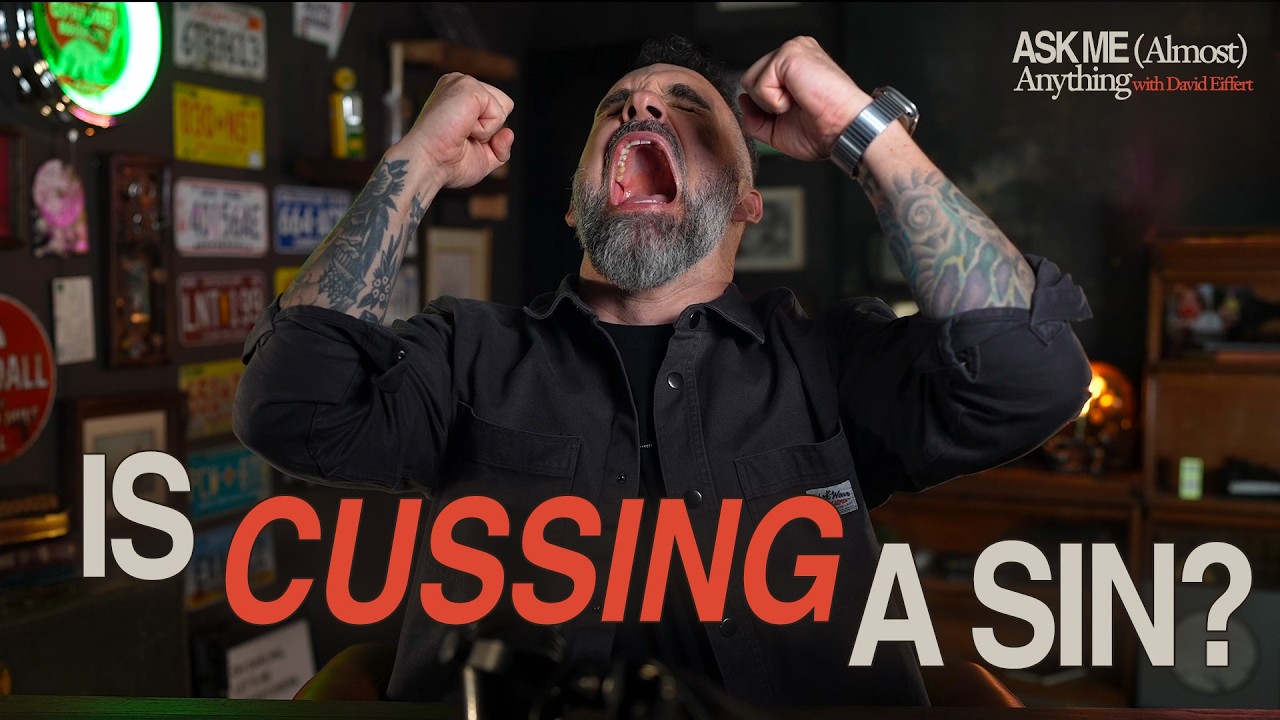
Rather than reducing the question of cussing to a list of forbidden words, this teaching reframes speech as a window into the heart. Working through Ephesians 4, Luke 6, James 3, and Colossians 3, it argues words are weapons that reveal what's inside us, and following Jesus changes how we speak.
Transcript
Is cussing a sin?
So when I was a kid, a friend of mine asked me if I had ever seen the show Beavis and Butthead. I had not. But the second I heard that phrase butthead, I thought to myself, that has got to be the greatest insult I’ve ever heard in my whole life. It’s hilarious. You’re if you’re saying that their head is literally a butt. That’s amazing. And so I went to my sister Holly, she’s my bigger sister, and I said, hey Holly. And then she said, What? And I said, You’re a butthead. And she looked at me and she said, Mom! And needless to say, it did not go well for me.
You know, every culture, I don’t know if you know this, has words that it considers problematic. So for us, what words turn a G movie into a PG movie? Or what words turn a PG movie into a PG 13 movie? What words, if you use them enough times, turn a PG 13 movie into an R-rated movie? And in music, what words and how many times are you allowed to sing them on an album before you slap a parental advisory sticker on it?
And so does Christianity abide by those same rules? Should our language basically be G-rated? Or maybe PG rated if you like you’re really upset? Or maybe is it okay to be more like a like a PG13 type Christian? And I think a lot of people, what they would love to have is like a list of words. We what we want to chart like a like a spreadsheet, the official Christian list of approved and unapproved vocabulary. But the problem is the Bible doesn’t give us a list of American swear words. I don’t know if you know that. And honestly, even if it did, it would keep changing because culture keeps changing.
What does my speech reveal?
And you see this in culture all the time. Like if somebody, somebody says one forbidden word on live TV and everybody acts scandalized. Just slides by without anybody blinking. And that tells you really that that culture has a very strange moral ranking system. And what shocks one generation doesn’t shock another. And what sounds normal in one place sounds vulgar in another. And so the question isn’t just which words are bad. I think the better question is what does my speech reveal? What does my speech do? And does my speech look like Jesus?
And I think Ephesians gives us a better maybe framework than a word list. Ephesians chapter 4, verse 29 says this:
Do not let any unwholesome talk come out of your mouths, but only what is helpful for building others up according to their needs, that it may benefit those who listen.
Your mouth reveals your heart
And I’ve got three points real quick. Number one is this your mouth reveals your heart. So you don’t have to wonder what’s going on in your heart. You just look at your words. Jesus says it like this, Luke chapter 6, for the mouth speaks what the heart is full of. That’s super direct. Jesus is saying your mouth isn’t random. Your speech isn’t disconnected. It’s not like a separate thing from who you really are. Your words reveal what’s on the inside of you.
And so your words, you can think of it like this your mouth is a microphone for your heart. And so when harshness comes flying out of me, that’s revealing something. When cynicism is my least favorite quality, when cynicism comes flying out of me, that’s revealing something. When vulgarity comes flying out of me, that’s revealing something. And so when you walk around and you’re sarcastic and you’re cutting and you’re crude and you’re degrading and you’re tearing people down, that’s revealing something. Not about just your words, but about your heart.
And so the question can’t just be like, did I just say a bad word? The question has to become why is that in me to come out of me in the first place? Because Jesus doesn’t treat speech like just like a like a random slip. He treats speech like fruit. And that matters because if you’ve got a mouth problem, it’s because you have a heart problem. If junk keeps coming out of me, it’s actually because there’s junk living in me. And that sounds uncomfortable, but it’s helpful. Because if the issue is only vocabulary, then the problem is easy. You just have to get better at self-editing. But the issue for the Christian is always deeper than that, because your mouth reveals what’s in your heart.
Words are weapons
Number two, words are weapons. So James in the book of James, chapter three, he talks about a huge forest fire. And then he says, think about how a huge forest fire is set ablaze by a tiny little spark. And then he says this the tongue is also a fire. That’s pretty strong language. So James is what he’s trying to do is he’s trying to help us see that words aren’t small just because they sound small. Words aren’t harmless just because they’re, you know, invisible. A small spark can burn down a forest. A few careless words can set a whole family on fire. A sentence can damage a marriage. Like a single phrase can wound a child.
And you know, you can say something and it can stay with someone for 20 years. And so you can wound somebody deeply without ever touching them. It’s like it’s like stabbing someone with a sword, then pulling it out and saying, I’m sorry. I’m so sorry. The sword may be gone, but the wound is still there. That’s why that’s why Paul in Ephesians chapter 4, it’s what he says is so helpful. He says this do not let any unwholesome talk come out of your mouths. Some translations say corrupting talk. What does that even mean? Corrupting talk would be words that leave damage behind, words that spread like decay. They’re words that tear down instead of building up.
And that’s why the Bible is always it’s always bigger than just cuss words. Right? Because you can avoid every official bad word and still use your mouth like a weapon. Did you know that you can gossip without cussing? You can slander without cussing. You can humiliate your spouse without cussing. You can wound your kids without cussing. You can smile in church and still use your mouth to poison people. You can keep your vocabulary clean while still having a dirty heart. And so before I say something, what I need to do is I need to ask is this helpful? Is what I’m about to say helpful? Is this healing or is this harming? Because words are weapons. And if they’re weapons, which they are, then you can’t just use them carelessly.
Following Jesus changes how you speak
Number three is this following Jesus changes how you speak. So let me answer the question super plainly. Is cussing a sin? Here’s my answer. Are you ready? It can be. But the deeper biblical issue isn’t just whether or not a word is culturally flagged. The deeper issue is: is my speech harmful? Is it filthy? Is it cruel? Is it contemptuous? Is it destructive? Look at what Paul says. He says this in Colossians chapter three. He says, but now you must also rid yourselves of all such things as these: anger, rage, malice, slander, and filthy language from your lips. And then in Ephesians chapter 5, he says this, nor should there be obscenity, foolish talk, or coarse joking, which are out of place, but rather thanksgiving.
And so, yes, absolutely. Words matter, absolutely. They matter, but the reason they matter isn’t just because God’s trying to keep a naughty word chart in heaven. It’s because following Jesus changes all of you. It changes what you love, it changes what you think, it changes what you’re becoming, and yes, it changes how you speak. So the mature question is not like, can I get away with this? The mature question is, does this sound like Jesus is doing work on the inside of me? See, that’s the discipleship question. Because the goal isn’t just sanitize speech, the goal is a sanctified life. The goal isn’t sounding cleaner, the goal is becoming cleaner.
Following Jesus changes more than just what you believe about stuff. It changes also your mouth. And so when you’re talking, like, don’t just ask, can I say it? Is this one on the list? Am I graduating from G-rated movie to PG movie? Like, not can I get away with this? Is this okay? Ask this question as I’m as I’m saying this, what is this doing in me? And what is this doing in the people around me? What kind of heart do I have that keeps producing this kind of speech? And is this making me look more like Jesus or less like Jesus? And so you might be asking, like, well, if following Jesus changes how you speak, then how come so many Christians still sound nothing like him? Well, that’s another question.