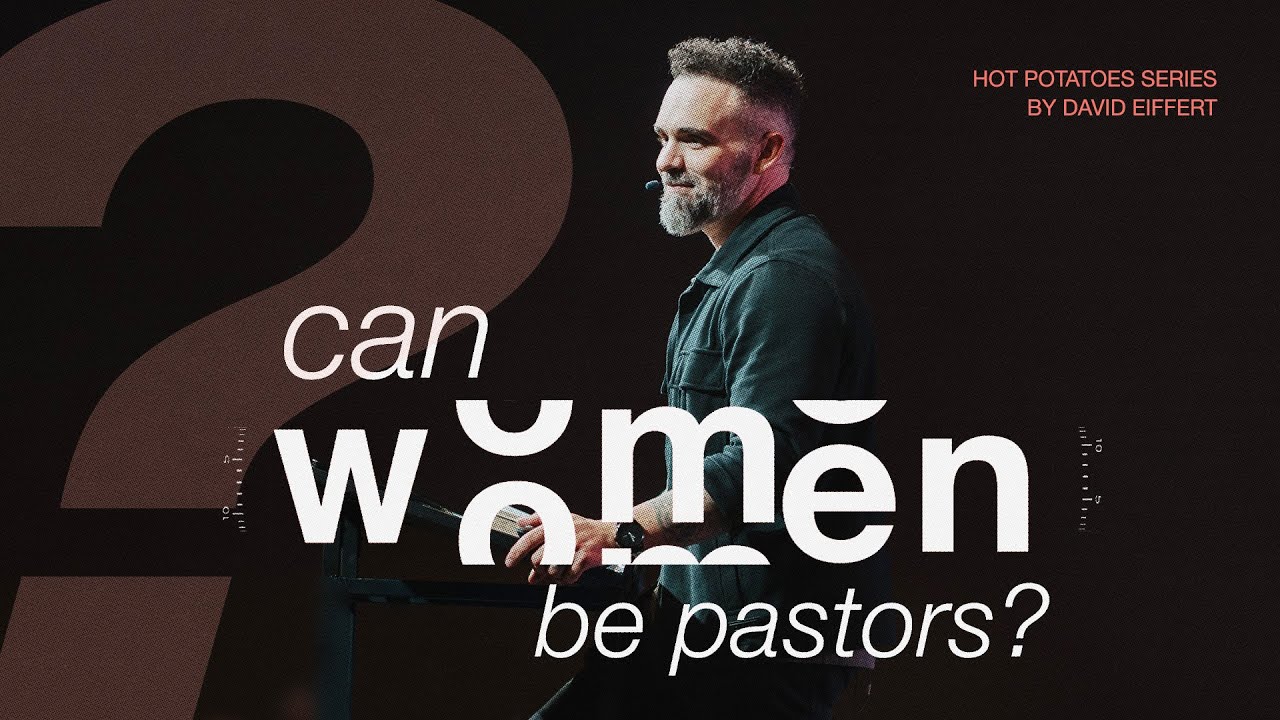
Can Women Be Pastors?
Scripture
A pastoral case for women in ministry, working through the two Pauline passages often used to forbid it and weighing them against the broader witness of Scripture - Miriam, Deborah, Huldah, Phoebe, Junia, and others - to argue that leadership in the church should be determined by gifting and calling, not gender.
Transcript
Buckle Up
I’m gonna warn you, the teaching is not gonna be long, but it is gonna be a little bit dense. It’s gonna require that you use your God given ability to think. And I know that can be painful. But I promise you it’s gonna be worth it because there’s freedom on the other side. And so here’s what I want you to do. I want you to take both of your hands. I want you to do this. And I want you to do this. Okay, you’re buckled up. Here we go. Let’s open in prayer. Heavenly Father, we’re so grateful for you. We’re grateful for your word. We’re beat for your church. We would ask that you help us to hear from you through your word, and that you would help us be people who honor Scripture and honor one another. In Jesus’ name I pray. Everybody said Amen.
Kathy’s Story
Well, years ago, I came across a YouTube video. It was about a lady named Kathy. And Kathy was a theology student at a seminary. Great, great young lady, super passionate about the ministry, loved, loved, clearly loved the kingdom of God, asked great questions, super engaged. Her professors were always really impressed with Kathy. Well, as time went on, though, it seemed like Kathy was getting more and more resigned and not participating as much, maybe even downcast and a little bit sad. And one day one of her professors went up to her and said, Kathy, you okay? And Kathy said, Well, I think, I think the devil is tormenting me. And the professor said, Oh my god, well, what you know what’s going on? What what’s happening? And she says, Well, I keep getting visions of something that I know can never happen. And the professor said, Well, what is it? And she said, Well, I keep having visions of me someday leading a class and maybe even talking in church. But I know that can never happen. And the professor said, Why not? And she said, Because I’m a girl.
See, because Kathy was raised in a church that taught that scripture taught that women were not permitted under any circumstances to teach men. And so she thought, and she said, and worst of all, she says, I actually want to do those things. So she thought it must be from the devil. Because she thought that she had a desire placed on the inside of her that could not have been from God, so it must have been from the devil. And I want you to know this that the topic of women in ministry and their ability to lead in the church, for some people is just a theological debate. You know, there’s like a big old thing, if y’all don’t know, or on YouTube, it’s like YouTube theologians. They pastor nobody. And so for them, they can just have theological concept, it’s just an abstract concept.
Real People’s Lives and Callings
But I am a pastor and I pastor actual people. And so I understand that when we’re talking about this subject, we’re talking about real people’s lives and real people’s callings. And so, can women be pastored? And I want you to know as we start that some of the churches, even churches in our city will agree with what I have the conclusions that I’ve drawn in my own personal study, and some will disagree. And for those who disagree, you know what? That’s okay. They’re still our brothers and sisters in Christ, like we still love we’re gonna not gonna use this or any other theological issue to divide Christians. We’re all on the same side, we’re all following Jesus together. It’s never my ammunition, it’s never my mission to give you ammunition to shoot your fellow soldiers. Right? So I’m not loading your gun with bullets so that you can shoot other Christians, right? So if someone disagrees with us, look, that’s all right. Like, like we love you, we honor you, let’s serve God together.
And I want to point out, my last disclaimer is this that there are, of course, differences between men and women. God made us different. And that’s a good thing. The diversity that we have in the body of Christ makes us stronger, not weaker. And so I’m not saying that there’s no differences. There is for sure both the masculine and the feminine, right? And they’re both beautiful and important and distinct. We live in a society that’s trying to blur and confuse gender. And I just want you to know I have not been corrupted by that. But can we agree that almost on almost every issue there’s a ditch on both sides of the street? Right? So in on this issue, we have one ditch, which is this. Any distinction between men and women is inherently bad. And that’s wrong. But there’s also a ditch over here that says women are weak and stupid and incapable, and that’s wrong too. So both ditches exist. Can we agree on that?
The Bible is Full of Women Leaders
And so the key is not to just find what you think, you know what what the idea and the goal, the mission for us is to find what scripture teaches. So are you ready to do that? We’ve got some scripture to go over this morning. Here’s what I’m gonna do as we begin. I’m gonna first tell you what maybe the biblical case is against women in ministry. A lot of churches think that women should not be in leadership in ministry, and why? Well, there’s two verses. Everyone say two. There’s exactly two verses that people point to. First Corinthians chapter 14, verse 34, and I’ll read it to you. It says this.
Women should remain silent in the churches. They are not allowed to speak, but must be in submission as the law says.
Then 1 Timothy chapter 2 and verse 12. Again, this is Paul. He’s talking to his young protege, Timothy, and he says this to young Timothy.
I do not permit a woman to teach or to assume authority over a man. She must be quiet.
And no, neither of those verses mention the word pastor. Interestingly, I should point out that the word pastor is only in Scripture one time in Ephesians. Right? But people take these verses to mean that a woman can’t be a pastor because it and they’re right that it would be impossible to be a pastor without teaching and without having authority. And on the surface, if you read those two verses, I mean it seems pretty clear. Am I wrong? It’s almost like what is there to discuss?
Well, I’ve got three things that I’d like to discuss with you. If you’re taking notes, I want you to write down this first one, and it’s this the Bible is full of women leaders. The Bible is full of women. It’s just a simple point that I’m wanting to make, and it’s this if Paul is making a universal, timeless point about women not teaching and not having authority, then the entirety of scripture disobeys Paul. Right? If that’s what he meant, the entire book goes against what he’s trying to say. And let me show you how we’re gonna do a quick tour going through some scripture, and I’m gonna show you.
So let’s start with the Old Testament. So first you have this lady named Miriam, Exodus chapter 15 and Micah chapter 6. This was a prophet who served as a leader alongside Moses and Aaron. So here’s a woman. She’s not quiet. It’s not like some behind the scenes thing. She is out front. She’s leading worship and she’s leading people. In Judges chapter 4 and 5, if you don’t know, during this time in Israel’s history, God chose to lead his people through these people called judges. They were both political and religious leaders. And there was this woman named Deborah, who was a judge over all of Israel. All so you had a woman leading the entirety of Israel. Not just the women, all of Israel. Most certainly, if you know, most certainly not staying quiet. And you might be thinking, well, that was probably wrong. Nope, nope. In fact, there’s other parts of scripture where Deborah is celebrated as an awesome example of godly leadership.
The entire book of Esther is literally about God saving his people through a woman leader. Right? There’s a lady named Hulda, 2 Kings chapter 22. She was a prophet, both to men and women, most certainly not keeping silent. I’d like to, I’d like to meet a prophet who stayed silent. They wouldn’t be a prophet. The entire job is not being silent. Right? And so Huldah was a prophet in the Old Testament. You might be thinking, oh, that’s just the Old Testament, though. I mean, that’s just Old Testament. You know, it’s cool. Okay, cool, cool. New Testament. Acts chapter 2, the day of Pentecost. You may have heard of it. You have women there that were prophesying with the men, being mouthpieces for God. Most certainly not being silent.
Acts chapter 16, you meet a man named Lydia. Lydia was leading the first European church in her home. You may be thinking a woman leader in the church in the Bible? Yeah. Acts chapter 18, Priscilla is a woman who trained Apollos in ministry. So you have Apollos who was a man, and you had a woman who was teaching the man how to do ministry. I do not permit a moment, but this is a woman who was teaching a man how to do ministry. Acts chapter 21. Philip had four daughters. All four daughters were recognized as prophets. So these are people who speak on God’s behalf, not being silent. Romans chapter 16, Paul. He calls Phoebe a deacon, and he calls Juni, quote, outstanding among the apostles. Whoa, a female apostle? Yeah. A female apostle. What’s an apostle? Well, an apostle in the Bible is someone who’s personally sent by either Jesus or the Holy Spirit with authority to do three things to establish the church, preach the gospel, and lay foundational doctrine. Right. So if Paul is saying women can’t do all that stuff, then why is he saying of Junia that she is outstanding among the apostles? Right? So something else has to be going on.
And so if female leadership is not God’s design, it wouldn’t be celebrated in Scripture. It would be condemned. The Bible might say, like, yeah, it happened, but but don’t follow their example. But scripture holds these women up as models for us to follow. And you might be thinking, Well, that was then, and this is now. Okay, so are you ready to think for a second? Okay, think this through. Throughout history, God has used women to lead his people, both men and women. But if we’re saying now in the church age, they’re not allowed to lead, then we’re saying that the revelation of Jesus didn’t empower women, it actually disempowers women. Like we’re saying that God was more open to women in ministry before Jesus came than after. Which sounds like a ridiculous thing to say, right? What why? Because Jesus championed women.
Well, I don’t time, like, can you tell? I don’t have time to get into all of these scriptures. But throughout scripture, you can see Jesus honoring women, Jesus empowering women, Jesus giving women dignity. Like Jesus lived in a time where women were like one step up from cattle. Right? But they were invisible in culture, but they were never invisible to Jesus. And so here’s the question. I’ll go on to the next point. The question is this if God never intended for women to lead, why did he appoint so many women as leaders? It’s quiet, I know. I suspected, I expected it would be. If God never intended for women to lead, why did he appoint so many women as leaders? That’s point number one. The Bible is full of women leaders.
Some Parts of Scripture are Cultural, Not Universal
Number two, I hope you brought your thinking caps. Some parts of scripture are cultural, not universal. Oh great. I look, I wish this wasn’t the case. People are like, this is this is the owner’s manual. Like, I I wish it was. That’s not what this is. Right? Like, like this, you part of reading scripture responsibly is understanding that scripture is weaving two kinds of fabric together eternal truth and things that were for specific time and a specific place. And if you don’t understand that, you’re always gonna struggle with the Bible, or worse, come up with horrible theology.
Let me remind you that there are lots of verses, even in the New Testament, that people have historically used to promote things that are clearly wrong. I need an example. Okay, so there was a time when a verse that was just as clear as the ones that we read was used to defend slavery. Let me get you an example. 1 Peter chapter 2, verse 18. He says, Peter says this, slaves submit yourselves to your masters with all respect, not only to the good and gentle, but also to the cruel. So here you have a verse that’s telling slaves to submit to their masters and not just good masters, also to cruel masters. And again, that seems pretty clear.
But now, wouldn’t you agree that, like, praise God, we recognize that the whole of Scripture champions the Imago Dei, the image of God in all people. And so it was a cultural reality that people had slaves, but you can’t honestly say that that was God’s idea or God’s ideal. And so you understand that though, not with one scripture, you understand that through the entirety of Scripture. We don’t find one verse to say what we think. That’s called proof texting. We don’t do that. We don’t find one verse to say what we already think. We let the entirety of Scripture show us God’s heart. And then we let God’s heart influence how we read all of Scripture. And so we have learned, thanks be to God, over the last couple hundred years, that hopefully that slavery and the slavery passages were cultural, not universal. Are you with me? Cultural, not universal.
And you might be thinking, like, no, sir, every single verse reveals eternal truth. Well, that’s ridiculous. Give me, let me give you three examples just because I think it might be funny. Number one is this, Deuteronomy chapter 23, verse 12. God says this designate a place outside the camp where you can go to relieve yourself. As part of your equipment, have something to dig with. And when you relieve yourself, dig a hole and cover up your excrement. For the Lord your God moves about in your camp to protect you and to deliver your enemies to you. So this is a verse that’s literally saying, when you poop, go outside of your camp, dig a hole, poop in it, and cover up the poop. Why? Because God walks in your camp and he doesn’t want to step on your poop. Right? Eternal truth. Right? Like, you know what I mean? It’s like, welcome to church. By the way, if you’re new, like restrooms are right everywhere. We go the new school way.
And you might be thinking, well, yeah, yeah, yeah, yeah, yeah. It’s old testament, though. It’s old testament, though. Like, of course it doesn’t, but everything in the New Testament, that applies to us. Cool. John chapter 13, verse 14. Jesus says, This now that I, your Lord and teacher, have washed your feet, you also should wash one another’s feet. Anyone doing that right now? My feet are a disaster. So you could come over and you can wash my feet if you want to, but you probably don’t. But we understand, of course, that this was a cultural practice because every war, everybody wore, guess what? Sandals. And so there was dust on their feet all over, and so they always had to wash their feet. It was a cultural thing. It’s not a universal, timeless command or instruction.
Second Timothy chapter 4, verse 13. Paul would say this to his protege When you come, bring the cloak that I left at Carpis at Troas, and my scrolls, especially the parchments. So here, Paul is literally saying, like, next time you see me, bring me my stuff. That’s the verse. Next time you see me, like, is that a universal truth? I’ll always be bringing the pastor his stuff. It doesn’t, it doesn’t even make sense. One more. First Timothy chapter five. Here we see Paul, he’s giving rules on how the church gives aid to people in their community. And look at what he said he tells Paul, or Paul tells Timothy. No widow may be put on the list of widows unless she is over 60, has been faithful to her husband, and is well known for her good deeds, such as bringing up children, showing hospitality, washing the feet of the Lord’s people, hello, helping those in trouble, and devoting herself to all kinds of good needs. As for younger widows, do not put them on such a list. For when their sensual desires overcome their dedication to Christ, they want to marry.
Right? So let me ask you a question. So if the church, let’s say, let’s say we have someone and we decide to care for someone who’s lost their husband, and they’re under 60, right? Like, like, are we disobeying Paul? Right? Like, are we forbidden for caring for widows under the age of six? No, because it’s not a universal rule. He’s talking about something specific. These churches were tiny. Like he might be talking about two people. Like a small group of people. And so there’s a lot in the Bible, you just have to understand this. I know this is like, why are you teaching? It’s important to know this. That when you read the Bible, even in the New Testament, some of the things that you read are going to be cultural, and some of the things that you’re going to be reading are universal.
And I would lovingly like to accuse lots of churches for at that they act like they don’t know that that’s true. Like they know that’s true. And so, like if a church says that a woman can’t teach, I want to lovingly ask them, do you still greet each other with a holy kiss? Right? Like around here, you know what we do? We hug, shake hands, the side hug. Big fan, very popular. Here’s one of your pastors. Let me ask you a question. Do you honestly wish I kissed more of you? You wish I kissed 200 people and then came to kiss you? Like I doubt it. It’s like, and now we all have mono. Everybody knows that that’s a cultural teaching.
And so the question then to ask when you’re reading scripture, when you’re reading these scriptures about women, but reading scripture in general is this asking this question is this something that’s universal or is this something that’s cultural? And I want to give you two criteria that can help you in making the distinction between those two. If you’re taking notes, I want you to write this down. Is this a consistent teaching throughout scripture, or is it not? Is this a consistent teaching throughout scripture, or is it not? So when there’s specific verses that seem to go against the rest of scripture, it’s usually cultural. Hit me with some examples. Okay, slavery. There’s a few verses, but we can’t honestly think that that’s God’s ideal or God’s heart. Polygamy, same thing. Right? And so Paul has these two verses where he says he doesn’t want the women to lead or to speak. But in other places, he’s commending female apostles and recognizing female prophets. And so throughout all of Scripture, God uses women to lead both men and women, and so we don’t let two verses override the entirety of Scripture. Are you with me? Right?
And so number one, is that a consistent teaching throughout Scripture, or is it not? Number two, or sorry, sorry, yeah. And then number two, these are the criteria is do the surrounding verses appear to be universal or cultural? The surrounding verses, what what kind of book am I in? What mode is this person talking about? Is this person just doing housekeeping? This church, is he talking about eternal things? Do the surrounding verses appear to be universal or cultural? So take 1 Timothy chapter 2. This is the verse where the or the chapter where Paul says women shouldn’t teach or have authority over a man. But if you back up, go two verses earlier, two verses earlier, look at what Paul says, verse 9. Women should adorn themselves in respectable apparel with modesty and self-control, not with braided hair and gold or pearls or costly attire.
So listen, if verse 12 is universal, shouldn’t verses 9 and 10 be universal too? Right? Like I wonder how many of you ladies like showed up today with braided hair or jewelry. Right? I’ve been to some churches where pastors’ wives wear more jewelry than like a wrapper. Bling. But but most churches, even super conservative ones, do not enforce the no jewelry, no braid rule. And so so Paul’s like in Paul’s time, understand this. In Paul’s time, braided hair and jewelry meant something different than it means today. Right? So it was a cultural teaching. We can extract the principle here, which is this. What do you think it is? Dressed modestly. Right? So that’s the principle, but we understand that what we’re reading is something that was cultural at the time.
And then the other verse, 1 Corinthians chapter 14, Paul says women should be silent, right? Silent. He doesn’t say, he doesn’t just say, he doesn’t say the leaders, he just says women. Right? So he’s not just talking to Jordan and City. He’s talking to all of you, right? He says, women should be silent. But look, three chapters earlier, in this same letter, look at what Paul says. He says, every man who prays or prophesies with his head covered dishonors his head. I don’t know what that means. Dishonors his head. But every woman who prays or prophesies with her head uncovered dishonors her head. It’s the same thing as having her head shaped. So here, Paul assumes that women, think with me, will be praying and prophesying in the church. He assumes that’s going to happen, but he just tells them to cover their heads while they’re doing it. Again, it’s a cultural thing.
And so praying and prophesying, would you think with me, are both speaking. Leading even. Right? And so in that same book where he says, be silent, he also says, and when you prophesy, do this, this, and this. And when you pray, do this, this, and this. So three chapters later, he says, like women shouldn’t be silent. So something else has to be going on. It’s not a universal rule that’s true for every church everywhere. He’s addressing specific messes in specific places. Context matters. Context matters. And Paul, there’s other times in scripture, he goes into great detail. Romans chapter 12, 1 Corinthians chapter 12, Ephesians chapter 4 on the spiritual gifts, right? All the spiritual gifts that can operate in the church. Well, why didn’t he take that opportunity to mention like, and by the way, some of those are just for men. Like why didn’t he why didn’t he say that? If it was a universal truth, don’t you think he would have told all the churches? Right? Or why why would he tell that to one church and not tell that to another? Right? Like if it was a universal truth that was true for all churches, it seems like a big oversight, right? If that’s what Paul really thought.
But listen to me, Paul didn’t think that. The entirety of Paul’s work shows that he doesn’t think that. Some people you might be thinking, well, yeah, yeah, but but not a lead or senior pastor. That’s it. But they can’t be like a lead pastor. They can’t be a senior pastor. Well, here’s the thing. So the office of senior pastor doesn’t even exist in the New Testament. Churches were led by teams of elders, not one top God, teams of elders who reported to any guesses? An apostle, some of which were women. Right, right. So so nowhere in the Bible are they making the distinction between like highest authority and all authority. It’s all or nothing. The verses say there is no teaching and there is no authority over men, period. And so if you’re taking that to be a universal principle, why would you make the distinction between like a children’s pastor and a lead pastor? Like that might be from somewhere, but it’s not from the Bible. There’s nothing in the Bible about that. Paul wasn’t talking about universal truth.
And so then what was he talking about? Well, let me, again, I’m flying, I’m flying, y’all. But let me just tell you this. Take Ephesus. So this is where Timothy is pastoring. So he’s mentoring his young protege, Timothy, who’s pastoring the church in Ephesus. And Ephesus, two things you should know. Number one is this is that this was a city that was dominated by this huge cult. The temple of Artemis. And it was all about this, it all it all centered around this female goddess, Artemis or Diana, if you read King James. And because of that, there was all these blasphemous teachings and practices, and there were all these new people coming from Ephesus into the church. And so there were all these women from the cult who were coming, and they were bringing like this blasphemous practice and teaching. And Paul said, like, I’m sorry, that can’t happen. I’m sorry that can’t happen. But to other churches that weren’t run by a cult, he doesn’t say that. Right? But he does say it to them.
Number two is this women, unfortunately, in this culture were uneducated. The majority of women during this time they couldn’t read. That’s why Paul comes and he says to the women, hey, be quiet and learn. But did you know today, thanks be to God, we live in a culture where women can read. And I bet most of the men in here would admit that their wives are much better readers than they are. Certainly true for me. Same thing in Corinth. He says, he says, I want the women to be quiet and learn. But he also assumes in the same book that they’re going to prophesy and pray. Context matters.
God’s Heart is for Gift-Based Ministry
Number one is this the Bible is full of women leaders. Number two, some parts of Scripture are cultural, not universal. And number three, and this is my last point. I told you it’s quick. God’s heart is for gift-based ministry. God’s heart is for gift-based ministry. So if women, if well, say this, if if scripture doesn’t forbid women be in positions of leadership, how do we determine then as a culture or as a as a community who goes where? Right? How do we decide that? Who do we decide? Who leads what and who who gets to lead a class and who gets to do the talk in children’s church and who gets to lead the youth and who gets to lead work. Like how do we decide that? Here’s the answer. Are you ready? It’s not about gender, it’s about gifting. It’s not about gender, it’s about gifting.
Galatians chapter 3, verse 28 says this. Paul says,
There is neither Jew nor Gentile, neither slave nor free, nor is there male and female, for you are all one in Christ Jesus.
Now listen to me. Paul is not saying that there is literally not male and female. That’s not true. What he’s saying is this is that we’re all united together. All one family, one body, and your and your worth to God and your worth to this community is not based on external divisions, whether you’re white or black, whether you’re short or tall, man or woman. Like all of that is true about you, but your value and your worth to God and your calling is not based on that. Right? And so, like, if someone wants to lead a small group, like we don’t say, okay, well, first things first, is it a man or a woman? No, the first thing we say is, are they gifted and called to do that? That’s the question, right? It’s gift-based ministry.
And let me say as I close, I want to say this that some of the most fruitful ministers in history have been women. I’ve got some examples for you on the screen. This is a picture of Amy Simple McPherson. She’s the founder of the Four Square Churches. She has led through her work, the church has led millions of people to Christ. And so the quite the question is, do you think that’s just going against God? You think she just like that God just didn’t want those churches? Or that God didn’t love those people? Right? This is a picture of Cory Tenboom. She risked her life to hide Jews during the Holocaust. Brought hope, brought the hope of Jesus into concentration camps during the Holocaust. And then she becomes this global evangelist after the war. Here’s the question: you think that was going against God? To bring Jesus into concentration camps? We wish she had just remained silent. That’s what we’re saying.
Catherine Booth, she is the founder of the Salvation Army, led thousands of people to Christ. You think that was going against God? He just he just wanted the gospel to go out less. He just wanted the gospel to be proclaimed less. Like that’s what we think. Jackie Pullinger, she’s a missionary in Hong Kong, led drug addicts and gang members to Christ for decades. You think that’s going against God? That God wished she had just stayed home. Even think like today, modern examples, Joyce Meyer, Christine Cain, leading people, thousands of people to Christ. Like you think God’s heart is for them just to be quiet because they’re female. You’ll know them by their fruit. Right? And are there are there bad women pastors? You bet. And there’s bad men pastors too. But you’ll know them by their fruit.
And so when you think, you think of those two verses, okay? Here’s two verses. The whole the whole argument is two verses. That’s the whole thing. Without those two verses, we ain’t having this sermon. It’s those two verses. But but then the entirety of scripture shows us God using women to lead. And I can say this for my for my own personal life. Like this is this is me. Women pastors and women preachers have changed my life. Did you know? Did you know the person who first noticed and recognized my gifting as a pastor? You want to know who that was? Pastor Cindy. I wouldn’t be up here if it weren’t for Pastor Cindy. And Pastor Marshall, but you know what I’m saying? Like she was the first. I wouldn’t be up here.
And can I just say, let me say this anecdotally? This is this is something that I think is, you know, the the church is described a lot in Scripture as a family. We’re a family. You know what I think is the best way to lead a family? Through a married couple. That’s what I think. One man, one wife, submitted to God together, leading their family together. And I’m so grateful that more and more of Christianity is recognizing that there’s beauty and goodness in having a church that’s led by a couple. And the man brings specific giftings and talents. My wife’s crying, and so I don’t want to look at her because I’ll start crying. And and the woman, she brings specific giftings and talents, and we’re better together than we are apart.
Pastor Marshall, amazing man. He’s done 45 years of ministry, and he’s not done yet. Incredible. But he he’s he wouldn’t be as good as he is without Pastor Cindy. Right? And she wouldn’t be as good as she is without him. And I wouldn’t be as good as I am without Jordan, and she wouldn’t be as good as she is without me. But but a couple, right? And there’s power there, and there’s protection there, and there’s wisdom there, and there’s maturity there. Like in because sometimes I see things the wrong way, but she sees it the right way. And she helps me. That happens all the time. You want to know where our conversations are at home? Me thinking something, and she says, Well, you’re wrong about that. And I follow, and I I need that. I couldn’t do I’m I’m God would help me. I I don’t want to do this without her. Because I’m not as good as I am without her. Right? And sometimes she doesn’t see things the right the right way. And I do, and I can help her. It’s just like a family. Right? Can you agree that a family is better when there’s a man and a woman in the house? And sometimes there’s situations and circumstances that make that impossible. There’s a failure, there’s a death, and it leads to one person leading a family, and God blesses that and God uses that. The same is true for churches. Right?
But but the majority of the time, when you look at churches, not always, but a lot of the time, when you see a church that’s healthy and full of life and full of love, a church that reaches not just men, not just women, but reaches the entire family, you see God using a married couple to lead the church. And so the question when you see someone that might have something to offer you, the question is not, is this a woman? The question is, is this person gifted by God to do this? And and listen, does this person live a life that honors that gifting?
And so here’s what I want to do. It’s a little bit different, but I’m hoping you’d be willing. So if you are a female in the room, because I know some of y’all will be like, I’m not a woman, I’m just a girl. Okay, if you’re a female in the room, young, old, it doesn’t matter. I want you to do something brave for me. I just want you to stand up. I’m not going to call you forward. Just stand up. If you’re able to, you know, of course, if you’re not. So to all the women, here’s what I want to say. I want to say that you are not second class citizens in the kingdom of God. God has a call on your life. And I feel like I want to say that I’m sorry for any experiences that you’ve had in the church that have treated you as less capable, less important, less qualified. That’s not the heart of God. The heart of God is for women who can who are confident in who God made them. And the church needs you. You’ve helped build the church just as much as the men. And so we want you to be full of courage. We want you to be confident in who God made you. So we honor you, we love you. And I can speak on behalf of all the pastors of this church and say that we’re committed, that this church is a place where you can grow in your giftings. You can serve in your giftings. And there’s not some glass ceiling, young ladies, know this. There’s not some glass ceiling over where it’s like, oh, you can work in the nursery, but you could never lead a class. Like our desire is this would be a place where everyone can flourish and everyone can grow. And we want to say thank you, women, ladies, girls, thank you for being a part of the church. We love you very much. You sit down.
And so if you’re curious what kind of church it is that you’re sitting in, I want you to say, I can speak on behalf of me, I can speak on behalf of Ambassador Marshall, that we will continue to be a church that empowers both men and women, who pulls the giftings out of them, who cheers them on, empowers them. We’re gonna do everything that we can to spot the Miriams and the Debras and the Priscillers. Why? Because we’re better together than we are apart. In Jesus’ name. Amen.
Here’s my closing statement. Pull out your phones if you want. God calls both men and women to serve and lead his church according to their gifts. The Bible is full of women leaders. Scripture celebrates women who taught, led, and spoke prophetically to both men and women. Two, some parts of Scripture are cultural, not universal. Paul’s restrictions address specific issues in specific churches, not universal prohibitions. Three, God’s heart is for gift based ministry. Leadership should be determined by gifting, character, and calling, not by gender. We’re committed to empowering both men and women because we’re better together than we are apart. Can I get a good amen?