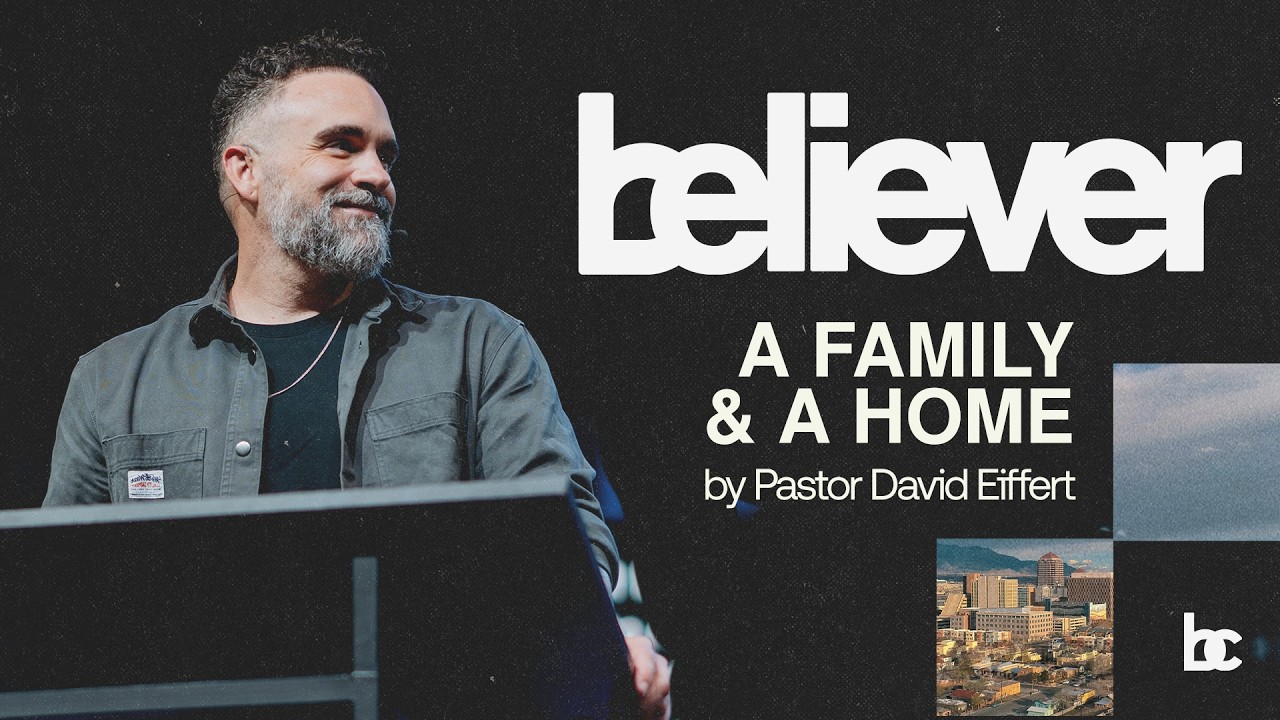
A Family & A Home
Scripture
Exploring what it means for the church to be family rather than just a gathering, drawing from Mephibosheth's story and Jesus's words that whoever does the Father's will is his family, calling believers to share joy and burdens and refuse to quit on one another.
Transcript
Hey, if you all have your Bibles, I’d like to invite you to turn with me to Matthew chapter 12. We’re in week two of a series that I have entitled Believer. What we’re talking about a little bit for the series is, you know, as a church, 46 years looking to the future, celebrating the past, looking to the future. It’s a new season with a new name, Believer Church. And so it’s the same Jesus, it’s the same mission, but it’s new language. So we’re going over some of the language of who we are, what our culture is. I don’t know if you know this, but language is important, because it’s not just fun slogans - they can also be things that center our shared life together. These are pieces of language that we’ve worked on communally for a really long time, and we think they’re going to play a big part in who we are in the future.
So I just wanted to show you what I showed you last week. Believer Church: Follow Jesus, love Albuquerque. That’s the big slogan for us. You’ll see that everywhere. And then we have what we’re calling our six commitments: we follow Jesus, we lead with love, we speak truth with grace, we love Albuquerque, we give freely, and we are family.
Last week we talked about “we follow Jesus.” That was the whole idea last week - we’re a Jesus-first people. And under each of these commitments, there’s a little paragraph that as the series progresses, I’m going to be revealing to you. Here is the paragraph under “we follow Jesus”:
Jesus is at the center of who we are. Not religion, not tradition, not an institution. We are unapologetically Jesus-first people, learning to follow him the way the first disciples did, by the power of his Spirit. We hold everything we do up against one question: does this look like Jesus?
Can I get a good amen? Y’all here this morning? Good.
We Are Family
So what we’re going to talk about this week is we’re going to go to commitment number six, and we’re going to talk about this: we are family. Why don’t you say that with me - we are family.
You know what’s interesting about the Christian faith is about ten minutes after you say yes to Jesus, you look up and you see that there are lots of other people around that have also decided to follow Jesus. And a lot of those people you wouldn’t pick. Some you would perhaps, but a lot of the people in the room you wouldn’t pick. But Jesus looks at us as a collective group and he says this about us: that we are family. We’re family.
You know it’s interesting because every church says “we are family.” Everybody says that. Olive Garden says it - when you’re here, you’re family. They’ve been saying that for probably three decades. I’ve gone a lot, and I’ve never been invited to Thanksgiving. I’ve never gotten a call.
So everybody says that we’re family. But I’ll tell you that for me personally, just my testimony - y’all know this, I’ve told you a lot of times - I’ve been coming to this church since I was a fetus. Literally, that’s not a figure of speech. I first started attending when I was in my mom’s belly. They started attending the church that long ago. And so when I think about my time, I’ve never had any other pastors besides Marshall and Cindy in my entire life. I’ve never been a member of another church except this one.
And so sometimes I think about what it is that made this place sticky for me. I’ve got lots of friends that left - they left the church, they went to other churches. And it’s like, what is the thing that has made this place sticky for me? So I was thinking, well, was it the worship? The worship probably helped. The worship was good. Maybe it was all the incredible sermons that I heard over the decades? Probably. But I’ll say the thing that made the difference for me is this place has always been a time when my family comes together to be together. It’s not just me using marketing language to say this is literally my family. All my best friends are here. I met my wife at this church. We raised our kid at this church. My parents are here right now. My nephew’s here right now. This is a place where community happens for me.
And even when we go through great celebration, the thing that we’re most excited about is to come here and share it with you, because you’re our family, right? And when things get hard and things are bad, the place that I draw strength from - outside of God, you know what I’m saying - the place that I draw strength from when I’m in a place of need is this family.
And so it’s just so much more. And I think that there’s a lot of people that will come to a church like this, will come to a service, and they just come and they sit and they’re like, “Yeah, I get it, it’s cool, but I don’t think anybody even knows my name here.” And look, we need to do a better job at our part in that. We do everything that we can, but we’re going to do even more to get to know you, to get you plugged in - but also understand that you have a part to play in that too. If you come in and you don’t talk to anybody, you show up five minutes late and you just go sit in the corner, and then as soon as service is over you take off - look, I hope you like it, but that’s just a fraction of what we actually offer as a church community. Because we’re not just a gathering of people to sing songs and listen to a talk. We’re family. We live life together. We celebrate together. We cry together. And we’re a family.
So here’s the paragraph behind the idea of us being family. I hope that it’s not cultish, you know what I mean? Because I know that when it sounds like “oh, they’re a family” - like if there’s a documentary on a church called The Family on Netflix, y’all know what it’s about. It’s about a cult. But anyway, that’s not us. So here’s our paragraph:
We are family. We are a family of spiritual fathers, mothers, sons, and daughters. We treat each other with compassion, mercy, and kindness because that’s how Jesus treats us. We are imperfect people learning to become more like Jesus, and we are doing it together because that’s what families do.
And you might be thinking, interesting language there. You could have said “we’re a community.” You could have said anything. But actually, the family language - that’s something that we get from Jesus. Jesus himself would call his followers a family. And it happens in such a cool way to me in Matthew chapter 12. Jesus is teaching, the room is packed, and then someone comes up to Jesus and says, “Hey, hey, hey, Jesus, your mom and your brothers are here and they want to talk to you.” And watch what he says when his mom and brothers show up while he’s talking to his followers.
He replied to him, “Who is my mother, and who are my brothers?” Pointing to his disciples, he said, “Here are my mother and my brothers. For whoever does the will of my Father in heaven is my brother and sister and mother.” (Matthew 12:48–50)
Isn’t it interesting that you probably never expected for Jesus to call you his mother? Whoever does the will of the Father is my brother and sister and mother. And I’m just thinking, if you’re Mary, that’s a bad day. She’s been outside a while, waiting. She’s like, “My son’s in there.” And then someone comes up and says, “Hey, Jesus, your mom’s here.” And Jesus is like, “Who’s my mom? Who’s my mom?” Don’t try this at home, by the way. Don’t try this with your wife. Let’s imagine I was talking to the staff, and Jordan shows up, and someone comes and says, “Hey, David, your wife’s here.” And I say, “Who’s my wife? Y’all talk to the staff - y’all are my wife.” I’d be sleeping in the courtyard. Not even at home.
So what is Jesus saying here? Well, the reality is Jesus isn’t trying to be rude, but he’s saying that there is a family that’s even deeper than family by blood. And that’s what Jesus invites you into. He doesn’t invite us into a building or a program. He invites us into a people. And it’s a people that he calls a family.
So if you’re taking notes, I’d like you to write down this title: a family and a home. I’ve got three things for you.
One: Jesus Makes Us Family
Turn with me, if you have your Bibles, to 2 Samuel chapter 9. It’s kind of an interesting story and encounter here. If you don’t know where we’re at, near the beginning of 2 Samuel, there’s this man, Saul - he’s the king. He lost his mind over the song, as we’ve talked about. He’s jealous of David, and he’s been trying to kill David. But what’s interesting about the story that we probably talk about less is that Saul at the same time has a son named Jonathan. And as fate would have it, Jonathan and David are best friends. And in this time when Saul is trying to kill David, David makes a promise to Jonathan to care for his family when he becomes king, should his father not succeed in murdering him.
So when we fast forward to chapter nine, Saul is dead, but also Jonathan is dead. So the guy trying to kill David is dead, and his son, who was David’s best friend, is also dead. And now David is king. And in the ancient world, when you become king, one of the first things you do is you clean house - you locate all the family of the previous administration and you kill them. I’m glad that we don’t have that ritual here in the US. We do have a softer version of it, which is we don’t kill them, but we just spend all four years complaining about how bad the last administration was. It’s like we don’t kill them, luckily, but there’s usually not a lot of love lost between one administration and the next. Especially if they’re pretty different. And Saul and David were quite different.
But look at what David does instead.
David asks, “Is there anyone still left of the house of Saul to whom I can show kindness for Jonathan’s sake?” (2 Samuel 9:1)
And I just wanted to point out that nobody suggested this to the king. This wasn’t like a focus group saying, “What we should probably do is bless Saul’s family.” Nobody’s saying that. But that’s his idea - hey, is there anyone still around from the family of the guy who tried to kill me? Great, go find him, because I want to give him stuff. That’s what David is saying.
And so it turns out Jonathan, his best friend, has a son, and his son is named - anybody know? Mephibosheth. I’ve been practicing it all week. I can read it, no problem - I just see letters and I know who it is.
So there is a son, there’s an heir. And David says, “Well, go get him.” So David’s guys show up at Mephibosheth’s place. And if I’m Mephibosheth, I’m thinking I’m a goner - it’s been a good run, I’ve had fun, but it’s over for me. That’s what I would think. But they grab him, they take him over to David.
When Mephibosheth, son of Jonathan, the son of Saul, came to David, he bowed down to pay him honor. David said, “Mephibosheth?” “Your servant,” he replied. (2 Samuel 9:6)
I love that the first thing that David says to him is his name. He doesn’t say “son of Jonathan.” He doesn’t say “grandson of Saul.” He calls him by his name.
“Don’t be afraid,” David said to him, “for I will surely show you kindness for the sake of your father Jonathan. I will restore to you all the land that belonged to your grandfather Saul, and you will always eat at my table.” (2 Samuel 9:7)
Whoa. All the land that the previous king had, that had been lost - I’m going to return that back to you, Mephibosheth. And you will always eat at my table. That’s not just eating at the table - that means something really significant in this culture. It shows in verse 11:
So Mephibosheth ate at David’s table like one of the king’s sons. (2 Samuel 9:11)
Not as a guest, not as staff, not as a charity case you see near the kitchen - but as one of the sons.
And if you’re a professional Bible reader in the room, when you hear this story - a king that calls someone by name, says “don’t be afraid,” restores what was lost, offers you a seat at the table - you’re thinking, “Oh, that’s like Jesus.” And that’s exactly what it is. So King David on his best day is a preview of King Jesus.
And I find it worth noting that Mephibosheth isn’t searching for the king. The king is searching for Mephibosheth. And in the same way, that’s how it is with us - I tell you this all the time, we don’t search for God. And even if you did, you wouldn’t be capable of finding him. The only way that we have access to him is that he comes running for us. Everything that we do in the Christian faith is a response to something initiated by God.
So the fact that God calls you by name is actually good news. A lot of people, when they think, “God’s calling my name,” think it’s because I’m in trouble - principal’s office, God wants to say something. But I want you to know this: God doesn’t tolerate you. Maybe your wife does, but God doesn’t tolerate you. He calls you by name because you have a place at his table.
But what’s really ironic is I think a lot of people don’t want to accept the invitation to sit at Jesus’ table because of the other people that are sitting at the table. It’s like Jesus is like, “Hey, you want to come up for dinner?” And you’re like, “Oh, right on, what time?” And Jesus is like, “7:30.” And you’re like, “Cool, cool, cool, cool… who else is going to be there?” It’s like, “I need to see the guest list before I know if I’m interested in coming or not.”
And there’s a lot of people that should be in this room that aren’t in this room - not because they got any problem with Jesus, but because they could not make peace with the reality that you get to sit at the table just like they do.
I think even Gandhi said something about it - like, “Pastor, I’m cool with Jesus, but I don’t like his people.” And I get that. But what you got to understand is this: Jesus doesn’t offer individual memberships into the kingdom. It’s not a gym. What he offers is brothers and sisters, a family. You could say it like this - I’ve got it on the screen:
You can’t say yes to the king and no to his family.
So what’s the solution? Well, the solution is to come to the table with humility. Understanding that as ridiculous as it feels to you that they’re allowed at the table, it’s also ridiculous that you’re there. The whole thing is absurd.
And so you come and you understand, “Man, this Christian life thing - I just got to understand that what is offered is living life with people who are just as imperfect and frail and fragile and insecure and moody as you are.” And it’s actually beautiful that we’re family. We’re family not because of our bloodline. It’s not because of what church you go to - that’s not the reason that we’re family. It’s because of our faith in Jesus. That’s the thing that makes us family. So I can go across the world and find a Christian that’s my brother. I can go to the church down the street - this room is full of my brothers and sisters. I can go to these churches and they’re not competition, they’re my family. I can go to Citizen Church and say, “I bless you, my brothers and sisters, I pray that God would bless you.” I can go to Legacy Church. I can go to Calvary Church. I can go to Sagebrush Church. And do we have differences? Yeah. Welcome to being family. It didn’t stop making you family. The thing that makes us family is not church membership, it’s not bloodline - it’s the fact that we’ve put our faith in Jesus.
Number one: Jesus makes us family.
Two: As Family, We Share the Joy and the Weight
Look at what Paul says. Romans 12:15:
Rejoice with those who rejoice, mourn with those who mourn.
Isn’t it interesting that your life situation can pull me into either rejoicing or mourning - not because of something that happens to me, but because of the fact that you are my family?
I’m thinking about that question: which do you think is harder, rejoicing or mourning? Now before you answer, I’ll say that most people would say I think it’s probably mourning - that’s probably hard. But I’ve been thinking about it, and I’m not super sure that’s true. Most of us are better at the funeral than we are at the party. What do you mean? Because mourning with someone costs you a casserole. Rejoicing with them costs you your ego.
Hit me with some examples. You’re at work. Someone says, “Hey man, I got that promotion we’ve both been pursuing.” “Oh my god, congratulations!” And inside you’re dying. It’s like, “I’m so happy for you,” but you’re thinking, “Well, I applied for the promotion too, it just got political, blah blah blah.” And it’s like, wow, you were celebrating with them for like four seconds, and now it’s already about you. Your internal dialogue already shifted off of your brother onto you.
Or how about this one - a friend says, “We finally booked it, two weeks in Hawaii!” You’re like, “Congratulations!” But you’re thinking, “Must be nice.” “Must be nice” is not the language of someone celebrating with somebody else. And the thing that happens for all of us - this happens to me too - is that it feels like their win is your loss. Especially when they get the thing that you prayed for. They got the job you were praying for. They got the baby you’ve been praying for. They got the engagement you’ve been praying for ’cause you’re single. And I’m not judging the feeling, I’ve had the feeling. But the truth is this: their win is not your loss. God did not run out.
It’s not like - you know, Wednesdays I play volleyball and then I go to Arby’s. See, all this - it’s the best. I get two sandwiches, one for me, one for the dogs, every week. So they come home - roast beef Wednesday. And so it’s like they get this block of meat and it’s divided amongst them. So I put some in their food, and we do a whole sitting, and sometimes when I break off a piece and I feel like it’s overly large compared to the other pieces, I feel like the other dogs are saying, “What the - ?” But the reason is because there’s a limited amount of roast beef. This is a really dumb analogy, but there’s a limited amount of roast beef, and so the other dogs’ win is your loss quite literally. But you just got to understand that is not God’s economy. We live in a world where everything is scarce and there’s not enough for everybody. God’s economy is limitless.
And I would even argue that you position yourself to receive better when you can actually rejoice with other people who are receiving, as opposed to getting jealous. The place to receive from God is by doing what he says to do. And he tells us to rejoice when other people are rejoicing. Let their good news just fill the room for a minute. That’s what I want to tell people - just let it occupy the room. You don’t have to say, “Oh yeah, well, you know, some vacation, oh yeah, well you know we’re hoping to go to - ” It’s like, shut up about your vacation. They’re telling you about their vacation. Let their vacation occupy the room for two minutes. Ask them a second question about it. “Oh, what’s the first thing you’re going to do when you land? Oh my gosh, what hotel are you staying at?” Let it be about their celebration for five whole minutes.
And I’ll be honest, this is tough with pastors. I hate to do too much pastor talk around here, but I was having lunch maybe a month or two ago with a pastor friend in town - smaller church, and when they think of a big church, they think of us. We were having lunch and just talking, and I said, “Man, how’s church going?” And he said, “Oh yeah, it’s going good, you know, we’re getting some guests, and we redid the guest bags and all this stuff.” And I’m like, “Man, that’s so incredible, guy, you’re so smart, how did you think to do that? That’s so cool, that’s so smart.” And I told him, “Man, you are crushing it, you’re doing such a good job, and I’m so proud of you, man, the church is benefiting, you’re reaching people for God.” And he says, “That’s funny, ’cause I was going to tell you that same thing. I was going to tell you what a good job you’re doing, all the changes you’re making, the church is growing, it’s just so awesome.” And there was nothing sensational about it - we weren’t trying to puff each other up. The only thing sensational was the pizza. Y’all ever had that Jamani pizza? Oh, forget about it. The angry one - pepperoni with sliced hot honey, if you’re into that kind of thing.
Anyway, we were there, and it just felt so unusual and refreshing to me in my heart to hear pastors - in the world it’s competition, but in the kingdom it’s brothers and sisters. So we celebrate with other people that celebrate.
And I think people can sometimes land on one of two extremes. Some people in the room - not you, but other people in your row - only bring us the weight. It’s just a prayer request every week, we never hear the outcome. “How you doing?” It’s like the only thing you bring is weight, it’s just hard, it’s hard, I need, blah blah blah - you never tell us anything good that happens. Other people are the opposite - they just want to show us the highlight reel. “Amen, brother, things are so great, brother, praise God, I’m so blessed, God is good.” But the family gets both. The family gets both when you’re winning and when you’re fighting.
You can write this down, I’ve got it on the screen:
If you’re winning, don’t win alone. If you’re weary, don’t be weary alone.
And so the other side is not just celebrating with other people - it’s also learning how to mourn with those who mourn. Look at how Paul says it, Galatians chapter 6:
Carry each other’s burdens, and in this way you will fulfill the law of Christ.
So carrying each other’s burdens is the family job description, and it says that when you do that, you’re fulfilling the law of Christ. But look at what he says three verses later, verse five:
For each one should carry their own load.
Wait, what? Well, which is it - do we carry each other’s burdens, or do we carry our own load? Both. Here’s how I understand it: a burden is like a boulder - this thing that will crush you. It’s the diagnosis, the layoff, the kid that’s in trouble, the marriage falling apart. And if you try to carry that boulder alone, it will crush you. But the load, that’s like your backpack - and in that backpack are things that no one can carry for you. That’s your choices, your decisions, your walk with God, the condition of your heart.
So the boulder we carry together, but you carry your own backpack. Or if you’re me, I carry my backpack and my daughter’s stuff - I carry her backpack. She’s nine, she’s a freakishly strong kid, she can do multiple chin-ups, dead hang. But when it comes time to carry her water bottle, she’s the weakest human being on the planet. Dead. Anyway - we carry the burden together, but you carry your backpack.
So here’s something I’m trying to get better on. I was thinking about it, praying about it this week. Something I’m trying to stop saying as much, although it’s hard: “Let me know if you need anything.” I say that all the time. I look at my texts and I’m like, why am I saying “let me know”? Nobody in the history of humanity has ever “let the other person know.” “Let me know” is where help goes to die. “Let me know if you need anything” means “I’m trying to be nice and this conversation is over.” That’s what that means. Family doesn’t say “let me know.” Hey, mom, let me know if you need anything - you don’t say that. Family says, “I’m bringing dinner Tuesday. I’ve got your kids on Thursday. I’m driving you to that appointment, don’t argue with me, I will pick you up at eight.” It’s not “let me know if you need anything,” because family - we carry each other’s burdens. We’re not hitting him with “let me know if I can do anything for you” - we run to each other to help carry each other’s burdens.
There’s no better, more obvious example than when my wife and I were in California when our daughter Grace was born. She spent a couple weeks there in the NICU, and we were in California for multiple weeks. And one thing that’s just amazing about that season, of course, is God’s goodness and his faithfulness, but also how the family sprung into action. I know we’ve already told you about this, but when we think about all the different people that played a vital part in making that possible - we had a lady come to our house to housesit with like one hour’s notice, three weeks of housesitting, multiple dogs, and she came at 10 p.m., “I’ll be there right on,” ’cause we had to hop on a plane, we had to roll out quick. There were people who got our flights, and here was the car rental, and “I’ll text you the thing on your phone” - all these different pieces coming into play. And then family came down to California to help us care for them. My mom and dad brought a truck ’cause we had so much stuff, it wasn’t like it could fit in a carry-on - had a whole truckload of stuff for this baby. And then there were people who had connections with people in government agencies who were able to follow up and help us with all the paperwork, and there were all sorts of strategic things that needed to take place for us when we were in the middle of the biggest battle of our life. The family was there.
Me and Jordan carried plenty. I had plenty in my backpack. I had to carry my own faith. I felt like I was carrying my own family. I was carrying like money exiting the bank account, you know what I mean? There was plenty that I was carrying, but I was not carrying the burden myself. I was carrying my backpack, but the family was helping me carry the burden.
And you might say, “Pastor, here’s my problem, man - I just don’t know what to say to people who are grieving.” People tell me that. Pastor Shirley, you probably hear that. “I don’t know what to tell people who are grieving.” Here’s the thing that’s good: Paul doesn’t tell you to say anything. He just says to mourn with them. So you don’t have to explain anything, you don’t have to fix anything to be able to mourn with them. Here’s some words, you ready? “I’m so sorry. I love you. I’m here.” You don’t have to have an answer to be a good friend.
But family shares both the joy and the weight. And let me just talk briefly - I’m wrapping up here - men are amazing at carrying and terrible at being carried. That’s just true. It’s like, “No, no, no, no, no, we’re fine, we’re fine, we’re fine.” You’re not fine. You’ve been having cereal for dinner for four days. Let somebody help you. Let somebody in. That’s not a weakness. That’s family.
Number one, Jesus makes us a family. Number two, we share the joy and the weight.
Three: We Don’t Quit on Each Other
We don’t quit on each other. So what’s awkward about the Christian faith is, let’s say someone says something bad about you, someone betrays your trust, someone’s rude to you, and then you come to church and they’re sitting three rows over. Well, Paul says this in Colossians chapter 3, verse 12:
Therefore, as God’s chosen people, holy and dearly loved, clothe yourselves with compassion, kindness, humility, gentleness, and patience. Bear with each other and forgive one another. If any of you has a grievance against someone, forgive as the Lord forgave you.
I think it’s significant that he says “bear with each other.” He didn’t even say “enjoy each other.” He didn’t say “click with each other,” because sometimes being family is bearing with each other. And statistically, sometimes the person that needs to be borne with is you. There were multiple spouses in here that wanted to say amen - not about your spouse, it’s too late for that.
And the standard is this: forgive as the Lord forgave you. And I think it’s hard because oftentimes for a lot of us, we’re used to having relationships that are consumer-based - like a business. Let’s say you go to Costco, and Costco stops carrying the thing that you want, so you go to Sam’s Club - you didn’t hurt Costco’s feelings, they’re not going to call you and say “we’ve been missing you.” It’s just consumers. And we have to be really aware of not letting that tendency come and bleed into how we understand church and church community.
My last story is this: there was a time when the creative team - I was up here and I was like, “Let’s go ahead and show that photo that I gave you,” and the photo didn’t come up. I was like, “Let’s put up that photo,” and I said, “Come on, guys.” And then I was like, “Well, never mind,” and I kept preaching. Then I got off stage and I looked at my phone - I never sent them the photo. So I went to him and said, “I’m so sorry, I’m so sorry, please forgive me, I’ll do better next time.” And now, whenever something’s not right on the screens, I assume it’s me, not them. But we got to give each other that love and that grace.
Lead With Love
My last one is this - “lead with love,” one of our other commitments. I’m just going to read it to you because we’ve been dancing around it all morning:
Love is our first move toward every person. Not love is a feeling - love is a habit. Before anyone believes what we believe or lives how we live, they are already loved by God, and they will be loved by us. We love God, each other, and Albuquerque the way Jesus loved us - first and without conditions.
So it’s not just about attending church services. It’s about committing to becoming a family. And if you’re saying, “I want to, but I don’t know how” - let me tell you, there’s lots of different ways. You can join a serve team, you can join a small group. But just do the work, because sometimes becoming a family is someone coming to you, other times it’s you going to someone else.
But it’s not just about being church members together. It’s about being a family. Here’s my closing statement: make room in your life for the family Jesus gave you.
One: Jesus makes us family. You can’t say yes to the king and no to his family.
Two: we share the joy and the weight. If you’re winning, don’t win alone. If you’re weary, don’t be weary alone. You carry your backpack, but we carry the boulder together.
And number three: we don’t quit on each other. Forgive as the Lord forgave you - not as much as they deserve, as much as you received from Jesus.