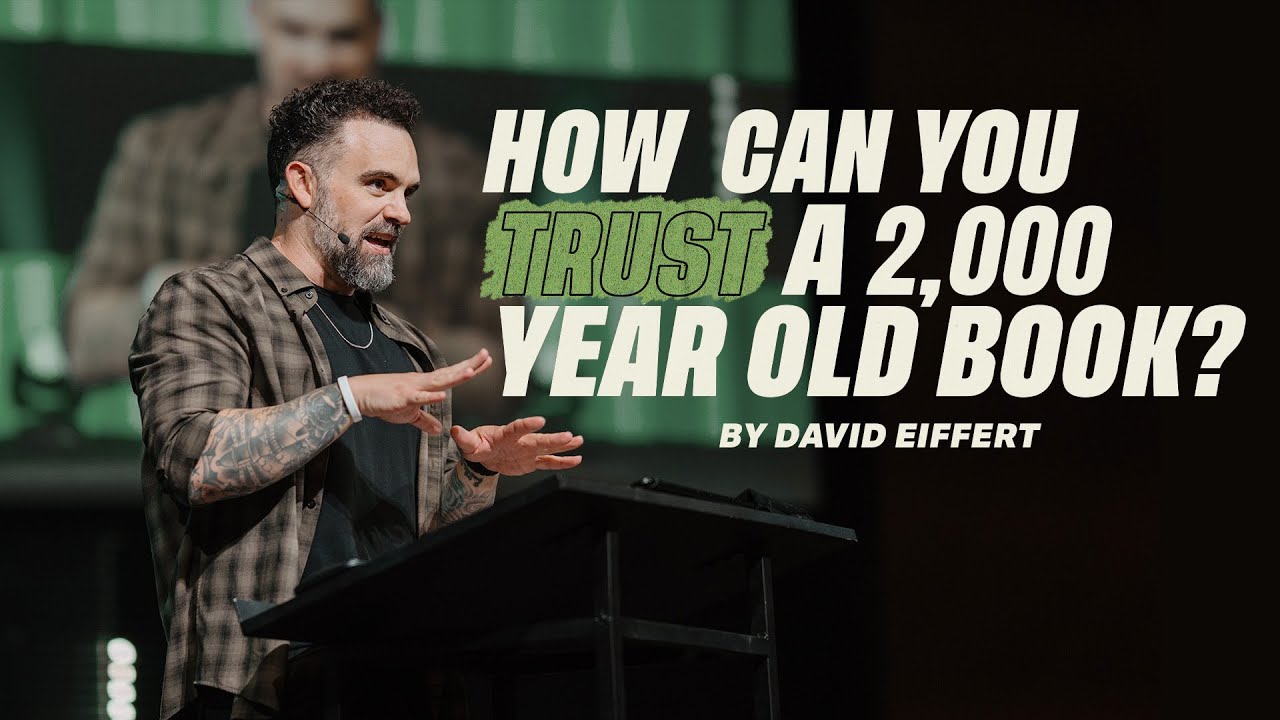
How Can You Trust a 2,000 Year Old Book?
Scripture
A five-point case for why a follower of Jesus can trust the Bible: the Gospels are historically reliable first-century documents, Jesus himself proves trustworthy, Jesus honored the Hebrew Scriptures as God's word, he promised the Holy Spirit would preserve his message, and the early church received the apostles' writings as Scripture.
Transcript
Luke Chapter One
So grateful for all of you. Luke chapter one, beginning in verse one, it says this.
Many have undertaken to draw up an account of the things that have been fulfilled among us. Just as they were handed down to us by those who from the first were eyewitnesses and servants of the word. With this in mind, since I myself have carefully investigated everything from the beginning, I too decided to write an orderly account for you, most excellent Theophilus, so that you may know the certainty of the things you have been taught.
Let’s pray one more time. Heavenly Father, today we would ask in particular that as we seek to grow and learn and understanding of this amazing book that you’ve given us, we would ask that you would help us to have open minds, to have open hearts, and that you’d help us to receive what you would have to share with us today, and that you’d help us to implement what you have to share into our daily lives. Again, we say thank you. We love you. It’s in your sons, let me pray. Everybody said amen.
Hot Potatoes
Okay, so this is week two of a series that we’ve entitled Hot Potatoes. And I know y’all are thinking that’s the worst title, and I think you might be right, but let me just explain to you how being a pastor works, one of the things that we do. So when we plan out the year, we try to understand how different things are happening throughout the year. You know, this is the balloon fiesta, this is Fourth of July weekend, this is, and so we kind of track and try to monitor the attendance of church throughout the year, and so that we know that during the summer, church attendance is like super high and low. It’s always fluctuating. Reasons for that’s pretty obvious. Y’all travel, you guys go out, and so we know it’s not the right time to do a series that’s really like dependent on the previous weeks. Because some of y’all are gonna be here one week and then you’re not gonna be able to be the next because it’s a summer.
And so some people will, a bunch of churches will do, like, you know, at the movies, where each sermon will be about like a movie. That’s not really my style, but so what we decided to do is instead do this series that we called Hot Potatoes, where each of the weeks are their own self-sustaining message where we’re addressing a hot topic issue on your faith journey. And last week, if you weren’t here, we talked about this was the opening question why are Christians so judgmental? Why are Christians so judgmental? And these were the points just review. Everyone believes in absolute truth, even if they say they don’t. Number two, God’s rules are rooted in love, not control. Three, Jesus shows us that truth needs grace and grace needs truth. And if so, if you missed that, I’d encourage you to catch it on the podcast or YouTube. Because I think we talked about some foundational issues that everything else sits on.
Can You Really Trust a 2,000-Year-Old Book?
And so this week we’re talking about a new question in the faith, and the question is this can you really trust a 2,000-year-old book? Can you really trust that surely? Yes. Pastor Shirley, yeah. Can you really trust a 2,000-year-old book? You know, it’s no secret at all that about 10 years ago, my generation, I’m a millennial, I’m an elder millennial. Any millennials in the house? Thank you. I’m sure you saw there’s like 17 hands, and that’s precisely the point I’m about to make. It’s no secret at all that about 10 years ago, my generation experienced what we might call a mass exodus from the Christian faith.
Now, if you go to any church, not just our church, any church across the nation, there are teenagers, there are people in their 20s that are like on fire for Jesus. Thank you for that. Thank God for that. But there’s like this group, let’s say maybe 30 people between the ages of 30 and 45 that are eerily absent from the American church. Some of them are your children. Right? And there’s a lot of reasons for this. I’d say that probably the biggest reason why this mass exodus occurred is because my generation became really careless on the voices that we let into our minds and into our hearts. And it began to erode our trust in the Bible.
And so if you think like talking about scripture, hey, look, I already believe in the Bible, I love the Bible, it’s not that important. It’s important. It’s an important topic because it’s something that if the devil can attack your confidence in Scripture, for most people, it’s just a matter of time before you’ve exited the faith all together. But I just need to let you know that the Bible for me is one of my great loves and great passions in this life. Like right after high school, y’all probably know this, I went right to Bible college in Colorado. I had no plans at all to be in ministry. There was like all these ministry tracks, you know, when you’re in Bible college, you kind of had to choose, oh, do you want to do this type of ministry, this type of ministry? And I said, like, I don’t want to be in ministry. I’ve got no interest in ministry, which is funny. I obviously in hindsight, plus I had no interest in ministry, but I just loved the Bible.
Why the Bible is Important
And I want you to know that I still love the Bible. I have, in fact, I have devoted a significant portion of my life to teach this book to people. So the question is why though? So we as Christians, if you identify as a Christian in the room, we are people who want to follow Jesus. Are you with me? Right? And so, in order to be a follower of Jesus, what that means, a Christ follower is to be more influenced by Jesus than by anything else. Right? Because if you’re more influenced by something else, like let’s say the television, right, you might be a good person, but you’re not a Christ follower. You’re a TV follower. So to be a Christ follower is to be more influenced by Jesus than anything else.
And in order to do that, well, then you have to know how Jesus lived. And you have to know what Jesus taught. And so then the question for the Christ follower is this how do you get to know the teachings of Jesus? Right? Because, like if we’re all about Jesus, then where is it that we go to find out about Jesus? Where do we go to find out who Jesus is, what Jesus taught? Well, the answer, of course, I’m sure you probably see it coming, is the Bible. And so that’s why for the Christian, the Bible is very important. It’s important for us to have a high view of Scripture.
Because think about it like this. If it weren’t for Scripture, none of you would know Jesus. Right? And like you might be thinking, no, no, that’s not true. We don’t need the Bible. Creation declares the glory of the Lord. And look, that’s true. That maybe like because of nature, you might understand that there’s like a God of the universe in some super generic, you know, creator, creator God kind of way. But like last time I checked, trees don’t talk. Right? And so like if you believe the specifics of the Christian faith, like you believe that there was a man, fully God, fully man, who came to earth, who died a brutal death, who rose on the third day to offer forgiveness to you. So if you put your faith in him, you can have eternal life. He comes to save us all. Like if you believe that, listen to me, listen to me, millennials, it’s because of this book.
The Bible as a Love Letter
Right? Like the reason that you believe any of that, the reason that you’ve even heard of the cross is because of this book. The only reason you’ve ever heard of Jesus is because of this. And so, as people who follow Jesus, the Bible becomes very dear to us. We don’t worship the Bible. This is an important point that some of y’all might not know. We don’t worship the book. Right, we worship Jesus. Right. But because we worship Jesus, we read the Bible. John Stott, a phenomenal evangelist, theologian, pastor. He said this in 1956. A man who loves his wife will spill love her letters and her photographs because they speak to him of her. So if we love the Lord Jesus, we shall love the Bible because it speaks to us of him, right?
So we love scripture. Why? Because we’re supposed to? No, we love this book because it shows us and it teaches us Jesus. And so the Bible’s precious to us because it is the love letter, in a way, a love letter from our Savior to us. And did you know? I just need I just want to say this every time I talk about scripture. Did you know that you can understand the scripture yourself? Right, like did you know that you don’t you don’t need someone else interpreting the Bible for you? And in fact, hearing a preacher, like hearing me today, and then going home and going to the Bible yourself to make sure the preacher isn’t full of baloney, is something that actually scripture encourages.
The Berean Jews
Did you know that? Did you know that scripture encourages you to go home and make sure that I’m not full of baloney? Right? Prove it, no problem. Here we go. Acts chapter 17, verse 11.
Now the Berean Jews were of more noble character than those in Thessalonica. So one group was better than the other group. Why? For they received the message with great eagerness and examined the scriptures every day to see if what Paul said was true.
Isn’t that cool? Right? So it’s like that you’re a you’re you’re of more noble character. Why? Because every day you go home and you make sure what David says is true. It’s amazing. That that so we’re not people here that think like, well, the paid professional preacher man says it, so I’ve got to believe it. Like, we’re not into group think. You can think for yourself. All I can do is present you with an idea, and then it’s up to you to do your homework, to come back to scripture and decide if you agree with me for not.
I just I just want you to know, you might be like, that’s obvious. There’s a lot of churches that do not feel like you’re capable of understanding this book by yourself. But you are. You can you can read it, and maybe it’s like, man, I read it, it doesn’t make any sense. Keep reading. Come to me, you know. Like, let’s get us, let’s get you going on a study Bible. Let’s get you go, you know, you need some help. Sometimes I need a tour guide. Boy, if I’m if I’m going to like 2 Chronicles, I need a tour guide. So there’s no judgment there. But just know this that this is a book that can speak God’s word and God’s life to you directly. It doesn’t have to just be Joyce Meyer’s sermons all the time. And that’s cool. But it doesn’t have to be that. It can be that you can read this book for yourself.
What is That in Your Hand?
Um, you know, most people I know probably don’t bring a paper Bible anymore, and that’s totally fine. I totally get it. But if you brought a Bible, I’m wondering if you could do a paper Bible, if you could do me a favor and just hold it in your hand. If you have your phone, don’t hold it in your hand. That’s so dorky, okay? Just pretend you brought one. Okay, here’s my question. Are you ready? What is that that’s in your hand? What is that? Of course, and that’s that’s a if that phrase sounds familiar, that’s a phrase, that’s of course the the phrase that God asks Moses when he’s at the burning bush. Moses walks up to the burning bush and God says to Moses, what’s that in your hand? And Moses looks in his hand and he says, Oh, it’s it’s my staff.
And this amazing that’s it’s this staff that Moses carries that is like this man-made natural staff that’s imbued with God’s power that ends up being like the vessel, if you think of Moses as that, it’s like the vessel that God’s miracles work through. You’ll recall that Moses throws his staff on the ground multiple times and it turns into a snake. In fact, at one point, the snake staff eats the snakes of the Egyptian, you know, magicians. The staff it brought the Egyptian plagues, the staff parted the Red Sea, the staff broke water from a rock, on and on and on and on. And that ends up becoming for us a great metaphor for scripture.
Because what you’re holding in your hand is a very absolutely man-made natural thing. Right? It was penned by humans. Right? It was copied by humans, canonized by humans, translated by humans, printed by humans. You know what I mean? Like, like the Holy Spirit didn’t press this calfskin leather on. Like humans did this. So it’s it’s kind of like the staff of Moses that it’s a very natural thing, but at the same time, it’s been filled with the power of God, and it becomes for us the most reliable source that we have to point humanity to Jesus. And because of that, the Bible, outside of God Himself, is one of the most powerful forces in the world.
The Gospels are Historically Reliable
And so if someone were to come to me and ask, maybe some of my some of my co-millennial friends, they ask, you know, can you really trust a 2,000-year-old book? Well, all I could do is this is I could tell them and kind of bring them in on my journey on how I found this book in spite of all of the history, all the different details that had to go into this book being in a printed form right now, despite all of that, why I think that this is a reliable source to understand Jesus. Also, I just wanted to say this if I’m like flying through it. If you want this more in depth, I actually wrote a book. It’s a brief 100-page book. It’s called Inspired, How God Speaks Through Scripture. It’s free, although you can only get it here at the church because we print it ourselves. But I have it for you. We printed about a hundred copies there in the foyer, though, they’re free, and so feel free to grab one if you want to jump in more in depth, but a hundred, so it’s first come, first serve.
Okay, so when I was young, let me start like this. When I was young, if someone were asked to ask me, do you believe the Bible is the Word of God? You know what I’d say? Yes. And then if they said, okay, why? You know what I would say? Because the Bible says so. And boy, I thought that was a great answer. Now, not so much. Right? Scripture is inspired because Scripture says it’s inspired. What I didn’t realize as a kid is that’s what we call circular reasoning. In fact, a well-known evangelist, I took his name out because I don’t take cheap shots. A well-known evangelist says this. How do I know the Bible is the word of God? Because the Bible says so. Right? And if you’ve been following God for a long time, you might think that that’s like sounds pretty good, but I need to tell you to the outsider, that’s a very unconvincing position.
And I can prove it. Are you ready? I’m gonna prove it to you. Already, my next slide. This slide is the word of God. Give all your money to David now. Here’s the question. Why don’t you believe that’s the word of God? Right? It says it’s the word of God. So almost certainly, like if you believe that the Bible is the word of God, there are reasons outside of because it says so. And I think it’s important to recognize that, especially in our society, because did you know that the Bible is not the only thing that says it’s the word of God? The Quran also claims to be the word of God. The Hindu scriptures also claim to be the word of God. The Book of Mormon also claims to be the Word of God. It’s in fact it says it on the cover. Another testament of Jesus Christ. It’s a it’s funny, it’s like Jesus was just sitting around, he’s like, first one was good, but you know what it you know what it needs? A sequel. And let’s wait 1700 years for dramatic effect.
Right? So all of these books claim to be the word of God, right? So is that proof that all of those books are the word of God? No. And so why do we believe it when Scripture says it’s the Word of God and the Quran doesn’t? Why, you know, so that’s what we’re gonna talk about. Can you really trust a 2,000-year-old book? I’ve got five lightning fast points. They get faster as we go. This is how I have arrived in my assurance of Scripture as a millennial. I’m like a black duck, and then I’m a I’m a I’m a millennial who believes in the in the Bible. Why? Okay, here you go. Number one, ready? The Gospels are historically reliable. This is where you start. The Gospels are historically reliable. I’m not talking about in the inspired word of God, I’m not talking about God’s word, I’m just talking about historically reliable.
Just about everyone agrees, all historians, everyone agrees that the Gospels, which is the first four books of the New Testament, Matthew, Mark, Luke, and John, are first century documents. Means it’s written in the first century after Jesus. Some would argue mid-century, some would argue late century, but no one debates that the gospels are first century documents. They are. And I think it’s important just for you to know, it’s like my only point that I’m gonna make, then we’re gonna get to more practical stuff. But in historical terms, that’s incredibly close to the events that they describe. And that’s helpful because it reduces the risk of stories evolving over time. Right, and there’s more accountability if you’re writing about something that happened recently versus events that happened a long time ago.
Right? So, so like, for example, let’s say someone says Plato never existed. And some of y’all are like, Plato, I got Plato at my house. Not Plato, Plato. Right? If someone says, like, man, Plato never existed, you know, like fourth century BC, right? Well, they would receive a lot of criticism for that, but it would be hard to prove that it’s untrue. But now imagine someone came and said, like, Taylor Swift never existed. Right? They’d be a laughing stock because it’s much harder to deceive when you’ve personally experienced something. Contrast that with someone like Buddha. Y’all know Buddha is the leader of the Buddhist faith. Buddha lived here on earth, and the earliest writings that come up from Buddha were written five hundred years after his time on earth. And it’s like it’s it’s just kind of a long time to say super specific stuff about a guy.
You know what I mean? Like it’s like, and then he winked. It’s like, really? 500 years ago? Like you remember a wink from 500 years, it’s been past generation after generation. Like, like, what did you eat for lunch last week? I don’t know. You know what I mean? Let alone like a wink 500 years ago. Right? And so it’s like all of these historical texts, they all have the the danger of kind of doing the telephone game. Y’all remember the telephone game, right? Like where someone says something in ears, like it’s like read your Bible every day, and then read your Bible, and then by the end, they’re like, What did you say? And it’s like, feed your poodle, cheddar spray, you know what I mean? It’s like that’s not what I said.
Right, but the gospels are different. It’s because these are these are not stories that were written about Jesus hundreds of years later. These were stories, these were accounts from people who are motivated to get the story right, written in the century that he was born. Luke chapter one, again, verse one, I’m gonna read those four verses again.
Many have undertaken to draw up an account of the things that have been fulfilled among us, just as they were handed down to us by those whom from the first were eyewitnesses and servants of the word. With this in mind, since I myself have carefully investigated everything from the beginning, I too decided to write an orderly account for you, most excellent Theophilus, so that you may know the certainty of the things you have been taught.
So in the first century, writing was like a really expensive thing to do. It’s not like now, or like any bonehead can, you know, launch a blog and like you know, spew whatever, not your blog. I’m sure your blog’s great. Yeah. I can’t wait to read your blog. But like in the first century, writing was really expensive. It was this really costly thing. And so oftentimes what would happen is they’re if they’re wanting to do this historical document, which is what the gospel of Luke is, they’re wanting to make this there’s like a rich person, a well a well-to-do person, in this case a man by the name of Theophilus. He would sponsor the project, and so he would he would employ a very highly educated person like Luke to write this orderly account. It’s a very expensive people to do. And so he would sponsor this project to write these historical documents, and so he would not have tolerated made-up stories in his sort historical document.
We’ll move on to the next point, but here’s the summary of this point. The gospels are historically reliable because they document the most influential man in the history of the world, and they were written in a precise way very soon after the events took place by people who were motivated to get the facts right. I know that’s I know it seems like a lot, but that’s like a little foundation that you need in my way of understanding all of this that you think and you understand that we can learn about a real man named Jesus in these gospel books. Number one, the gospels are historically reliable.
Jesus is Trustworthy
Number two is this, Jesus is trustworthy. Jesus is so the next step, if someone believes that the gospels are reliable, is they would learn about Jesus, right? And they’d start to be impacted by Jesus, and they would find Jesus trustworthy in their heart. They would let Jesus become their teacher. And so, like, still at this point, we’re not worried about the Bible being the word of God. We just recognize that these are reliable books, and we’re reading and learning about Jesus. And even in that small move, we’re giving Jesus like an inroad into a person’s heart. Even then, like Jesus is starting to compel us.
I remember years ago, I was a youth pastor at this church, and I had been a youth pastor for I don’t know, five years. And just for whatever reason, I was like feeling I was in this really kind of dry season. Has anyone else ever felt that? Right, right. It just wasn’t like feeling God. I just, you know, I was still doing, I was still doing all this stuff. I was still, you know, still praying, I was still preaching in my particular head, but I just felt like, man, I don’t know, I just feel disconnected from God. And I wasn’t super sure what to do. So this one day I just decided for whatever reason I was just gonna start reading through the Gospel of Luke, and I was gonna read the whole Gospel of Luke front to back.
And so I remember I was just reading, I was just reading about Jesus and the life of Jesus, and like how kind he was to people, and how generous he was to people and like how quick he was to forgive people and like how empathetic and how he he was always making time and space for people that culture would forget. And he he was always like going out of his way to show love to people who like the world wasn’t loving, you know, and then I kept I kept reading, and then one day I finally got to the crucifixion, and Jesus is being like brutally beaten, and he hung on this cross, and like some of his last words, he says on the cross, Father forgive them, they know not what they do. And I remember like I I just closed my Bible and I set it down and I and I just cried and I just cried and cried. There’s just there’s just something about like the life of Jesus that’s just so touching to me. It’s uh it’s like sad and it’s happy.
And I remember like at that moment, I I was already a pastor, but I remember I just I just I closed my eyes and I and I told Jesus, I said, Jesus, I trust you with my life. But like whatever you think about anything, like I’m just going with that. Right? Yeah, like I won’t make any more decisions, you make the decisions, you tell me what to think, and I’ll think what you think. Right? Like, and I just find Jesus trustworthy. Are you with me? I’m building up to something here, right? But I but I trust these books teaching me about Jesus, and then I find Jesus trustworthy, and I start to give my life to Jesus. The gospels are historically reliable. Two, Jesus is trustworthy.
Jesus Trusted and Honored Scripture
Number three is this Jesus. So this is this is where the logical loop starts to pay off. Right? So, like when what Jesus had when he was here on earth, what he had, we’d call maybe the Hebrew Bible. Right? Essentially just the Old Testament. The New Testament hadn’t been written yet. He’s the main character, it hadn’t been written until after. But Jesus recognizes the Hebrew Bible, this is what you have to understand, as Scripture, as the Word of God. Jesus does. And so even if you’re someone that’s like, man, I don’t know about Scripture, but I love Jesus, millennials. Listen to me. Jesus honored Scripture. Right? So if you want to be all Jesus this, Jesus that, Jesus that, Jesus that, but I don’t care about the Bible, you can’t be, because Jesus treats the Bible as Scripture. Jesus does.
And I’ll be perfectly honest. Like, if it if it weren’t for that, I would the Old Testament would be hard for me. Am I the only one? Because it would feel like a big fairy tale. I cannot possibly be the only person in the room that reads some of this stuff, and it’s like, that’s we’re not talking like literally, are we? This one actually happened, you know what I mean? A huge fish swallows a man, right? And then and he lives in the stomach of the fish for three days, and he’s vomited onto the beach and he survives. It’s like, man, I’m claustrophobic when I get in an elevator. You know what I mean? Like, imagine him, like probably not the best idea. Snow snow repenting, like in from the from the belly of a fish. But it feels like a ridiculous story. It feels like I understand the point of the story, but it’s not like a real story, is it? It’s not like an actual story. You know what I mean? Because it just seems like that, right? A flood that covers the entire earth. It’s like, yeah. Yeah, yeah, yeah. Yeah, yeah, yeah. You know what I mean?
Like a talking donkey, Balaam has this, he’s riding a donkey, and the donkey stops because there’s an angel in the road, and the donkey can see the angel, but Balaam can’t see the angel, so the donkey just thinks he’s got a wicked donkey, so he smacks the donkey, and the donkey turns around and he says, Like, what have I done to mistreat you that you would treat me in such a way? You know what I mean? It’s like I cannot possibly be the only person that’s like, are we ever supposed to like believe these for real? Or you know, it just feels ridiculous. There’s just parts of the Old Testament that feel like a fairy tale. In fact, there is there was an early church movement called Marcionism. Marcionism is regarded as a heresy in the church, but the idea was this is that we believe in Jesus and all that he taught, but we reject the Hebrew Bible and the God of the Old Testament. And it almost sounds good. Now that’s a religion that millennials could get on board with. You know what I mean? Because they love Jesus.
The problem it the problem is this that Jesus recognizes the Old Testament as scripture. Jesus does, as the word of God. And so you have a pickle, like if you trust Jesus, well then all of a sudden you are forced face to face to decide what you think about this precious book. Look, give me some verses, no problem. Jesus says this, Matthew chapter 5, verse 17.
Do not think that I have come to abolish the law or the prophets. I have not come to abolish them, but to fulfill them.
Law and prophets, what’s he talking about? If he’s ever talking about the law and prophets, he’s talking about the Hebrew Bible.
Verse 18: for truly I tell you, until heaven and earth disappear, not the smallest letter, not the least stroke of a pen will by any means disappear from the law until everything is accomplished. Therefore, anyone who sets aside one of the least of these commands and teaches others accordingly will be called least in the kingdom of heaven. But whoever practices and teaches these commands will be called great in the kingdom of heaven.
This is not the talk of someone who finds Scripture untrustworthy. He’s saying if you ignore even the tiniest little bit, you can still come in, but you’ll be last. You know what I mean? Like, you’ll be least in the kingdom of heaven. Mark chapter 12, verse 35, Jesus says this.
While Jesus was teaching in the temple courts, he asked, Why do the teachers of the law say that the Messiah is the Son of David? It’s an important point here. David himself, listen to this, speaking by the Holy Spirit, declared, the Lord said to my Lord, sit at my right hand until I put your enemies under your feet.
It’s just amazing that Jesus here, he quotes Psalm 110. That’s what this is. And he says that David was inspired by the Holy Spirit when he wrote it. And so the implication is this is that if you follow Jesus, you need to take the Bible as seriously as he did, right? Right? Because, because remember, I’m I’m I’m sitting there crying and I’m saying, like, Jesus, you you’re right. You know, whatever you think, we’re just gonna go with what you think. If I have an idea that’s different than your idea, then I’m wrong and I’m dumb, and I’m going with what you think. Right? So, like if that’s where you actually are in life, then you just have to understand that what he does is he teaches us to diligently study the scriptures. And he describes them as being inspired by the Holy Spirit when he wrote them.
Here’s the closing idea of this. If you find Jesus trustworthy, you have to take the Bible seriously, because Jesus took it seriously. One, the gospels are historically reliable. Two, Jesus is trustworthy. Three, Jesus trusted and honored Scripture.
Jesus Promised His Message Would Be Preserved
Number four is this Jesus promised his message would be preserved. So think about think about it like this. It makes sense that if Jesus was showing us a new way to be human, which he is, right? He would have to have a plan on how to get that info out. And writing at this point was the primary way that that would happen. And so it makes sense that Jesus would have to be thinking through how he’s going to get his message out. And so I don’t know if you can picture this, but I picture Jesus sitting with his disciples as they’re about to undergo this really influential writing project. There’s like 12 guys and them, not exclusively them, but they’re about to write the most influential book in the history of the world. There’s like these 12 knuckleheads. And when I say no, like they are knuckleheads, they’re about to write like the most important book.
And so Jesus is their coach, he’s trying to help them how to do it. Look at what he says, John chapter 14, verse 26. He says this to his disciples,
but the advocate, the Holy Spirit, whom the Father will send in my name, will teach you all things and will remind you of everything I have said to you.
So I picture the disciples like thinking like, yeah, but what if what if we don’t remember all the details on all the stuff that you do? You know, what do we Jesus says it’s okay because the Holy Spirit is gonna come and he’s gonna remind you of everything that I said. John 16, verse 13, he says this, Jesus.
But when he, the Spirit of truth comes, he will guide you into all the truth. He will not speak on his own, he will speak only what he hears, and he will tell you what is to come.
Same thing. So he’s saying the Spirit’s not only gonna help the disciples remember what he said, he’s actually gonna show them more things and even show them things to come that they’re gonna be able to include in their books. Number one, the gospels are historically reliable, Jesus is trustworthy, Jesus trusted and honored Scripture for Jesus promised his message would be preserved.
The Early Church Treated the Apostles’ Writing as Scripture
Number five is this the early church treated the apostles’ writing as scripture. So you might be thinking, like, yeah, well, here’s the thing, it’s all well and good, but but like Jesus likes the Old Testament, but the New Testament wasn’t written. So how do we know that the New Testament is worth anything? On your right that Jesus isn’t here to validate that. So the best that we have is that Jesus said that it he’s going to watch the message, but then also the church, they validate the New Testament as Scripture. Give me some examples, no problem. Second Peter chapter 3, verse 15, says this.
Bear in mind that our Lord’s patience means salvation. So this is Peter writing. Just as our dear brother Paul also wrote you with the wisdom that God gave him.
So here you have Peter who’s writing about Paul’s writings.
Verse 16, he writes the same way in all his letters, speaking in them of these matters. His letters contain some things that are hard to understand, which ignorant and unstable people distort as they do the other scriptures to their own destruction.
Isn’t this interesting? So here you have Peter, who’s talking about Paul’s writings, and he says that people distort Paul’s writings just like they do the rest of Scripture. So it’s interesting that we have Peter calling Paul’s writings scripture. And if you know these two guys did not always get along. Peter and Paul did not always get along. But Peter, but Peter refers to Paul’s writings as scripture. And there’s lots of other examples of that. There’s times when Paul refers to Luke’s gospel as scripture. But you might be thinking, like, man, there’s there’s no way to validate this through Jesus. But the point is is this is that is that as we continue to follow the Spirit, and as we continue to let him lead us in Scripture, we we we let him be the tour guide, we let him teach us how to do it, and then we believe him when he says that I’m going to inspire the rest of Scripture.
So four points. The gospels are historically reliable. Two, Jesus is trustworthy. Three, Jesus trusted and honored Scripture. Four, Jesus promised his message would be preserved. Five, the early church treated the apostles’ writings as scripture. Woo! Okay, so I know that that was a lot, but I I think it’s an important thing for you at least to consider this. And if someone were to come to me, like if we were having coffee, and someone were to ask me, like, all right, put all your notes away, like, how is it that you actually find this book reliable? Like it it feels hard. I I would say this I I find Jesus to be trustworthy. I do. Right? And because of that, I’ve I’ve oriented my life around following him. And so I take the Bible seriously because he took the Bible seriously. And and he chose to use these writings to preserve his message.
And maybe for you, like you’re like you’re still on the journey of trusting Jesus. Like, not for salvation, but for everything, right? Like, like you trust him with aftermarket affairs, that’s all cool, right? Like, he’s gonna take care of me when I die, but then there’s still like this side, it’s still a lot of you. And and you’ve never kind of made that like transition to like you get all the ideas, you get all the votes, whatever idea, like you get the votes, right? It’s and it’s hard. It’s hard to get there. It’s hard to actually say, like, he’s right, I’m wrong, if I disagree with him, I’m wrong. It’s hard, and a lot of Christians never get there. But maybe for you, you’re in here this morning or you’re online, and and you would be honest enough to say this. I’m not there, but I want to get there. I want to trust Jesus enough to where I just do what he says instead of like maybe half what he says, half what I say.
To which I would I would I would say this trust develops through relationship. Right. Right. This is what this is what I can tell. That like even think about your own life. Think about the people that you trust the most, right? Maybe they’re sitting next to you, maybe it’s like not them, right? But think about the people in your life that you trust the most, right? Like, how did that happen? Right? Well, it was it because like you like studied them forensically and you did you did experiments on them and you demanded like irrefutable proof before you believe. No, no, the trust came through relationship, right? And the same is true with Jesus, that you just here’s what I can say. Like, if you want to, if you want to receive more from this book, and you want to like actually have a desire to experience Jesus through this book, because I know that where a lot of people are, it’s like, no, I believe Jesus’ words are in there. It’s just not as interesting as ESPN. I hear you.
But like if you want to become someone who cares about this thing, and you want to become somebody who gives their time, receiving from this amazing book, I would say this. Well, that desire is gonna come through relationship. It’s it’s gonna come through you just spending time with God, inviting him in, talking to him about things that happen all day. You know what I mean? Like, like some of y’all talk to yourself all day long. You know what I mean? Like, oh wow, oh that hurt. Oh wow, well, I better get groceries. Oh, it’s time to go. Oh, my, you know what I mean? It’s like you’re talking to yourself all day long. I’m just like, I’m like, just tweak it. Just say what you can say the same stuff, but just start saying it to him.
If people start thinking you’re crazy, you know, and they’re like, You talking to yourself, you’re like, no, no, no. And they’re like, oh, he’s so how spiritual. Instead of like, we need to call somebody. Right, but just start talking to him throughout the day. Just talk to him. Just say, and and some people, some people have these beautiful prayers, you know what I mean? Like, I love hearing Shirley and Gail and Pastor Cindy pray, but I also kind of hate it. You know why? Because I’m feeling like I’m the worst prayer ever. You know what I mean? Like, I don’t know how to pray good. Like my prayers are a lot like text messages sometimes. It’s like, hey God, me again, need help, car making weird sound. Thanks. You know what I mean? It’s like a text to my dad. Right? Right. Sounds like this. Please fix it. Bye. Doesn’t have to be beautiful, right?
But man, if you want to trust, if you want to develop like that trust relationship with God, I can say the way to do it is you start becoming aware of his presence. Like this is this is not a mental trick, but but to go, like, I know the difference. I’ve got these two modes where sometimes I’m walking around, and I don’t know why. Maybe I’ve done the right thing. I don’t, I’m not sure exactly all the things, but but I’m just walking around and like I’m doing the stuff that I need to do, and I’m kind of like aware that God’s also in the same space as me. Am I the only one? Like you just it just feels like I just know that he’s around. And then other times I go a day and a half and I don’t think about that at all.
And and what I can tell you is this, man, it’s such a sacred unbelievable gift that God has his presence available for us, and that it’s not, it doesn’t have to just be what we feel, right? Because your experiences are not necessarily the truth, right? What you think is not necessarily the truth, right? But you need you need this, you need this, but you also need the desire to even want to do this, right? Because there’s we all know we should be doing this, right? But how do you get that? It’s just by becoming aware of his presence, right? And start to be just like I was talking about when I was reading the gospel of Luke, right? Just try work to move your mind back onto the amazing life, the amazing man that Jesus was. Like what he what he came, what he brought. Like it’s an amazing life. And that as you’re captivated by him, as you as your heart is captured again by his beauty and by his grace, by his patience, then you’ll just naturally start to feel drawn again back into the story.
I don’t know if that resonates at all with anybody, but man, when when I start appreciating Jesus again, reading scripture becomes easy for me. Right? Because I’m just hungry. I’ve got a hunger for him. And that comes through relationship. I’ve got two more verses and then I’ll get you out of here. 2 Peter chapter 1, verse 20. Says this.
Above all, you must understand that no prophecy of scripture came about by the prophet’s own interpretation of things. For prophecy never had its origin in the human will, but prophets, though human, spoke from God as they were carried along by the Holy Spirit.
2 Timothy chapter 3, verse 16.
All scripture is God breathed and is useful for teaching, rebuking, correcting, and training in righteousness, so that the servant of God may be thoroughly equipped for every good work.
All scripture is God breathe. And so we wouldn’t, we wouldn’t read that and say, aha, proof. No, no, but we would read that and say, Amen. I believe that. Right? Because I’ve because I’ve experienced that. Right? And then once once knowledge of who Jesus is, once it transitions from from just things that you’ve read about to things that you’ve experienced, then no one can ever take it away from you. That’s what’s so amazing about the presence of God, right? It’s because it can turn things like I read about Jesus’ kindness to I’ve experienced Jesus’ kindness. One can go away, it can be replaced by other thinking. No one can ever take it away from you once you’ve experienced the goodness of God.
And then we start to orient our life around not the book, but who the book shows us, which is Jesus Christ. So here’s a question I have for you as as we close this morning, and it’s this something for you to think about possibly this week. It’s this what has the final say when I’m deciding what’s true? What has the final say when I’m deciding what’s true? And I know many of you would say, Oh, Jesus. But is that true? You know what I mean? Like, like maybe for you, what actually has the last word is your experience. Oh, well, I was raised that we don’t talk blah, blah, blah, blah. It’s like, okay, well, that’s how you were raised, right? Maybe that has the last word for you. Maybe for you, it’s like your own moral compass. It’s like, I just feel like this is right, and I just feel it, maybe it’s your logic.
And then today for you, maybe today would be an opportunity for you to realign your world view with his, to come back to the place where you’re saying, God, whatever it is that you think about the situation, that’s what I think about the situation. God, show me your heart towards these people. You know, it’s like we live in a city that’s like full of complexity. Y’all know this, right? And even for you, I know that there’s a number of you, when we’re talking about the homeless, you’re like, it’s a little hard because you feel conflicted. Right? And it’s just like, okay, so when we go out there and I’ve got to wait, I’ve got a waitress, there’s people on the side of the road, I’ve got my family, all of these different people, that our prayer would be like, God, give me your heart towards these people. God give me your heart towards this city. Right? Like, I know I was raised like I’m putting all of that aside to say, Jesus, I want to follow you. And I want to follow what you would have me to say, yes, but also what you would have me to think, to align my worldview with his.
Here’s my closing statement. The Bible’s trustworthiness flows directly from its connection to Jesus. One, the gospels are historically reliable, written soon after the events by people motivated to get the facts right. Two, Jesus is trustworthy. His life and love win our hearts, compelling us to trust our whole lives to him. Three, Jesus trusted and honored Scripture. So if you follow Jesus, take the Bible as seriously as he did. Four, Jesus promised his message would be preserved. He says the Holy Spirit will keep his message accurate in Scripture. And lastly, number five, the early church treated the apostles’ writings as scripture, eyewitness testimonies, we can build our lives upon.