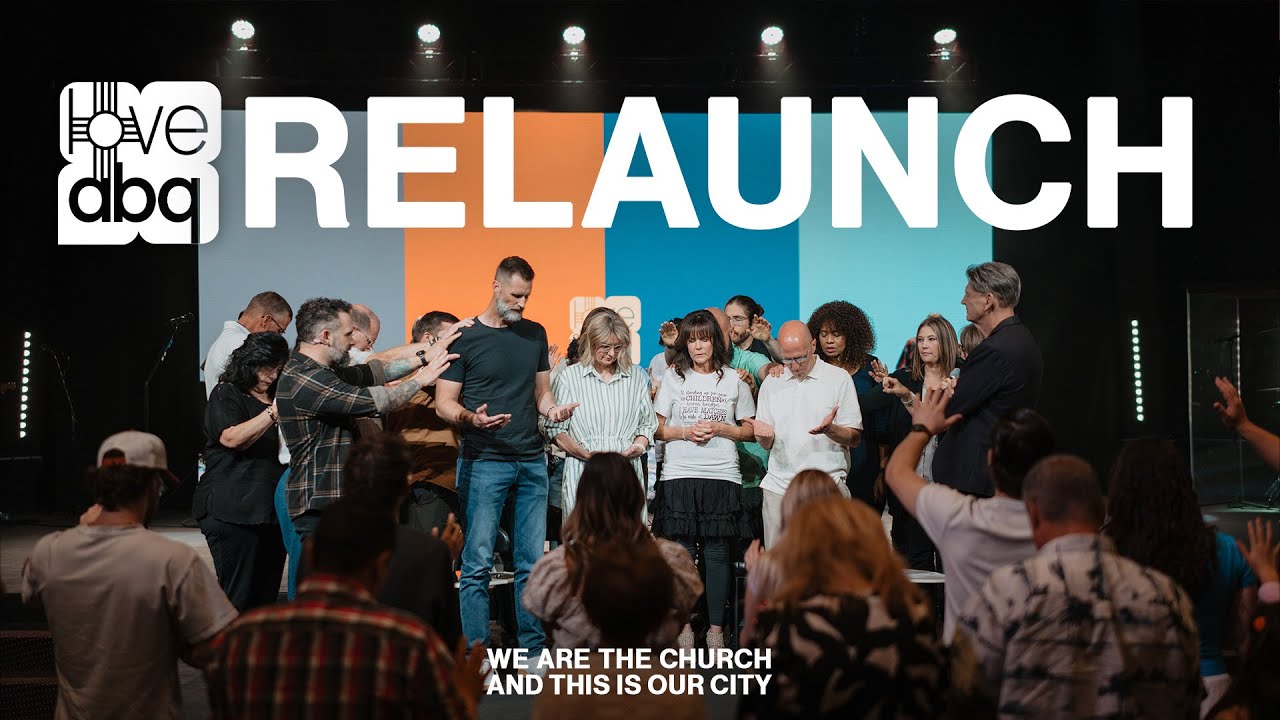
Believers Center's Love ABQ relaunch frames practical care for the poor, the unhoused, the addicted, and trafficking victims as direct service to Jesus himself. Working from Matthew 25 and James 2, the message argues that gospel word and gospel deed belong together, then introduces four city pain points and ministry partners addressing each.
Transcript
Jesus says how you treat those in need is how you treat him
Well, today is a very special day that I’m really excited about. We’re relaunching something that’s very close to my heart and something that I believe is close to God’s heart too. At the end of the service, also we want to let you know you’re gonna have an opportunity to partner with us, to partner with these amazing people we’re getting to know and participate in what God is doing in the city. But before we do that, I’ve got, you know, like probably 10 minutes of content that I’m gonna do a quick teaching, and so I’m gonna hit you with a big theological point right off the bat. If you’re taking notes, I’d like you to write this down. Jesus says how you treat those in need is how you treat him. Jesus said, okay, so not your favorite pastor, not your favorite politician, not your favorite social media influencer. Jesus says, how you treat those in need is how you treat him.
In fact, let me show you Matthew chapter 25. I’m gonna read a few verses for you here. This is what’s known as the Olivet Discourse. This is where Jesus is describing the end times, and he says this beginning in verse 31:
When the Son of Man comes in his glory, and all the angels with him, he will sit on his glorious throne. All the nations will be gathered before him, and he will separate the people one from another as a shepherd separates the sheep from the goats. He will put the sheep on his right and the goats on his left.
It’s funny that modern day, if you call someone a sheep or people a sheep, it’s not a compliment. Right? It just means like you can’t think for yourself. But if you call someone a goat, that’s a compliment. This means the greatest of all times. You know, so like, oh, that’s the goat. So in modern culture, sheep is bad and goat is good. Well, in Matthew 25, it’s the opposite. The sheep is good and the goat is bad. Why? Because the sheep receive good news and the goats receive bad news.
The king will reply, Truly I tell you
Let me show you, verse 34:
Then the king will say to those on his right, this is the sheep, come you who are blessed by my father, take your inheritance. The kingdom prepared for you since the creation of the world. For I was hungry and you gave me something to eat. I was thirsty and you gave me something to drink. I was a stranger and you invited me in. I needed clothes and you clothed me. I was sick and you looked after me. I was in prison and you came to visit me.
And then the righteous will ask, what? Like when did we do all that stuff for you, Jesus? And he says this in verse 40:
The king will reply, Truly I tell you, whatever you did for one of the least of these brothers and sisters of mine, you did for me.
But then to the goats, he says this:
Then I will say to those on his left, depart from me, you who are cursed into the eternal fire, prepared for the devil and his angels. For I was hungry and you gave me nothing to eat. I was thirsty and you gave me nothing to drink.
And the goats will say, when? When did we see you hungry and thirsty and naked and in prison? When did we see we would have taken care of you, Jesus? And he says this:
He will reply, truly I tell you, whatever you did not do for one of the least of these, you did not do for me.
Can I get a good amen? You did not do for me. And so it’s interesting here that Jesus says in the verse, you may have noticed, that he doesn’t say, you did not feed them. Right? He does not, he doesn’t say you did not clothe them. He says, you didn’t feed me. You didn’t clothe me. So again, Jesus says how you treat those in need is how you treat him.
You have a crystal clear mandate
You know, we live in such a politicized time. Where it and all the pastors, all the speakers in here can tell you, it’s so political right now that it’s become difficult to say much of anything without people saying, like, oh, well, you’re just a blank. Oh, well, you’re just a blank. And so let me say this there’s lots of different opinions on how involved the government ought to be in caring for those in need. Some people think the government should do more. Some people think the government should do less. And hey, you know what? That’s cool. You do you. Like you can think whatever you want. Yeah, I know it’s like for some of you, it’s like your main hobby is to have political opinions. Because it’s fun to have opinions about people that have jobs you’d be terrible at. You know what I mean? It’s just fun, yeah. Right?
And so think whatever you want about the government’s responsibility, but what’s not up for negotiation, listen to me, is for the Christ follower. If you take Jesus seriously, you have a crystal clear mandate to care for people who are in need. And that’s really the heartbeat behind everything that we’re doing here this morning. Is that when we love our city, when we care for those in need, we’re caring for Jesus. We’re serving Jesus. And I want to talk to you just for a few minutes before we talk to some really interesting people, but I want to talk about our city.
This church is called to do something
If you’re new here, I don’t know you, but this church has been around for 44, just short of 45 years, which I think is absolutely incredible. Such an inspiration, and this church exists and has always existed, amongst other things, is to help heal this city. This Hebrew phrase, tikkun olam. I bet Jesse knows it. There’s probably not a lot of people who know tikkun olam, it’s a Hebrew phrase, it means to heal to heal the world. And we believe that that’s the mission of God, to repair the world. In fact, John 3:16, y’all probably know. But do you know John 3:17? It says this:
For God did not send his son into the world to condemn the world, but to save the world through him.
Oh, is that it? Just saved the world? Well, it’s like no big deal, right? Just he just came to save the world. Well, we as Christians, we agree with Jesus that Jesus is the savior of the world. And that’s not just church talk, like we actually believe that. Someone help me preach this. Like we have the audacity to believe that Jesus is the only hope for this city. We have the audacity to believe that Jesus specifically, not just love, not just, but specifically Jesus is the only hope for this city and the only hope for this world.
And so if you want to be about the Father’s business, well, then the business that you’re concerning yourself with is saving the world. And you may think, okay, thanks, PD. Okay, right. It just saved the world. Okay, that’s cool. Well, let me say it like this is the next thing you could write down. You are not called to do everything. But you are called to do something. Right? You are not called to do everything, but you are called to do something. This church is not called to do everything, in that truth. But this church is called to do something.
Love ABQ is this church’s ministry
And one of the ways that we have done something over the years is through this ministry called Love ABQ. We still support, we still do outreach internationally. We support church planners and missionaries internationally every month. So every month, just to let you know your money is going to Thailand. Every month your money is going to Romania. That’s not changing. But Love ABQ specifically is about the Albuquerque metro area. And you might say it like this Love ABQ is this church’s ministry to the practical needs of our city. Okay, Love ABQ is this church’s ministry to the practical needs of our city.
Practical needs, what’s that? Practical. Well, I don’t know if you’re familiar with Maslow’s hierarchy of needs, but if you’re not, let me butcher it for you. You ready? If you don’t have air, you’re not gonna notice that you’re thirsty. Come on. Okay, like no one’s at the bottom of the ocean drowning, saying, like, I could sure use a Gatorade. Like a you’re not gonna notice. Right? If you’re suffocating, you’re not gonna notice that you’re thirsty. If you don’t have water, you’re not gonna notice that you’re hungry. If you don’t have food, you’re not gonna notice that you don’t have shelter. See, there’s a hierarchy. And only once your primary need gets fulfilled, can you consider the next step.
And so you may say, well, how does that apply to a ministry context? Are you ready? If you don’t have food, you’re not going to be concerned about your spiritual life. Right? Like you’re not thinking about your eternal salvation when your kids haven’t eaten today. Right? You’re not thinking about progressive sanctification when you’re trying to sleep on central and not have your stuff stolen. Right? And that’s why physical needs and spiritual needs both have to be addressed.
Word and deed
In fact, when you came in the facility when you drove onto the property this morning, you saw, I’m assuming, banners that said word and deed. What does that mean? Word and deed. That’s a phrase that’s followed me and my ministry around for 10 years now. That what it means is this is that when we spread the gospel, we do so in word. That’s the gospel message, and indeed, that’s the gospel action that always accompanies the word. And so word and deed, they always go together. Physical needs and spiritual needs both need to be addressed.
And you may be thinking, like, well, I don’t care about that. I just like the gospel message. That’s all I care about, the gospel message. Well, look, I don’t know what kind of Christian you are, but I can tell you that the Bible is clear that if you want to be someone who spreads the gospel, we do it in the words that we say, but we also do it in the deeds. Look at what James says, James chapter 2, verse 15:
Suppose a brother or a sister is without clothes and daily food. If one of you says to them, go in peace, keep warm and well fed, but does nothing about their physical needs, what good is it? In the same way, faith by itself, if it is not accompanied by action, is what? Dead, right? Faith, if it’s not accompanied by action, is dead.
Okay, so thus Love ABQ. And Love ABQ has had lots of different expressions over the years. Many of you are familiar with in these recent past years, we’ve had a great partnership with Feed Mexico Kids. I asked Pastor Javi, this was a ministry that started in the youth and kind of spread to the church as a whole. But since August of 2023, this church has purchased and packed over 5,000 food bags for New Mexico kids. I’ve got a picture of some of some of these.
Project Love
But some of y’all, if we go back even farther, some of you old school members, what did I call? Oldsters. I called y’all on Easter. Some of the oldsters in the room might remember that it used to be called anybody? Project Love. Project Love. And we would do these outreach events. Raise your hand if you ever went to a Project Love Outreach event. Okay, that’s probably 25% of you. Well, what it was is we would go and we’d take over a school or take over a community center, and people would come through the line and we’d give them, you know, these big boxes of food. We’d do free haircuts, health screenings, dental checkups, and prayer.
And we haven’t always been, I was talking with Pastor Cindy this week, we haven’t always been great at tracking stuff. Maybe we’ll be better. It’s not the primary focus, you know, you’re not trying to like count stuff. But during this 13-year period where we did these mobile outreaches, we did keep track of it, and I just wanted to share a few stats from that time just because I thought it was really cool. So from 1998 to 2010, listen to this, we served 65,168 people went through the lines. To which we gave them 2,419,000 pounds of food, 8,471 boxes of clothing, 3,947 haircuts. Mel, did you give all those? That’s a lot of dandruff. 7,135 health screenings, 8,887 dental screenings. And listen to this. During that time we saw 8,033 salvations and 4,562 rededications. Amen.
And that was just during a 13-year period in just this one particular branch of the ministry. And so we’re not sharing any of this to like pat ourselves on the back. But the point is that this has always been and always will be a core part of who we are as believer center. And so some of y’all might be thinking, like, well, let’s bring that back. Bring that back. You know what I mean? Let’s get back to the good old days. It’s like, well, hold up. Because Pastor Javi, I don’t know if anybody appreciated Pastor Javi this past week when he preached. Phenomenal. Well, he one thing he told us to do was to change our approach, not our values. Change our approach, not our values. Or you might say it like this our mission stays the same, but methods over time change. Right? So the mission stays the same, but how you accomplish it changes. Why? Because the world changes. Because the city changes, because what works changes.
Four pain points in our city
And so, just to be transparent for me, I’ve spent a great deal of time over the last two years or so in prayer, but also learning from the people in our city how a church like ours, you know, there’s smaller churches than us in town, there’s bigger churches in town, but how a church our size with our resources, what is a church like us? What are we able to do that makes a meaningful difference in a city? Because churches can just be like food bags, food bags, food bags, food bags, and like food bags, and they’re just like done, check, and food bags are great. We’ll be doing lots of food bags. But let me say it like this we don’t want to just be well intentioned, we want to be wise. We don’t want to just be good at it, we don’t want to just do the right thing, our hearts from the right place. Yeah, that’s great. The heart is important, but we also want to be wise in what we do.
And so after a season for me of like learning and listening from people who are really like at the front line of caring for people in our city, we as an executive team, we as a pastoral team, is we’ve landed on what we’re calling four pain points in our city. Four pain points in our city. You probably have them in your little handout, but they’re this if you don’t take in notes. Poverty, homelessness, addiction, and human trafficking. Most public officials and ministry leaders that I’ve talked to will generally agree on this list. One to add would be in Albuquerque, and I guess it’s crime, obviously, right? People would say, Well, how about crime? What about crime? But for a church, crime is kind of downstream from other things that, and by the time something becomes crime, it’s kind of out of our hands. You know, like we can’t go and like enforce the law. We can care for people who are victims of crime, we can love people who’ve committed crimes, but by the time something’s crime, it’s hard for us to deal with it really directly.
And so instead, a church like us, what we want to do is we want to deal with pain points that are upstream to crime. So things like poverty, things like addiction, and these are things that turn into crime. And so we’re working to provide aid in these four areas directly, where we’re just gonna do something. We’re gonna pool our resources together, we’re gonna pool our people together, and we’re just gonna do something about it. Other times we’re gonna do it through a partnership with a local organization, and most commonly both. But all four of these areas, can you just leave those up if if that if that doesn’t mess you up? Did I even give you a maybe I didn’t even give you a slide that was right for those four areas? Okay, okay.
Poverty
Number one is poverty. So let me hit you with some stats. 16% of people in Albuquerque live in poverty. 16%, it’s almost 50% higher than the national average. 21% of school aged children, 70% of APS students come from low-income households. 70%. And so poverty. Poverty. And so poverty is not the same as homelessness, right? People who are experiencing, it’s not the same. So poverty might be something like this. It’s a kid who depends on their school for breakfast and lunch during the week, but then they don’t have any food during the weekend. It’s poverty. And maybe it’s like working families who can’t afford to buy holiday meals. Maybe it’s people for a multitude of different reasons. They can’t afford food, they can’t afford rent, they can’t afford utilities, and they can’t afford basic necessities. And so this is a need in our city, higher than most cities.
So the question is how do we do it? Well, just I’m gonna hit you super fast. Number one, food bag ministry. We give out weekly food to people who need food. We have always done this. We’re ramping it up, but this is not something that’s new. This is something that has been core to the DNA of who we are as a church for a lot of years now. Also, we’re continuing and ramping up our partnership with Feed New Mexico Kids. We’re gonna hear more about Feed New Mexico Kids, but what they do is they provide weekend food bags for food insecure children. Number three, seasonal outreaches. This is special outreaches that we do throughout the year, things like Thanksgiving outreach, things like Christmas outreach, poverty, number one, poverty.
Homelessness
Number two, homelessness. Listen to this. According to New Mexico, the New Mexico Coalition to End Homelessness, homelessness in Albuquerque has doubled in the last two years. Doubled in the last and if you live in Albuquerque, like you know that, right? You’ve experienced that. Like I’ve told you before, Eddie, he’s our he’s our best friend who is experiencing homelessness right now. He’s an amazing man, we love him very much. He hangs out right by the McDonald’s by our house. We eat McDonald’s way too much because we’ve got a seven-year-old, you know, so you do what you can to survive. But we know Eddie, we’ve known Eddie for years now. We love Eddie, you know, we see, we look out for we know where Eddie lives. He lives in this tent in this yard. We know where he lives, we know where he goes to, we know where he hangs out, we know his McDonald’s order. Two double green chili cheeseburgers and a large diet coke. So when we drive through McDonald’s, we see Eddie, and I just say, Hey, Eddie, and he says, Oh, David, oh, hey, Grace, how are you doing? I was like, You want dinner? I said, Yeah, he doesn’t have to tell us what what he wants, we just know. And so that’s Eddie. But now, the last couple years, it seems like Eddie, it’s not just Eddie anymore. Now it’s Eddie, and we’ve met Zach and we’ve met Tony, and we’ve met Liza and like 20 other homeless people that we haven’t met yet. But homelessness, right? So it’s continuing to grow.
And so this might be people who are experiencing this for a number of different reasons. Veterans who have PTSD, huge population of homelessness, families who have lost their house, maybe like a medical crisis, job loss, folks battling mental illness, folks battling addiction. And so the question is what does a church like ours do? Do we just let, you know, maybe we just let them live in our houses or something like that. But we’re trying to be, we’re trying to not just be well intentioned, we’re trying to be wise. So a couple things that we’re doing that we want to share with you is number one is we’re launching what we’re calling a mobile outreach team. What is that? So mobile out, we’ve done it a few times, and we’re just kind of doing little pilot tests, trying to figure it out. But what that is is it’s a group of people. We set up tents, we set up, you know, all and we and they just provide food. We provide food, hygiene kits, and most importantly, just relationship building with people living on the streets. It’s our mobile outreach team.
And then we’re also partnering with two amazing organizations that I’m really excited for you to get to know. Number one is New Creation Albuquerque’s refuge safe outdoor space. Some of you, I’m sure, have probably seen that on the news. If you watch the news, if you’re if you’re over 50, you still watch the news, you might have seen it. But it’s an amazing ministry. It’s phase one housing through the first ever city-approved safe outdoor space. And then also we’re partnering with Mesia Recovery. This is phase two housing, which is amazing. So it’s phase one housing, phase two housing, and we’ll tell you more about those in a minute.
Addiction
Poverty, homelessness, number three, number three is addiction. Listen to this. According to the New Mexico legislator, New Mexico has the sixth highest drug overdose death rate in the US. Sixth. And listen to this, and the number one highest alcohol death related rate in the nation. So, what states do people drink themselves to death the most? New Mexico. And so our approach to helping in this so it’s like, what does the church do about that? Well, our approach in the fall, we’re excited to tell you that we’re launching a recovery small group here at the church, which we’re very excited about. There’s lots of people who are very excited about it. And we’re also partnering with a new organization called Next Step Ministries. Next Step Ministries here in town. It’s a Bible-based housing and clean living program for men who are recovering from addiction or coming out of incarceration. It’s amazing.
Human trafficking
Poverty, homelessness, addiction, number four is human trafficking. And then I’m gonna stop talking. Okay, most people don’t realize that human trafficking happens in this city right now. Like people don’t realize that, but according to the National Human Trafficking Hotline, New Mexico consistently ranks in the top 10 states for human trafficking cases per capita. In the top 10. And the reason for that, there’s a lot of different reasons. I’m sure Toya could tell you why, but one of the reasons is that there’s I-25 and I-40. It’s a big passageway, and so we end up being kind of like a big trafficking corridor. And if you don’t know this, the largest part of human trafficking is sex trafficking. And sex trafficking, listen to this, the average age of entry for people who will be sex trafficked is 11 to 14 years old. And that’s true for boys and girls.
And so if you’re thinking, Pastor Dave, that’s just not pleasant to think about. Like, I agree. I don’t like, I don’t like thinking about it. I don’t like talking about it. I don’t like writing that kind of stuff in my notes. I don’t like, but the church cannot, can positively not just sit by and do nothing. And our church in particular, we’re very fortunate because we have been able to partner with For the One. It’s a ministry here in town led by our very own Toya Kaplan, who’s incredible. Nobody else got any claps, Toya, so I’m just pointing that out. For the one, they’ve got two strategies. Number one is prevention and disruption through their vulnerable no more campaign. We’ll tell you about it in a minute. And then direct survivor support, where they take care of people who have are survivors and have been rescued out of human trafficking. They do that through collaborations with other ministries.
And so how we’re partnering? We’re partnering, we’re doing things in-house, but we’re also partnering with five organizations. Two of them are existing, and three more organizations that are starting today. And we’re financially supporting all of those ministries monthly, starting today, but also and maybe even more importantly, is that we are providing boots on the ground support. That’s what we’re calling it volunteer support, project support, building support, logistics support, manpower support, and of course, prayer support. And what’s awesome about today is that we’ve got the leaders of all of these ministries with us. And so these are people who saw something that needed doing. And instead of saying, like, gee, whiz somebody ought to do something about that. No, they said, I’m gonna do something about it.
Feed New Mexico Kids
And so really excited for it. We’re gonna jump into the first one. We’re gonna kick off how we’re addressing poverty through our partnership and through our work with Feed New Mexico Kids. So if the creative team is ready, take a look at this video.
Hey, Believers center family, my name is Tracy Rodden with Feed New Mexico Kids. I’m the executive director. I wanted to take a few minutes just to introduce you to who we are and what we do. Feed New Mexico Kids actually packs weekend snack packs for kids that typically eat while they’re at school, and over the weekend they’re not sure where their next meal is gonna come from. You know, obviously this is a lot of processed food, but we have to have shelf stable food. Okay. Try to say that. This is food that kids can open, make, and kind of reseal, hence the Ziploc bag, right? Okay. So each week here at our Feed New Mexico Kids warehouse, in addition to our 13 church partners, Believers Center being one of them, we pack over 5,000 snack packs a month for APS and five other school districts. And of course, you know, we wish that we had broccoli and you know, fresh, you know, apples and things like that, but it’s gonna go bad. And honestly, I don’t know if the kids will eat it, right? Yeah. So this has is the highest protein for the money and what kids will eat. Snack packs are about five dollars a snack pack. Okay. And wow, so you’re feeding a kid for the whole weekend for five bucks. Yeah. So everybody knows the price of food has gone up 25%. Yeah. Um, it’s I I actually grew up a food insecure child, and one of the things my dad always taught me was the price of food will never go back down. Typically, it just keeps rising and rising. So that’s why we need so much help. Yeah. Do you know any sort of demographic as far as the ages of the kids that you do the snack packs for? Yeah, so it’s all age groups from age five all the way up to 18. So if they’re in school, there are demographic. Okay. Um, I can tell you that 90,000 children in New Mexico are food insecure, meaning they don’t know where their next meal will come from. So that’s about one in three. And kids that are food insecure statistically, they are two times more likely to skip a grade, three times more likely to be suspended, five times more likely to commit suicide, and the age group is starting younger and younger, but 10 to 11-year-olds on up, those food insecure children are more likely to be sex trafficked or trade sex for food than their peers that are food secure. So it’s kind of an iceberg situation that we’re dealing with. Um, and the Lord is really faithful though. Yeah, He He’s just showing us what to do step by step. Yeah. So we want to thank you and ask you if you want to be involved, you can find us at feednkids.org.
Well, hi everyone. This is my friend Tracy. I’d like to so excited to get you to introduce or to introduce you to Miss Tracy. What an inspiration. And I want to start off by just saying thank you. Thank you for feeding our kids for all the ups and the downs that probably have come with this ministry. And we want to say thank you for that. It’s amazing. An inspiration to all of us. And I want to ask you, just got a few minutes to spend with you. I want to ask you this. With all like we know in Albuquerque, there’s lots of different needs. It’s just like Jesus, like the need can sometimes feel overwhelming. And it’s hard to know sometimes what the right thing to do. So, what would you say about this work specifically feeding kids that you felt drawn to?
Well, I did grow up food insecure, so I don’t want to ignore everybody over here. I know it’s hard. I know. It’s hard to like panorama. Look, they waved at you. Thank you. I always can count on Javi to be the friendly guy there. Um I did grow up food insecure, and so when I heard about this ministry, I am not the founder, by the way. I just want to be super clear about that. Of course, the Lord is a founder, but it was called to the attention of Holly Slade. And she’s the one that began this ministry in 2017 with the blessing of our church, and they kind of said, Well, let’s give it a try and see how it goes. And here we are in 2025. And it’s grown tremendously. But as a food insecure child, I grew up um with the issues that we see in our state. And then as I became an adult and food insecurity kind of disappeared from me, I kind of wanted to walk away from that. And I don’t know if anybody here grew up food insecure, but once you move past that, or any of the other ministries of people who will be speaking up here, you don’t really don’t want to revisit it. But I was called by the Lord and encouraged by my husband. Makes me tear up to think about it. And um, you know, our state needs it. Your stats are like right on, by the way. He I was I was gonna say, I’m I guarantee you one of these my stats is gonna get corrected by the expert on this. You’re exactly you’re exactly right. I just want to give one more stat. Um, all of that information translates to 90,000 children are food insecure, meaning they don’t know where their next meal is going to come from. And those children are gonna become adults. Incredible. Wow, they’re not gonna stay young forever. So wow, and it’s not for you for you if you if people don’t know about the snack packs, it’s food, but it’s also you’re putting encouraging we are, yeah. So, like the um it’s not just the food, it’s also the heart piece that you guys are dealing with.
Yeah, and I’m involved, um, not just because of my background and I can identify, but children don’t have a voice, they can’t speak for themselves. So, as a and they don’t always have an adult to speak for them. And I just want to be really clear too. These children are not, they’re not always children that, oh, the parents addicted to drugs and sleeping on the streets. A lot of times they they’re just families in hardship, you know, that they just are having a hard time making ends meet, or the parents may be incarcerated and they’re being raised by a grandparent who’s 70, 80, and they don’t have legal custody, so you know, the first thing you think of is the government needs to give that, you know, grandparent help. Well, they have to have legal custody, they have to be able to go online and apply and work in computer and do all those things, and it’s just harder than you think it is for them.
You know, one thing I think is so amazing about Jesus is he talks about that when we when we care for his kingdom, that our needs are cared for as well. And I’m sure you’ve experienced that. I’m not texting, by the way. These are my notes. Oh, it’s good. Oh, perfect. No, where were we going to be able to do that? I’m not like trying to figure out what to make for dinner. Yeah, I know. What are we ordering? Yeah, okay. It’s not McDonald’s. Yeah, I know, really. I do like McDonald’s. If you see me there, it’s been a bad day. We won’t judge. Yeah. It’s comfort food. Yeah. Right. Yeah. Okay. So yeah. So Jesus says when we care for his kingdom, our needs are cared for as well. So have you experienced that in your life? And how might you encourage people who feel like, man, I I can’t give anything. I don’t even have enough for myself as it is.
Well, that’s true. We don’t have enough for ourselves, right? And I have experienced a lot of hard times. Um, not that long ago, um, just 15 years ago, I had a really difficult time in my life. My first husband had passed away, and I was 40 and I had three children. And I thought, how am I gonna figure this out? What am I gonna do? And I just kept thinking, if I’m just smart enough, if I just know the right people, if I just work the angles, I can figure it out. And then the Lord kind of over a more than just a one-second time, kind of taught me, um, I don’t have to figure it out. Like, it’s all his, it’s not mine. And he figured it out for me once I kind of released it. I kind of opened my hands and I said, none of this is mine, it’s all yours. If you don’t want me to have it, I don’t want to have it. Um, and that’s just something that keeps coming back, right? If you’re if you don’t think you have enough, you don’t have enough. The Lord has it all, he’s gonna give you what you need to help the that not just my ministry, but all these ministries that you’re um focusing on growing. That’s beautiful.
And I think it you know it’s so amazing when we think about caring people caring for people, just in the verses we just read, that when Jesus talks about, man, when you’re caring for those who are in need, you’re caring directly for me. And so the question is how have you seen that play out, that connection with your feeding kids, but you’re actually this is a way of you serving Jesus. Um have you seen that play out in your own life?
Yeah, so something it’s not the obvious answer you would think of. Um, how have I seen this affect um our community? The obvious answer would be we’re feeding kids, which is our number one goal, right? Feed the children, feed the children, regardless of age, religious belief, you know, whatever, you know, we don’t we just see a child from five to eighteen. And I just want to say really quickly something that I learned that kind of shocked me. A lot of the food insecure people that we’re helping are unhoused teens who are 18 who are still in school, and um because they’re 18, they don’t qualify for any help or benefits, so they’re actually um working jobs like at a McDonald’s so they could get food to bring home to their families, but also to eat, and and they’re expected to help out financially in their homes that they’re living in. So um it sounds like Toya’s gonna be the person to really talk about this, but I’ll say that um we target at Feed New Mexico kids with our weekend snack packs, middle-age and high schoolers because they’re at the highest risk and they’re the most vulnerable. Okay.
And then um the other thing I wanted to say was we see we have 13 locations. So our primary location, if you think of us as a McDonald’s franchise without the fee, we are the hub at our warehouse where then we have like spokes on a wheel, believers center being one of them, where we go out because the church in the community serving knows your community. You know the man that needs the food at the McDonald’s nearby. I forgot his name already. I apologize. I am 56, so my mind. But uh we come in and we help you guys and other partners, some are businesses figure out how to have their own feed New Mexico kids. So you’re working in your community. We have another church in the South Valley, they’re working in their community. We have a community in Pecos, all the way in Pecos, right? Wow. Where kids are going home, getting off the bus, walking into a dirt floor tent at the end of every day, and they have a snack pack to get them through the weekend. But I see the most growth in servants that show up because we have Bank of America showing up to pack, we have fifth graders showing up to pack. 55th graders came. I just want to give a quick shout out. Is Lauren Stewart here? She’s in Kids. She’s working. But she is our admin, and she has been fabulous. She I had to be out of town for a child. Yes, thank you. I hope she gets to hear this. Um, but I had to be out of town. One of my grandbabies was um supposed to be coming. Um, and so she took over 50 fifth graders packing at our warehouse, right? No one better, so nobody better. So to say all that is to say, I’m seeing the servants come in, and it’s not always believers, but the non-believers are seeing the believers do what we say. Yeah, we love our city. We want to be the hands and feet of Christ. So the non-believers are seeing the believers. Yes. We pray before we pack. We ask for prayer requests when we, you know, before we pack. And uh we just keep and they just keep coming. Every Monday we have 30 people show up. Incredible. So it’s servants, I see, just making the difference. Beautiful. One, don’t you think what an inspiration? What a help to the city. Gosh, we sure can love you, Miss Tracy. Honored to partner with you.
New Creation Albuquerque’s Refuge Safe Outdoor Space
Okay, so next we’re gonna talk about how we are addressing homelessness, people experiencing homelessness through the partnership with new creations, ABQ’s Refuge for the Safe Outdoor Space. Here we go.
Hey Believer Center, welcome to this space. We call it our Refuge Safe Outdoor Space. It’s a space of welcome for the journey toward home. So we’re so glad to invite you here to show you around. It’s been super exciting. We’ve been about five weeks in, and it’s been beautiful. When someone comes in, they receive a tent, sleeping bag, a blanket, they get storage, secure storage to put secure important documents in. We connect them with a caseworker that helps them with their challenges and their goals to move towards greater stability, and then we just kind of see what we need from there. We have four women, so we’re trying to provide hygiene items, you know, which you don’t think about, but food stamps doesn’t cover that kind of stuff. So, whatever we can provide that makes it a little more comfortable. So we got the porta body and a hand washing station. It’s actually pretty central because a safe place to go to the bathroom is like something we take for granted. You have to the only place you can go to the bathroom for free in the city is a public library. Simple things like being able to take a shower, yeah, do lunch, yeah, yeah, use the rest, right? Have sanitary products, right? Toothbrush, yeah, can make a can be as a life change for folks. One woman shared on the news that since she’s been here, she’s been reunited with her children. She had three or four children that she was isolated from, but just that place of stability, and I think that feeling of man, I’m showered, I’m clean, I’m stable, I’m moving somewhere, kind of lifts up hope and allows someone to open themselves up to restoration, reconciliation, you know. And that’s in five weeks, you know. So I think God’s really gonna do some beautiful things. So yeah. Yeah, a few years ago, Francis House started just writing down the names of those who lost their lives while still living on the street. So that’s what this is. This is what this is, yeah. This is why we do what we do, because it is dangerous on the street and people are vulnerable. So it’s just been a beautiful opportunity for us. We’ve learned so much, and this beloved community is developing, and so thankful for your partnership for you coming alongside of us as we come alongside others as we seek the peace and flourishing of our city together.
This is my friend Jesse, everyone. I’m really excited. For those of you who don’t know, he is he’s been my friend outside of Toya, who I’ve grown up with, he’s been my friend the longest out of all of these relationships, and so he’s really been instrumental in my life. In fact, an interesting story when we had our young adult group, The Outlet was a young adult meeting that Jordan and I led, and when we were in California adopting our daughter, who’s now seven, Jesse preached exclusively for me. I just it I just threw my entire ministry at Jesse and he preached for me, and he continues to make an impact on my life and teach me in so many different ways. And one thing, when we were over there a few weeks ago, it was kind of like the grand opening, the ribbon cutting of the outdoor safe space. One thing that you kept talking about is you kept talking about how the people of Albuquerque, these are our neighbors. And for me and some of the other people there from the church, that really made an impact that you kept using that word neighbors. And in fact, I wanted to let you know that that’s some language that me and Jordan we’ve even adopted with our own daughter. So now when we see homeless people, because sometimes she loves them, sometimes she’s a little concerned, sometimes all those all those different things that are coming up on the inside of her. And I say, Well, we we’re always safe, sweetheart, but these are our neighbors. We love them, and so we’ve started calling the homeless folks that we see our neighbors too, and so on to thank you for that. And so the question I have for you is this how does that word neighbor change how we approach people living on the streets?
Yes. Well, thank you so much for inviting me into this space. I love it. Yeah, the idea of neighboring, I think is crucial because it invites us, number one, it invites us into love, right? The sphere of love. Love God with all your heart, soul, mind, and strength, and love your neighbor as yourself and you. Beautiful. Alluded to Jesus, someone asked Jesus, who’s my neighbor then? Because we that’s what we want to qualify it. Like we’re supposed to love him like God. Exactly. Like no, it’s it’s it’s everyone. It’s even the one that you would think that doesn’t deserve it. And so neighboring invites us into love, the greatest commandment. It also invites us into mutuality and interdependence. Because if someone’s my neighbor, and not just someone experiencing homelessness, or not someone who’s just hungry or not someone who’s just addicted, but if these if this is my neighbor, then I have a responsibility towards this person. I’m invited to love and to live in community with my neighbor. And it’s a mutuality, because if they’re my neighbor, guess what? I’m their neighbor. And we both have responsibility toward one another, so it elevates the dignity. It’s not just someone to receive, but it’s also someone to receive from. So, yeah, neighboring is it’s all it’s all Jesus. Beautiful. I love it.
You know, something that you may not know, you probably don’t know some of you, but Jesse used to be a youth pastor here in town, another church, and then he felt like God kind of did something new on the inside of him, and he kind of started to butcher your story. No problem for free, yeah. Is he started to feel like maybe there was a different calling on the inside of him, and so he moved him and his entire family, his wife and his young kids, right into the international district so that he could be living alongside the people that you felt like you were called to love and to serve and to neighbor and so I think what’s so inspirational about you is a lot of different things but that you don’t have your real life and your ministry life so a lot of people do a lot of pastors do where it’s like this is our ministry life this is our real life but for you it’s this integrated piece where you you took your whole life and moved it into what maybe some of us would call missional living and so what would you say that we could learn from you and people who’ve done things like you about what we might call missional living?
Well, I don’t know what you can learn but I’ll tell you where this comes from I just see that I don’t see any separation between ministry and real life I see Jesus invited us into a kingdom life like a whole life invitation into the movement that is the kingdom of God so Jesus came on the scene he said the kingdom of God is at hand to repent and believe in the gospel the good news the good news that God is on the move to heal and I don’t know that Hebrew word that you use so you are smarter than me but one one thing I’ll use another Hebrew one tiny thing another Hebrew word is shalom and that is that whole that restoration of wholeness in three directions with God humanity and God humanity and humanity and humanity and creation that that God is restoring and returning the world, healing the world, returning it to shalom. And so our life, what we sign up for is with Jesus is not just for him to come into our hearts, but for our life to come into his kingdom. Come on. And to participate and partner with him in the restoration of all things.
And so, can I keep going real quick? Yeah, I won’t preach too long. Let me stand up and I was kidding. Sorry. Well, real quick, Eugene Peterson, an author translated the message. But he said that anytime you connect with somebody, whether it’s a random stranger or your child in the morning, you are showing up to a meeting already in progress. And that is a meeting with God and that person, that God is at work returning that person to shalom. And the invitation of the Christian of the Follower of Jesus is to hear and discern how do I join what God is already doing with that person. So the subway artist, subway sandwich artist making my sandwich, how is God at work? God, how can I partner with you in returning shalom? So that’s I think how I understand missional living. It’s beautiful.
And I think something you you even said it here, you know, you say it on the video, you say it in person, is this concept of dignity. Right. I think for a lot of people, we don’t maybe consider the importance of dignity. You don’t appreciate maybe how important dignity is until you feel like you don’t have it. And so the question is like when someone encounters someone who is experiencing homelessness or an unhoused person, what is one practical thing they could do that honors that person’s dignity?
Well, I think you modeled it already, Eddie. Know their name, right? And share yours. Whenever my children are with me, I try to introduce my kids. I think we have a conception, especially in America, that if you’re poor, you’re somehow morally or spiritually deficient. That we we kind of rank if you’re wealthy or powerful, you must have done something right. If you’re poor or on the street, well, you must have done something wrong. And that’s just not the case. In fact, Jesus always is flipping that. He says, Blessed are the poor, blessed are the meek, and he has woes for the rich and the powerful. And so he’s flipping this constantly. And so I think what we need to start is by seeing the person as someone who from whom I can receive. Again, a neighbor from whom I can learn. A Jesuit priest, Gregory Boyle, who works with gang members in LA. He says, when he asks this question, I kind of live by this question. When will we start seeing or when will we start? How does that quote go? I’m gonna get it. Uh-oh. I got it. When will we start standing in awe at how much the poor carry rather than in judgment at how they carry it? So we need to start with awe with the person in front of us, and that’s where that dignity comes from, because they carry so much more than I have to, and I stand in awe that my neighbor or that Eddie even walks, right? Even smiles, even says, remembers your name because he carries so much. And so we start there and begin a relationship. It’s beautiful. Gosh, well, we we appreciate you so much. Yeah, I appreciate Pastor Jesse, what he’s doing. We look forward to learning more about you, about what you do and you’re in partnership.
Mesia Recovery and Next Step Ministries
Okay, so next we’re gonna talk to an amazing man who has two ministries that he’s representing. Many people who live on the streets, addiction is a part of their story. And so what we’re gonna see now is how us as a church, how we’re partnering with an amazing couple ministries to address addiction in our city. Here we go.
Good morning, believer center. This is Mesia Recovery. This is our ministry. It’s a 32 one-bedroom apartment complex that we use to transition people that are struggling with addiction. When they come to us, we help them with their independent living. We have supportive services, and basically we’re just trying to teach them how to live sober and how to apply their faith out here. When we first started this project last year, this was an apartment complex well known in the city for drugs and drug activity, but praise God, just the transformation that’s happening just by bringing people in recovery, people in faith, and it’s completely transformed the whole company. Well, we brought Tracy over here, and now he’s actually one of the security specialists at the safe speech. Okay. So not only are people in recovery here, but now they’re serving and giving back. You know, hey. I might as well give back back. Yeah. You know, I want to be sound positive to be able to part when I leave. And yeah, that will be remembered. Maybe we’re some, you know, judge young. Yeah. Christ changes our lives, and then we try to pass that on. Really? Yeah, yeah. We help with jobs, we help with training, with resources, whatever they may need help with, that’s what we provide here. All that we require is that they’re active in the recovery, that they’re sober, and that they’re going to church once a week, and that they’re receiving supportive services, and that they’re seeking God first. Now it’s beautiful how that’s how it works because Tracy’s been there. I mean, I’ve been there so we can speak to them in a way that maybe some other people can because you know that’s why we’re here. We’re trying to make a difference in this community, and truly the only way that can be done is one life at a time. One life at a time.
So one life at a time. This is next step ministries, and what next step ministries are, we’re that transitional piece for a man coming out of prison or program. We help them transition back into society, and we do that through discipleship. We’re teaching our men how to apply Jesus to every area of their life. This apartment is definitely different than any other apartment on the spot. It’s a community of believers living together, and it’s the main thing I hear from anyone that comes in next step. They’re just amazed at that community pinisa. Wow, everyone looks out. Yeah. And how many how many men do you have here? So I have eight here and four at the other house. Yeah. We keep it small. Yeah, oh yeah, that’s right. Cycleship takes time. So this is our second property. This is our leader, leader’s house. So after they come to us that next step, first they come to the apartments, and then as they mature in their faith, then they come up here. Typically they stay with us between one and a half and two years. Okay. But after that, what we do, we set them up so by the time they graduate, they have the option we have a first-time homeowners program, or if they want to get their own apartment. And so when they do graduate, we still communicate and we still continue the discipleship. Wow. Do people in this program pay rent? Is that a like a subsidized yeah? Well, we do, we help them. We as they transition to us, we help them. But the goal is yes, every man pays rent. We just charge $500 a month. That way they’re able to save and plan for their future. But the goal behind it is a lot of guys have never had their own place that so they they gotta get used to the wow, I have to pay rent every month. Right. It’s due on the first every month. So we’re training them, getting them ready for when they have their own place. Yeah, it’s beautiful, and I mean, literally, you’re gonna get to see the lives that are impacted. Beautiful.
So everyone, this is my amazing friend Todd, and like I said, he’s representing two different ministries here this morning. There’s been a time when you were in three different ministries, now you’re just focused just two. He’s only got two full-time ministries that he that he leads. Um, but of course, so we have Mesia, so that’s one of the programs that we’re keeping in the homelessness camp. But then we also have next step ministries, which is transitional housing for people coming out of incarceration and coming out of addiction. And so I think it you have an amazing testimony yourself too, because you’re helping people who have found freedom and are finding freedom from addiction, but you have a story yourself. So I asked if you would be willing to spend just a minute or two telling us your testimony.
Good morning, church. Good morning. Um, addiction and people struggling with addiction is very near and dear to my heart. Um, I struggled for over 20 years, was strung out of meth, became a meth cook, been to prison four times, couldn’t stop, didn’t know how to stop, and then in June 6, 2006, I met Jesus. So, in that interaction of meeting Jesus, I knew in that instant that I was done. I was done with the drugs, done with the lifestyle, done with all of it, because I knew I was done running from God. So after that day, God kind of lit me up and put a fire in my heart and a passion within me to help those that are struggling with the same thing. Beautiful.
And tell me tell me the connection here too, because you and Jesse are friends, and so he has the refuge safe, the safe outdoor space, and there’s a connection with you, is that right? Yeah, so we met three years ago, and I knew there was something more to that, so we began to partner up and we wanted to make a difference in that area, but no coincidence and all how God operates and how things work. So the very house that we’re using for the safe space was actually a house I used to cook meth in. So is that incredible? Isn’t that incredible?
Uh so here’s a question for you, Todd. Uh, just a few weeks ago, I was talking, uh, I did a sermon, and I was talking about the power of testimony. And so how have you seen the power of testimony? Because I’m I’m sure you’re probably never far from a testimony in the work that you do. How have you seen the power of a testimony create a breakthrough for people struggling with addiction? Yeah, that’s also part of why I do what I do. I want to be that that person that brings that help and that hope. So then as we begin to disciple our men and teach them and bring them to a better place, then they go out into the communities and start speaking those words of life to people struggling with the same things. Amen. Powerful.
And I think, yeah, one of the reasons I think ministries like yours, and I’ve got multiple ministries, but if we were to just focus on next step for a minute, one of the reasons that ministries like yours is more effective than other types of ministries is because of the power of accountability and community. So could you speak to why community is so important for people in recovery? Absolutely. It’s one of the most powerful things that happens at next step. So you have a group of men, a group of believers that live together, they do life together, they share their struggles, their pains, they pray together, and they follow Jesus together. And it’s amazing to see. So these these guys are doing life together, but these are men with all different backgrounds, been prison, gangs, violence, addiction, and now the all of these men have come together living in a community. And it’s just amazing to see. But part of that is also they help keep each other accountable. So when somebody’s struggling or when someone goes sideways, we come together around that person, we’re praying for them, and we’re helping them and bringing them back on the path that they need to be. It’s really beautiful to see, and it’s truly only something God could do.
I remember early on when I was when we were just we were just meeting, I was just learning. I’m trying to learn. So I’m Jesse scheduled meetings, and I’m like, Well, what do you think about people you know in car? How do we help people who are coming out of incarceration? And Jesse said, Well, if you really want to learn about that stuff, I need to introduce you to my my man Todd, he’s the expert in a number of these things. And so we we ate together and then we had a meeting together, and one thing the reason that I knew I loved you is because you we were talking about you know feeding people, and you said you said feeding people is super important, but she’s you said it’s not it’s not enough if we’re not dealing with the heart change behind he said because you can you can care for the physical needs, but if the heart doesn’t change, it’s not real long-term change. And so, as someone who’s involved in that, you because you help people, but you’re also involved in the heart transformation that comes from Jesus. So, what would you say that heart transformation looks like in people? So, at next step, we don’t just deal with the symptom, the symptom of using, we go deeper and we go to the cause, the root of it, which is the heart. So, there’s a reason why you use, so then we begin to embrace Jesus through that process, spend time with Jesus, get to know Jesus, and as we get to know Jesus, then Jesus begins to show us who we are and why He created us. And then in that transaction, then the healing, the restoration, and the transformation happens. So now we don’t use anymore because we don’t want to use Jesus’ transformed our heart. Come on. Do you all appreciate Todd? Wow. What an inspiration you are to us. Thank you. Privileged to partner with you.
For the One
So now we’re gonna do is for our last our last little segment, we’re gonna transition into something that happens in the shadows, and we’re gonna see how we are helping tackle human trafficking with our partnership with For the One.
Hi, I’m Toya Kaplan with For the One, and on a personal note, I want to mention that I have been attending Believers Center, it’s been my church home for over 30 years, and I want to tell you that For the One is a nonprofit that fights sexual child exploitation and sex trafficking. When we had Freedom House, which is a home for survivors for three years, that was an intense, awesome opportunity for us to understand what all of this looks like and why these girls are vulnerable. So when we closed the house and shifted over to prevention and disruption, turned into turning of the tide, that this became a war campaign. So we are an active boots on the ground. I say we’re a verb. Our nonprofit is a verb, and we fight all this through presentations, free events, and we do still support phase three survivors, those who’ve been rescued, still. Still work with sex trafficking survivors, and so New Mexico Dream Center is one of our main people that we partner with, and we try to make sure that the local survivors we work with get to celebrate Mother’s Day. So we do a huge thing at Christmas, and then we do Mother’s Day, and just want to make sure they feel celebrated. And these women are in Albuquerque, some of them are, some of them are. All of these are local. Everyone represents, if you just looked at this, and this was one person. Maybe it’s the woman who was groomed as a five-year-old. By the time she turned 13, her family sold her on to Central. That’s a real story. Maybe this one was sent by her mother to a convenience store to buy cigarettes, and and the mom had set up with a trafficker. So I’m just saying, every one of these represents whatever the story is. We love every girl that we’ve run across, every woman that we’ve worked with. But there’s a story we don’t just see that’s why I don’t use numbers all the time, because it’s so dehumanizing when you start to understand what these stories are and how heartbreaking it is. This could be an opportunity for them, you know, that could be an expression of hope for them, an expression of the love of Jesus for them, in a really dark situation. And that’s our goal is to make sure they do. So, to your point about numbers, we went to for the one. We can’t help all of them, but we can help the one that’s in front of us. So these are the ones here in front of us right now that we’re helping. So, and that is currently what we do, and thank you, Believers Center, for helping us all these years in all these ways. We love you so much. Beautiful.
I know most of you know Toya, or at least a number of you, and we’ve got a lot of new faces in here, but this is our amazing friend Toya. And like I said, Toya, I think the idea of human trafficking, but specifically the area that you work with, sex trafficking and exploitation, it’s such a heavy topic that I think for a lot of us we prefer not to think about it and even to think about it for a couple hours can feel really overwhelming. And so the question for that I have for you is what keeps you in this fight year after year and keeps you and and how is it that you’re able to work in this environment and not have it rob you of your peace. And as a side note, my whole life I wanted to be a stand-up comedian, and guess what? I’m not. But anyway, I love to hear people laugh. I want to say I’m home. This is where I’ve been for over 30 years. It’s my church home, and I thank y’all for supporting me all along. I wrote quickly in my note that from the inception I met with both Marshall and Cindy, but especially Cindy, and at a planning meeting, I sat with Cindy across the table at La Peep restaurant, and that’s when God downloaded into me the name for the one. Our home was Freedom House, which was appropriate for the time, but for the one was downloaded. And so, and so back to your question, God downloaded that name into me all those years ago, now over 10 years ago, so that I could be regrounded in the one in front of me, the one we can help, rather than the extreme numbers. I can’t settle on those because I’ll spiral off. I also need help real quick to make a point. If you’re in this room and you have either had sexual exploitation in your own life, or which will help you to blend, or if you know someone or love somebody in your life who you know has been exploited somehow, please raise your hand if you know someone who’s had, and I’m not just talking about sex trafficking because I’m about to make a point. If there’s abuse in somebody’s history sexually in your life, and you know that, and so I did that. There’s so so many. If you were to look around, I can see the room. 3.9 out of every four of the survivors that we work with have that as a piece of their story. And my hand is up because not only am I a victim, but I also love so many people, so many women, and also men have come to me with the same story. And so that is really what continues to drive me. It’s the healing God gave me. It’s I’m living in answer prayer, but it’s also what I can extend through prevention, through education, through what we do, through the assistance to sex trafficking victims and survivors. That honestly is what just continues to make me bring the matches. If you’re if you have a problem or anybody you know does fighting for our children, that is the lane we’re in, and that’s what we’re fighting for. So we’re not ever giving up. Let me just say that right now. It’s for the one that’s in front of us. Beautiful.
And I think so. For you, your your ministry has taken different shapes, you know, and and right now you’re really focused to mostly help and focus on prevention, right? Because of course, you know you’ve got the FBI task force, and you can work with all those guys. But what you’re thinking is if we can stop people from getting in this system, like you you had told me, you said once they’re in the system, God can do a work, but boy, that’s a big long process to heal from all of this. And so, man, if we can if we can stop people from getting in that system, that that’s that’s where the real change can happen. And so the question I have, just in a real practical way, is what can parents, teachers, and really all of us learn about protecting the vulnerable people in our lives.
Okay, so through the journey, because we started with Freedom House, we began to really understand the depth of their vulnerability. But what was really hard for both Art and I, and there’s women in this room right now that worked at the house, was that we continue to show up after the accident. After basically, my image is like an ambulance getting to someone after we always arrived after it happened, and it’s heartbreaking to love these women and see that you can pray, obviously. We work with them, we hand in hand with them through the process, but that’s what was so hard for us, is never getting to the other side of it ahead of it. And so that became our goal as soon as Freedom House ended up shutting down, which was hard, but I won’t go into that. We don’t have time. Anyway, my focus on that second road during worship, I got it downloaded to me, that we would be switching over to vulnerable no more, which is how do we get to these people before they’re in a residential home for survivors? How do we get to your children, your sisters and brothers? How do we get this information to them before the predator gets to them? And we’re in the race of our lives to get to those children and those people before the predators do. And so what we’re saying is that that’s become our focus is to get to you all. I’m trying to pour this into your heart so you understand. Don’t be afraid, be empowered, don’t be afraid. Get yourself educated. And so, in a roundabout way, the point being that if you understand what those vulnerabilities you said, you’re the teachers, the law enforcements, the community, you parents, grandparents, if you will educate yourself, we can get ahead of this together. Amen. Wow, wow.
Okay, so if someone’s sitting in here thinking, okay, and you know, our hearts, all of these, all of these ministries that we’re talking about, by the way, these are all opportunities that we’re we’re organizing ourselves and doing our work internally so that we can be partners with all of these great ministries. And maybe for you, you know, something that Toya say is saying to you your heart, but you’re thinking, I can what can I even do? I don’t even know where to start. Maybe what’s something that someone could do this week to make a difference?
Well, for us, and really for all of these, and just one quick thing, all of these things are intermingled. Every single like our people group is in their people group. We’re all connected. And so not just ours. Can you put that up for me? Yeah. It’s the answer really for me personally and for what we do in a minute. There they go. There they are. There it is. It’s there. Anyway, is that you go on to these people, like look at their information. If you have a passion to learn more, do that. Go to each one of these organizations, look at their information and find out how can you connect with them online, how can you share their information? I know this is more than one thing. I’m just saying, go on to whatever their website is, their Facebook, Instagram, and follow them and share their information. That’s what you do. Educate yourself about what they’re doing and get involved. Amen. Amen. I moved in. Don’t you appreciate Toya and what she’s doing? It’s so incredible.